Cathedral
Repeated stone bays and recessed window openings
Earlier examples from earlier Kiln versions.
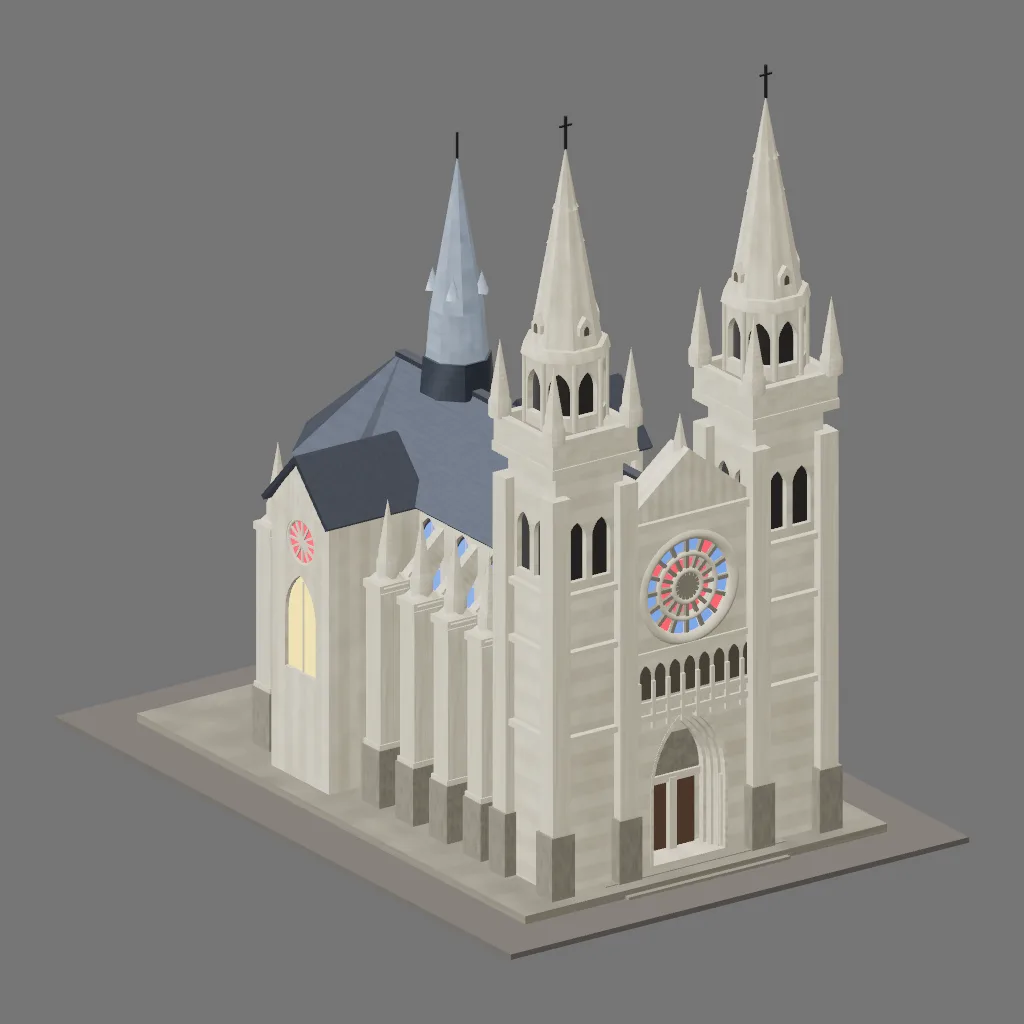
Drag to orbit after opening. The model starts stationary.
For your engine. The download is a standard glTF 2.0 binary (GLB) with PBR metallic-roughness materials. Optional extensions declared by this file: KHR_materials_emissive_strength. Importer support varies; see the Blender and Unity guide. glTF stores materials, not lighting or tone mapping, so your engine decides how they read. This 3D view tone-maps with Review Neutral, the Khronos PBR Neutral construction with a smaller glare offset (0.015 instead of 0.04), at exposure 0.9. Its Tone mapping control also shows ACES and Linear, for comparison.
Build measurements
- Triangles
- 16,982
- Estimated draws
- 481
- Materials
- 15
- Textures
- 8
- Animation clips
- 0
- Bounds X × Y × Z
- 54 × 56.35 × 38 m
- Build warnings
- 0
Measurements come from this build.
Download this build
Runtime: 2,040,240 bytes. Original: 2,040,016 bytes.
These GLBs are build outputs of the MIT-licensed example source; no separate terms are stated for the builds.
Runtime provenance metadataSHA-256 download hashes
- Runtime GLB
- 6b1cb8836340499ba7000f2ae05d7fe48b7067ad2d9b1cb1dff6464ab1edd612
- Original GLB
- 70774f397dbe48ed149b3a0ec1199af1921df2405eb3a224600585232784cab4
- Source
- eefd46ab244dff7ab3d9f2b1acae42265afed0ef3059130c32589804ccb20c98
The example source is part of the Kiln repository. Repository licence: MIT.
These GLBs are build outputs of the MIT-licensed example source; no separate terms are stated for the builds.
Recorded authorship
Claude Opus 5 through Claude Code
Source-header credit
- Source access
- Not recorded
- Inherited context
- Not independently recorded; source-header declarations only
- Starting example
- Not recorded
- Human input
- Header declares no hand-authored source; other intervention not recorded
- Authoring review
- Not recorded
Gallery GPU render of this exact source. Source, artifact, image hashes and camera settings are recorded alongside the poster; the artifact hash names the GLB bytes the image was rendered from, which the downloadable rebuild reproduces byte for byte only on the platform that recorded it.
Poster camera and render recordThe source behind this build
// A Gothic cathedral, at dusk, with the lamps lit inside.
//
// Authored by: Claude Opus 5, via Claude Code. Every part below was written by
// the model itself, looking at its own renders through the Kiln tools and
// revising. Not a line of it is hand-authored.
//
// This is the REPETITION example, and it is here because a cathedral is the
// thing a code-first modeller is actually better at than a mouse.
//
// A Gothic building is not a collection of unique shapes. It is one bay,
// resolved once and then repeated with variation: pier, window, flyer,
// pinnacle, cornice, repeat. Every real one was built that way, from templates
// held by a master mason, because that is the only way a workshop of four
// hundred people builds a coherent object over eighty years. In a viewport you
// copy-paste geometry and then discover, three hundred copies later, that the
// sill height was wrong. Written down, the sill height is a number in one
// place. Move BAY and the windows, the piers, the flyers and the pinnacles all
// move with it, because none of them knows where it is -- each one is told.
//
// Three things make this read as a cathedral rather than as a shed with
// pointed windows:
//
//   1. THE ARCH IS EQUILATERAL. Both arcs of a lancet are struck from the
//      opposite springing point at a radius equal to the full span. That is not
//      a stylistic choice, it is the compass construction, and it means an
//      arch's height is not a free parameter -- it falls out of its width, at
//      w * sqrt(3)/2. Every opening here obeys it, which is why they all look
//      like they belong to the same building.
//   2. THE BUTTRESSING IS STRUCTURAL. The flyers land on the clerestory wall
//      where the vault pushes, and the pinnacles are not ornament -- they are
//      dead weight stacked on the pier head to turn the flyer's diagonal thrust
//      down into the pier. That relationship is most of what separates a
//      cathedral silhouette from a castle silhouette.
//   3. THE WEST FRONT IS SYMMETRIC AND THE REST OF THE BUILDING IS NOT. A
//      facade faces the city and the two towers are a pair, so they match:
//      Cologne, Westminster and Notre-Dame all read as one composition for
//      that reason. Two earlier passes here tried to buy character by making
//      the towers differ -- first by leaving one unbuilt with a crane on it,
//      then by giving one a taller crocketed spire and the other a plain lead
//      pyramid. Both produced a building with a good half and a bad half, and
//      the eye goes straight to the bad half every time. Asymmetry has to come
//      from the PLAN instead, where it costs nothing: the crossing fleche
//      stands off the tower axis, the apse is only at the east end, and the
//      aisle bays run a rhythm the front never repeats.
//
// Lighting: it is dusk and the building is lit from inside, so the glass is the
// only emissive thing here. The windows are a small fraction of the elevation,
// so they run HOT -- small area, high intensity, the rule the vending machine
// example sets out. The rose is the exception. It is nearly 8 m across, so it
// runs cooler and takes its punch from the black tracery laid over it.
//
// Known limit: no interior. Every mass is solid and every opening is a recess
// cut about a metre into it with glass at the back. From outside that is the
// same picture as a modelled interior for a fraction of the triangles; walk the
// camera through the west door and there is nothing in there.
const meta = { name: 'Cathedral', category: 'architecture', role: 'hero' };

async function build() {
  const root = createRoot('Cathedral');
  const uv = (g) => autoUnwrap(g, { resolution: 1024 });
  const RAD = Math.PI / 180;

  // ---------- Plan ----------
  // +X is west, so the front faces the camera and the building runs away east.
  const Z_NAVE = 5.5; // nave wall line
  const Z_AISLE = 9.5; // aisle outer wall line
  const Z_PIER = 10.6; // buttress piers, 1.1 m proud of the aisle
  const Z_TRANS = 13.0; // transept gable ends
  const X_WEST = 16.0; // west face
  const X_NAVE = 11.0; // east face of the west block
  const X_CROSS = -11.5; // crossing centre
  const X_EAST = -18.0; // apse springing
  const APSE_R = 7.0;
  const T_HALF = 3.4; // half the transept's depth along X

  // Cornices. A Gothic elevation is three storeys and these are the three.
  const Y_GROUND = 1.0; // top of the podium; everything starts here
  const Y_AISLE = 10.0; // aisle eaves
  const Y_LEAN = 13.8; // where the aisle roof dies into the nave wall
  const Y_CORNICE = 20.5; // nave eaves
  const Y_RIDGE = 27.0; // nave ridge
  const Y_TOWER = 32.0; // tower belfry cornice

  // Five nave bays and one choir bay. The crossing has no bay -- the transept
  // is there. Piers stand on the bay DIVISIONS, not the centres, because that
  // is where a rib vault puts its load.
  const BAYS = [9, 5, 1, -3, -7, -16];
  const PIERS = [7, 3, -1, -5, -18];

  // ---------- The arch ----------
  // An equilateral arch: both arcs at radius = span, struck from the opposite
  // springing point. The profile's sill sits at v = 0, so a window is placed by
  // its sill and its height takes care of itself.
  const lancet = (w, spring, seg = 7) => {
    const hw = w / 2;
    const pts = [
      [-hw, 0],
      [hw, 0],
    ];
    for (let i = 0; i <= seg; i++) {
      const a = (i / seg) * 60 * RAD;
      pts.push([-hw + w * Math.cos(a), spring + w * Math.sin(a)]);
    }
    for (let i = 1; i <= seg; i++) {
      const a = (120 + (i / seg) * 60) * RAD;
      pts.push([hw + w * Math.cos(a), spring + w * Math.sin(a)]);
    }
    return pts;
  };
  const lancetTop = (w, spring) => spring + (w * Math.sqrt(3)) / 2;

  // ---------- Materials ----------
  // Limestone. Two things matter: it is a DIELECTRIC (metalness 0, or the whole
  // building goes to pewter under a low sun), and it is BEDDED. The horizontal
  // courses are what give a 30 m wall its sense of scale; without them the
  // towers read as extruded plastic however good the silhouette is.
  const stoneAlbedo = proceduralTexture({
    schemaVersion: 2,
    size: 1024,
    usage: 'albedo',
    name: 'Limestone',
    layers: [
      // Mid-value, not cream. The first pass sat at 0xc9c0ac and the whole
      // west front went flat: four archivolts, eight jamb shafts, a tympanum
      // and a trumeau were all modelled and none of them read, because carving
      // is legible by VALUE and a near-white wall has none left to spend.
      // Two stops down, with the course variance widened to match.
      { op: 'solid', color: 0x9a968c },
      { op: 'noise', colorA: 0x7c786e, colorB: 0xb4b0a6, scale: 9, octaves: 5, seed: 11, blend: 'overlay', opacity: 0.62 },
      // 34 courses over the tile. A mason's joint is a shadow line 5 mm wide,
      // not a drawn stripe -- but at 30 m it is the only thing giving scale.
      { op: 'stripes', colorA: 0x9a968c, colorB: 0x757165, count: 34, angleDeg: 0, blend: 'multiply', opacity: 0.30 },
      { op: 'noise', colorA: 0x6d695f, colorB: 0x9a968c, scale: 42, octaves: 4, seed: 3, blend: 'multiply', opacity: 0.30 },
    ],
  });
  const stone = pbrMaterial({
    albedo: stoneAlbedo,
    normal: normalMapFromHeight(stoneAlbedo, { strength: 0.85 }),
    roughness: 0.86,
    metalness: 0.0,
  });

  // The same stone lower down and wetter. Rain runs off a cathedral in
  // predictable places, and the bottom four metres of one is always darker.
  const stoneWetAlbedo = proceduralTexture({
    schemaVersion: 2,
    size: 512,
    usage: 'albedo',
    name: 'LimestoneWet',
    layers: [
      { op: 'solid', color: 0x6d6a62 },
      { op: 'noise', colorA: 0x53504a, colorB: 0x827e74, scale: 12, octaves: 5, seed: 27, blend: 'overlay', opacity: 0.60 },
      { op: 'stripes', colorA: 0x6d6a62, colorB: 0x565249, count: 22, angleDeg: 0, blend: 'multiply', opacity: 0.32 },
    ],
  });
  const stoneWet = pbrMaterial({
    albedo: stoneWetAlbedo,
    normal: normalMapFromHeight(stoneWetAlbedo, { strength: 0.75 }),
    roughness: 0.92,
    metalness: 0.0,
  });

  // Lead roofing: rolled sheet, seamed, and dark enough that the roofs read as
  // the negative space the towers stand out of.
  const leadAlbedo = proceduralTexture({
    schemaVersion: 2,
    size: 512,
    usage: 'albedo',
    name: 'Lead',
    layers: [
      { op: 'solid', color: 0x4a5058 },
      { op: 'stripes', colorA: 0x4a5058, colorB: 0x373d45, count: 40, angleDeg: 90, blend: 'multiply', opacity: 0.45 },
      { op: 'noise', colorA: 0x3a4048, colorB: 0x5b626b, scale: 30, octaves: 4, seed: 9, blend: 'overlay', opacity: 0.35 },
    ],
  });
  const lead = pbrMaterial({
    albedo: leadAlbedo,
    normal: normalMapFromHeight(leadAlbedo, { strength: 0.6 }),
    roughness: 0.58,
    metalness: 0.45,
  });

  // Bright lead for the crossing flèche. This one has been through three
  // hues. Verdigris copper at 0x4f8b78 read as a kelly green party hat behind
  // the gable; toned to 0x4e5f58 it was still the only green thing on a stone
  // and slate building. Then the roof lead was tried, and a steep cone in a
  // dark metal turns into a black spike, because almost none of its faces
  // catch the light -- it went from the wrong hue to the wrong VALUE, which is
  // worse. What a flèche actually is, is new sheet on a roof that is old, so
  // it belongs three stops ABOVE the roof beside it.
  const flecheAlbedo = proceduralTexture({
    schemaVersion: 2,
    size: 512,
    usage: 'albedo',
    name: 'LeadBright',
    layers: [
      { op: 'solid', color: 0x7f858c },
      { op: 'noise', colorA: 0x6b7178, colorB: 0x959da4, scale: 16, octaves: 5, seed: 41, blend: 'overlay', opacity: 0.55 },
      { op: 'stripes', colorA: 0x7f858c, colorB: 0x6e747b, count: 26, angleDeg: 90, blend: 'multiply', opacity: 0.30 },
    ],
  });
  const flecheLead = pbrMaterial({
    albedo: flecheAlbedo,
    normal: normalMapFromHeight(flecheAlbedo, { strength: 0.55 }),
    roughness: 0.60,
    metalness: 0.40,
  });

  const oak = gameMaterial(0x3b2a1c, { roughness: 0.80, metalness: 0.05 });
  const iron = gameMaterial(0x2a2c30, { roughness: 0.55, metalness: 0.80 });
  const shadow = gameMaterial(0x141210, { roughness: 0.95, metalness: 0.0 });
  // One stop up from `shadow`. A window reveal is a hole and should go black;
  // a blind arcade is a RECESS, and at 0x141210 eleven of them in a row read as
  // a set of teeth bitten out of the front rather than as depth in the wall.
  const recess = gameMaterial(0x342f27, { roughness: 0.95, metalness: 0.0 });
  const plaza = gameMaterial(0x3a3733, { roughness: 0.94, metalness: 0.0 });

  // Glass. Small area, so HOT. THREE hues and no more. An earlier pass had five
  // -- gold, amber, sapphire, ruby, emerald -- and the building read as a
  // stained-glass sampler: a green apse, an orange transept and a rainbow rose
  // all competing at once. The discipline that fixes it is not subtlety, it is
  // ARITHMETIC: warm at the ground where the candles are, cool up at the
  // clerestory where the sky is, and one saturated accent held in reserve.
  const glassGold = gameMaterial(0x8a7040, { emissive: 0xffca6a, emissiveIntensity: 2.8, roughness: 0.40 });
  const glassSapphire = gameMaterial(0x2c3f6b, { emissive: 0x4d86ff, emissiveIntensity: 2.4, roughness: 0.40 });
  const glassRuby = gameMaterial(0x6b2430, { emissive: 0xff3a4e, emissiveIntensity: 2.5, roughness: 0.40 });
  // The rose runs cooler than the lancets: it is 40x their area, and an
  // emissive that size with no GI behind it clips to white long before a
  // lancet does.
  const rose = (m, k) =>
    gameMaterial(m.color.getHex(), { emissive: m.emissive.getHex(), emissiveIntensity: k, roughness: 0.42 });
  const roseSapphire = rose(glassSapphire, 1.15);
  const roseRuby = rose(glassRuby, 1.00);
  const roseEye = rose(glassGold, 1.60);

  // ---------- Helpers ----------
  const slab = (name, w, h, d, position, mat, opts = {}) =>
    createPart(name, boxGeo(w, h, d), mat, {
      position,
      rotation: opts.rotation,
      parent: opts.parent ?? root,
    });
  const solid = (geo, mat = stone) => new THREE.Mesh(geo, mat);

  // A lancet prism, oriented to cut a wall whose normal runs along Z or X.
  // extrudeProfile on axis 'z' maps the profile's (u, v) straight to (x, y),
  // which is what a Z-facing wall wants. An X-facing wall is the same prism
  // turned a quarter turn about Y: local +X lands on world -Z, and the
  // extrusion (local +Z) lands on world +X.
  const lancetPrism = async (w, spring, depth, facing) => {
    const m = solid(await extrudeProfile(lancet(w, spring), { depth, axis: 'z' }));
    if (facing === 'x') m.rotation.y = Math.PI / 2;
    return m;
  };

  // ---------- Ground ----------
  slab('Plaza', 54, 0.4, 38, [-5, 0.2, 0], plaza);
  slab('Podium', 46, 0.6, 30, [-5, 0.7, 0], stoneWet);
  for (let i = 0; i < 3; i++) {
    slab(`Step_${i}`, 0.8, 0.22 * (3 - i), 15.0 - i * 0.8, [16.4 + i * 0.8, 0.4 + 0.11 * (3 - i), 0], stoneWet);
  }

  // ---------- Nave and aisles ----------
  // Everything is solid; see the known limit in the header. REVEAL is how deep
  // an opening is cut into a wall, and the glass goes at the back of the cut.
  const REVEAL = 1.15;
  // ...but the GLASS does not go to the back of the cut. A window set a metre
  // inside a wall is a window you cannot see: at the 55-degree azimuth a hero
  // shot is taken from, a 1.15 m reveal occludes 1.6 m of a 2.4 m opening and
  // every lancet on the flank goes black. The reveal is deep for the SHADOW it
  // casts on the elevation; the glass sits 0.35 m in, which is where a real
  // one is -- the splay that makes the wall look thick is on the inside, where
  // nobody outside is looking.
  const GLAZE = 0.35;

  const naveCutters = [];
  for (const bx of BAYS) {
    for (const sz of [1, -1]) {
      const c = await lancetPrism(2.8, 3.0, REVEAL * 2, 'z');
      c.position.set(bx, 14.5, sz * Z_NAVE);
      naveCutters.push(c);
    }
  }
  const naveBody = solid(boxGeo(X_NAVE - X_EAST, Y_CORNICE - Y_GROUND, Z_NAVE * 2));
  naveBody.position.set((X_NAVE + X_EAST) / 2, (Y_CORNICE + Y_GROUND) / 2, 0);
  const naveMass = await boolDiff('NaveWall', naveBody, ...naveCutters);
  naveMass.geometry = await uv(naveMass.geometry);
  root.add(naveMass);

  for (const sz of [1, -1]) {
    const cutters = [];
    for (const bx of BAYS) {
      const c = await lancetPrism(2.4, 2.5, REVEAL * 2, 'z');
      c.position.set(bx, 3.5, sz * Z_AISLE);
      cutters.push(c);
    }
    const body = solid(boxGeo(X_NAVE - X_EAST, Y_AISLE - Y_GROUND, Z_AISLE - Z_NAVE));
    body.position.set((X_NAVE + X_EAST) / 2, (Y_AISLE + Y_GROUND) / 2, (sz * (Z_AISLE + Z_NAVE)) / 2);
    const m = await boolDiff(`Aisle_${sz > 0 ? 'S' : 'N'}`, body, ...cutters);
    m.geometry = await uv(m.geometry);
    root.add(m);
  }

  // Glass and tracery at the back of every recess. A window is glass plus a
  // MULLION plus a transom: an undivided sheet of light reads as a hole in the
  // wall, and the bars are what make it read as a window.
  const glazeZ = async (name, w, spring, sillY, x, z, mat) => {
    const inner = w - 0.34;
    createPart(name, await uv(await extrudeProfile(lancet(inner, spring), { depth: 0.10, axis: 'z' })), mat, {
      position: [x, sillY, z],
      parent: root,
    });
    const top = lancetTop(inner, spring);
    slab(`${name}_Mullion`, 0.13, top - 0.25, 0.16, [x, sillY + (top - 0.25) / 2, z], stone);
    slab(`${name}_Transom`, inner - 0.1, 0.13, 0.16, [x, sillY + spring * 0.62, z], stone);
  };

  for (const bx of BAYS) {
    for (const sz of [1, -1]) {
      const tag = `${bx < 0 ? 'e' : 'w'}${Math.abs(bx)}${sz > 0 ? 'S' : 'N'}`;
      // A dark plate at the back of each cut, so the glass is never silhouetted
      // against raw daylight-coloured stone.
      slab(`ClerRev_${tag}`, 3.2, 6.4, 0.10, [bx, 17.6, sz * (Z_NAVE - GLAZE - 0.07)], shadow);
      await glazeZ(`ClerGlass_${tag}`, 2.8, 3.0, 14.5, bx, sz * (Z_NAVE - GLAZE), glassSapphire);
      slab(`AisleRev_${tag}`, 2.8, 5.6, 0.10, [bx, 6.0, sz * (Z_AISLE - GLAZE - 0.07)], shadow);
      await glazeZ(`AisleGlass_${tag}`, 2.4, 2.5, 3.5, bx, sz * (Z_AISLE - GLAZE), glassGold);
    }
  }

  // ---------- Transept ----------
  const T_RUN = T_HALF + 0.4;
  const naveRun = Z_NAVE + 0.6;
  const naveRise = Y_RIDGE - Y_CORNICE;
  const naveSlope = Math.atan2(naveRise, naveRun);
  const T_RISE = T_RUN * Math.tan(naveSlope); // same pitch, narrower span, lower ridge

  for (const sz of [1, -1]) {
    const tag = sz > 0 ? 'S' : 'N';
    const zEnd = sz * Z_TRANS;
    const cz = (sz * (Z_TRANS + Z_NAVE)) / 2;
    // Cut, like the nave and the aisles. The first pass built this arm as a
    // plain slab and then placed its window inside it, which sealed the glass
    // in solid stone -- the same mistake the vending machine's display made,
    // and just as invisible until you look at the elevation it faces.
    {
      const body = solid(boxGeo(T_HALF * 2, Y_CORNICE - Y_GROUND, Z_TRANS - Z_NAVE));
      body.position.set(X_CROSS, (Y_CORNICE + Y_GROUND) / 2, cz);
      const win = await lancetPrism(3.6, 4.0, REVEAL * 2, 'z');
      win.position.set(X_CROSS, 8.8, zEnd);
      const wheel = solid(cylinderZGeo(1.68, 1.68, REVEAL * 2, 20));
      wheel.position.set(X_CROSS, 18.3, zEnd);
      const m = await boolDiff(`Transept_${tag}`, body, win, wheel);
      m.geometry = await uv(m.geometry);
      root.add(m);
    }
    createPart(
      `TranseptGable_${tag}`,
      await uv(
        await extrudeProfile(
          [
            [-T_HALF, 0],
            [T_HALF, 0],
            [0, T_RISE],
          ],
          { depth: 1.0, axis: 'z' },
        ),
      ),
      stone,
      { position: [X_CROSS, Y_CORNICE, zEnd - sz * 0.5], parent: root },
    );

    // The end front: a triplet under a wheel window. The wheel lies in XY,
    // which is the plane a Z-facing wall lives in, so torusGeo needs no
    // rotation at all and cylinderZGeo is the disc that fits behind it.
    slab(`TranseptRev_${tag}`, 4.0, 7.6, 0.10, [X_CROSS, 12.4, sz * (Z_TRANS - GLAZE - 0.07)], shadow);
    createPart(
      `TranseptGlass_${tag}`,
      await uv(await extrudeProfile(lancet(3.6, 4.0), { depth: 0.10, axis: 'z' })),
      glassGold,
      { position: [X_CROSS, 8.8, sz * (Z_TRANS - GLAZE)], parent: root },
    );
    slab(`TranseptMullion_${tag}`, 0.16, 6.8, 0.14, [X_CROSS, 12.0, sz * (Z_TRANS - GLAZE + 0.07)], stone);
    createPart(`TranseptWheel_${tag}`, cylinderZGeo(1.5, 1.5, 0.12, 20), glassRuby, {
      position: [X_CROSS, 18.3, sz * (Z_TRANS - GLAZE + 0.06)],
      parent: root,
    });
    for (let i = 0; i < 6; i++) {
      slab(`TranseptSpoke_${tag}_${i}`, 0.16, 3.1, 0.16, [X_CROSS, 18.3, sz * (Z_TRANS - GLAZE + 0.14)], stone, {
        rotation: [0, 0, i * 30],
      });
    }
    createPart(`TranseptRing_${tag}`, torusGeo(1.62, 0.17, 6, 24), stone, {
      position: [X_CROSS, 18.3, sz * (Z_TRANS - GLAZE + 0.14)],
      parent: root,
    });
  }

  // ---------- Apse ----------
  // A half-octagon drum, the western half of it buried in the choir -- which is
  // how a real chevet meets its straight bays. The -22.5 turn puts a facet
  // CENTRE on the building's axis instead of an edge; with an edge on the axis
  // the east end comes to a point like a boat.
  // The drum's apothem, not its radius: an octagon's flat face is R*cos(22.5)
  // from the centre, and putting a window at R buries it 0.53 m inside the wall.
  const APSE_FACE = APSE_R * Math.cos(22.5 * RAD);
  const APSE_DIRS = [-1, 0, 1].map((i) => 180 + i * 45);
  {
    const drum = solid(cylinderGeo(APSE_R, APSE_R, Y_CORNICE - Y_GROUND, 8));
    drum.position.set(X_EAST, (Y_CORNICE + Y_GROUND) / 2, 0);
    drum.rotation.y = -22.5 * RAD;
    const cutters = [];
    for (const a of APSE_DIRS) {
      const c = await lancetPrism(2.4, 4.2, REVEAL * 2, 'z');
      c.rotation.y = (90 - a) * RAD;
      c.position.set(X_EAST + Math.cos(a * RAD) * APSE_FACE, 6.2, Math.sin(a * RAD) * APSE_FACE);
      cutters.push(c);
    }
    const m = await boolDiff('Apse', drum, ...cutters);
    m.geometry = await uv(m.geometry);
    root.add(m);
  }
  for (let i = 0; i < APSE_DIRS.length; i++) {
    const a = APSE_DIRS[i];
    const nx = Math.cos(a * RAD);
    const nz = Math.sin(a * RAD);
    const r = APSE_FACE - GLAZE;
    // Sized to the opening. A reveal plate three metres taller than the window
    // it backs is not a reveal, it is a black rectangle on the elevation.
    slab(`ApseRev_${i}`, 0.14, 7.0, 2.8, [X_EAST + nx * (r - 0.07), 9.4, nz * (r - 0.07)], shadow, {
      rotation: [0, -a, 0],
    });
    createPart(
      `ApseGlass_${i}`,
      await uv(await extrudeProfile(lancet(2.06, 4.2), { depth: 0.12, axis: 'z' })),
      glassGold,
      { position: [X_EAST + nx * r, 6.2, nz * r], rotation: [0, 90 - a, 0], parent: root },
    );
  }
  createPart('ApseRoof', await uv(coneGeo(APSE_R + 0.7, 6.8, 8)), lead, {
    position: [X_EAST, Y_CORNICE + 3.4, 0],
    rotation: [0, -22.5, 0],
    parent: root,
  });

  // ---------- Roofs ----------
  // A slab rotated about X by +t drops its +Z edge, so the south slope takes a
  // positive angle and the north slope a negative one.
  const naveLen = Math.hypot(naveRun, naveRise);
  for (const sz of [1, -1]) {
    slab(`NaveRoof_${sz > 0 ? 'S' : 'N'}`, X_NAVE - X_EAST + 0.5, 0.4, naveLen, [
      (X_NAVE + X_EAST) / 2,
      Y_CORNICE + naveRise / 2,
      (sz * naveRun) / 2,
    ], lead, { rotation: [(sz * naveSlope) / RAD, 0, 0] });
  }
  slab('NaveRidge', X_NAVE - X_EAST + 0.5, 0.36, 0.8, [(X_NAVE + X_EAST) / 2, Y_RIDGE + 0.12, 0], lead);

  // Aisles: a lean-to from the aisle eaves into the nave wall, broken at the
  // crossing because the transept is there.
  const leanRun = Z_AISLE - Z_NAVE + 0.5;
  const leanRise = Y_LEAN - Y_AISLE;
  const leanLen = Math.hypot(leanRun, leanRise);
  const leanSlope = Math.atan2(leanRise, leanRun) / RAD;
  const leanRuns = [
    [X_NAVE + 0.2, X_CROSS + T_HALF + 0.4],
    [X_CROSS - T_HALF - 0.4, X_EAST - 0.2],
  ];
  for (const sz of [1, -1]) {
    for (let i = 0; i < leanRuns.length; i++) {
      const [x0, x1] = leanRuns[i];
      slab(`AisleRoof_${sz > 0 ? 'S' : 'N'}${i}`, x0 - x1, 0.35, leanLen, [
        (x0 + x1) / 2,
        (Y_AISLE + Y_LEAN) / 2,
        sz * (Z_NAVE + leanRun / 2 - 0.25),
      ], lead, { rotation: [sz * leanSlope, 0, 0] });
    }
  }

  // Transept: the same pitch turned across the nave. Rotating about Z lifts the
  // +X edge, so the west slope takes a negative angle.
  const tLen = Math.hypot(T_RUN, T_RISE);
  for (const sz of [1, -1]) {
    for (const dx of [1, -1]) {
      slab(`TranseptRoof_${sz > 0 ? 'S' : 'N'}${dx > 0 ? 'w' : 'e'}`, tLen, 0.36, Z_TRANS - Z_NAVE + 1.0, [
        X_CROSS + (dx * T_RUN) / 2,
        Y_CORNICE + T_RISE / 2,
        (sz * (Z_TRANS + Z_NAVE)) / 2,
      ], lead, { rotation: [0, 0, (-dx * naveSlope) / RAD] });
    }
  }

  // ---------- Flying buttresses ----------
  // Pier, flyer and pinnacle are one assembly, built once and placed ten times.
  // The flyer's section is the honest one: a curved intrados carrying the load
  // and a STRAIGHT extrados above it, because the top of a flyer is a gutter
  // and the water has to run off it.
  const flyProfile = () => {
    const z0 = Z_NAVE + 0.4;
    const z1 = Z_PIER - 0.5;
    const y0 = 17.9;
    const y1 = 14.6;
    const pts = [];
    for (let i = 0; i <= 8; i++) {
      const t = i / 8;
      pts.push([z0 + (z1 - z0) * t, y0 + (y1 - y0) * t - 1.15 * Math.sin(Math.PI * t)]);
    }
    pts.push([z1, y1 + 1.45]);
    pts.push([z0, y0 + 2.05]);
    return pts;
  };
  const flyGeo = await uv(await extrudeProfile(flyProfile(), { depth: 0.75, axis: 'z' }));
  const pinnacleGeo = await uv(
    await revolveProfile(
      [
        [0.0, 0.0],
        [0.80, 0.0],
        [0.80, 1.1],
        [0.64, 1.4],
        [0.64, 1.8],
        [0.0, 5.6],
      ],
      { segments: 8, axis: 'y' },
    ),
  );

  let flySource = null;
  let pinSource = null;
  for (const px of PIERS) {
    for (const sz of [1, -1]) {
      const tag = `${px < 0 ? 'e' : 'w'}${Math.abs(px)}${sz > 0 ? 'S' : 'N'}`;
      const pz = sz * (Z_PIER - 0.3);
      // Three stages, each set back from the one below: that is how a buttress
      // sheds water, and it is what makes it read at thirty metres.
      slab(`PierBase_${tag}`, 2.1, 4.2, 2.9, [px, Y_GROUND + 2.1, pz], stoneWet);
      slab(`PierSet_${tag}`, 1.9, 0.5, 2.7, [px, Y_GROUND + 4.3, pz], stone);
      slab(`Pier_${tag}`, 1.7, 15.5, 2.4, [px, Y_GROUND + 7.75, pz], stone);
      slab(`PierCap_${tag}`, 2.0, 0.55, 2.7, [px, 16.9, pz], stone);
      createPart(`PierWeather_${tag}`, coneGeo(1.5, 1.5, 4), stone, {
        position: [px, 17.7, pz],
        rotation: [0, 45, 0],
        parent: root,
      });

      // Dead weight on the pier head, not ornament. See the header.
      if (!pinSource) pinSource = createPart(`Pinnacle_${tag}`, pinnacleGeo, stone, { position: [px, 17.4, pz], parent: root });
      else createInstance(`Pinnacle_${tag}`, pinSource, { position: [px, 17.4, pz], parent: root });

      // The flyer, built in the (z, y) plane and turned a quarter turn -- the
      // same trick as the window prisms.
      // A quarter turn about Y sends the profile's u to world -z, so the
      // SOUTH flyer takes the negative rotation. The first pass had these the
      // other way round and every flyer sprang from the pier on the far side.
      const opts = { position: [px, 0, 0], rotation: [0, sz > 0 ? -90 : 90, 0], parent: root };
      if (!flySource) flySource = createPart(`Flyer_${tag}`, flyGeo, stone, opts);
      else createInstance(`Flyer_${tag}`, flySource, opts);
    }
  }

  // ---------- West front ----------
  const westCutters = [];
  const portal = await lancetPrism(6.4, 5.6, 5.0, 'x');
  portal.position.set(X_WEST, Y_GROUND + 0.3, 0);
  westCutters.push(portal);
  const roseHole = solid(cylinderXGeo(3.8, 3.8, 6.0, 24));
  roseHole.position.set(X_WEST, 21.0, 0);
  westCutters.push(roseHole);
  const westBody = solid(boxGeo(X_WEST - 10.2, 26.0 - Y_GROUND, Z_NAVE * 2 + 0.2));
  westBody.position.set((X_WEST + 10.2) / 2, (26.0 + Y_GROUND) / 2, 0);
  const westMass = await boolDiff('WestFront', westBody, ...westCutters);
  westMass.geometry = await uv(westMass.geometry);
  root.add(westMass);

  // The rose. A big emissive disc would be a white hole in the front of the
  // building; what makes a rose read is the STONE laid over it, so the glass
  // runs cool and the tracery does the work.
  //
  // The first pass got the geometry wrong in a way worth recording: twelve
  // wedges running centre-to-rim, hues cycling round them. That is a parasol,
  // not a window. A rose is built as concentric RINGS of small lights, each
  // ring separated from the next by stone, because the tracery is what carries
  // the load -- the glass is only filling what the mason left. So: sixteen
  // lights in the outer ring, eight inside it, one eye at the centre, and
  // eight full-diameter bars whose sixteen arms land exactly on the outer
  // ring's joints. Blue outside, red inside, gold only in the eye.
  {
    const RX = X_WEST - 0.55;
    // An annular sector: out along one radius, round at r1, back at r0.
    const ringPane = (i, count, r0, r1) => {
      const step = 360 / count;
      const a0 = (i * step + step * 0.15) * RAD;
      const a1 = ((i + 1) * step - step * 0.15) * RAD;
      const pts = [];
      for (let k = 0; k <= 5; k++) {
        const a = a0 + ((a1 - a0) * k) / 5;
        pts.push([Math.cos(a) * r1, Math.sin(a) * r1]);
      }
      for (let k = 5; k >= 0; k--) {
        const a = a0 + ((a1 - a0) * k) / 5;
        pts.push([Math.cos(a) * r0, Math.sin(a) * r0]);
      }
      return pts;
    };
    for (let i = 0; i < 16; i++) {
      createPart(
        `RoseOuter_${i}`,
        await uv(await extrudeProfile(ringPane(i, 16, 2.55, 3.45), { depth: 0.14, axis: 'z' })),
        i % 4 === 2 ? roseRuby : roseSapphire,
        { position: [RX, 21.0, 0], rotation: [0, 90, 0], parent: root },
      );
    }
    for (let i = 0; i < 8; i++) {
      createPart(
        `RoseInner_${i}`,
        await uv(await extrudeProfile(ringPane(i, 8, 1.10, 1.95), { depth: 0.14, axis: 'z' })),
        roseRuby,
        { position: [RX, 21.0, 0], rotation: [0, 90, 0], parent: root },
      );
    }
    createPart('RoseHub', cylinderXGeo(0.62, 0.62, 0.30, 16), roseEye, { position: [RX + 0.12, 21.0, 0], parent: root });
    // The spokes are boxes standing on their long Y axis, swung about X --
    // which is the rose's own axis, so no second rotation is needed. Eight
    // bars, 22.5 degrees apart, give sixteen arms: one per outer joint.
    for (let i = 0; i < 8; i++) {
      slab(`RoseSpoke_${i}`, 0.26, 7.2, 0.28, [RX + 0.22, 21.0, 0], stoneWet, { rotation: [i * 22.5, 0, 0] });
    }
    createPart('RoseRingInner', torusGeo(1.15, 0.22, 6, 20), stone, { position: [RX + 0.26, 21.0, 0], rotation: [0, 90, 0], parent: root });
    createPart('RoseRingMid', torusGeo(2.35, 0.20, 6, 28), stone, { position: [RX + 0.26, 21.0, 0], rotation: [0, 90, 0], parent: root });
    createPart('RoseRingOuter', torusGeo(3.8, 0.42, 8, 32), stone, { position: [RX + 0.32, 21.0, 0], rotation: [0, 90, 0], parent: root });
  }

  // The great door. Recessed orders are the whole point of a Gothic portal: one
  // flat arch reads as a hole punched in a wall, four stepped ones read as a
  // doorway you could walk through.
  {
    for (let i = 0; i < 4; i++) {
      const w = 6.4 - i * 0.44;
      const band = await boolDiff(
        `Archivolt_${i}`,
        await lancetPrism(w, 5.6, 0.50, 'x'),
        await lancetPrism(w - 0.48, 5.6, 0.9, 'x'),
      );
      band.geometry = await uv(band.geometry);
      band.position.set(X_WEST - 0.22 - i * 0.55, Y_GROUND + 0.3, 0);
      root.add(band);
    }
    slab('Tympanum', 0.35, 3.0, 4.6, [X_WEST - 2.35, Y_GROUND + 7.2, 0], stoneWet);
    slab('Lintel', 0.55, 0.55, 4.9, [X_WEST - 2.25, Y_GROUND + 5.5, 0], stone);
    slab('Trumeau', 0.7, 5.4, 0.6, [X_WEST - 2.25, Y_GROUND + 2.8, 0], stone);
    for (const s of [1, -1]) {
      slab(`Door_${s > 0 ? 'a' : 'b'}`, 0.22, 5.2, 1.85, [X_WEST - 2.4, Y_GROUND + 2.75, s * 1.1], oak);
      for (let i = 0; i < 3; i++) {
        slab(`DoorBand_${s > 0 ? 'a' : 'b'}${i}`, 0.1, 0.18, 1.75, [X_WEST - 2.5, Y_GROUND + 1.2 + i * 1.7, s * 1.1], iron);
      }
      // Jamb shafts. Eight thin columns are the cheapest thing on this model
      // and they are what make the doorway look carved rather than punched.
      for (let i = 0; i < 4; i++) {
        createPart(`Jamb_${s > 0 ? 'a' : 'b'}${i}`, cylinderGeo(0.19, 0.19, 5.2, 8), stone, {
          position: [X_WEST - 0.45 - i * 0.55, Y_GROUND + 3.0, s * (2.95 + i * 0.24)],
          parent: root,
        });
      }
    }
  }

  createPart(
    'PortalGable',
    await uv(await extrudeProfile([[-3.9, 0], [3.9, 0], [0, 3.0]], { depth: 0.7, axis: 'z' })),
    stone,
    { position: [X_WEST - 0.35, Y_GROUND + 11.4, 0], rotation: [0, 90, 0], parent: root },
  );
  slab('WestString', 0.5, 0.5, Z_NAVE * 2 + 0.4, [X_WEST - 0.05, Y_GROUND + 11.2, 0], stone);

  // The gallery: a blind arcade across the front between the door and the rose.
  // One arch, built once, placed eleven times.
  {
    // Eleven arches at 1.0 m across a 1.15 m opening left 0.15 m of stone
    // between them, and the whole band collapsed into one dark stripe. Nine at
    // 1.22 across 0.88 leaves 0.34 -- a third of the opening -- which is what
    // makes the rhythm read as columns rather than as a gap.
    let arcSource = null;
    const arcGeo = await uv(await extrudeProfile(lancet(0.88, 1.7), { depth: 0.4, axis: 'z' }));
    for (let i = 0; i < 9; i++) {
      const z = -4.88 + i * 1.22;
      const opts = { position: [X_WEST - 0.15, 13.6, z], rotation: [0, 90, 0], parent: root };
      if (!arcSource) arcSource = createPart(`Gallery_${i}`, arcGeo, recess, opts);
      else createInstance(`Gallery_${i}`, arcSource, opts);
      slab(`GalleryShaft_${i}`, 0.46, 3.4, 0.30, [X_WEST - 0.02, 13.2, z - 0.61], stone);
    }
    slab('GalleryShaft_end', 0.46, 3.4, 0.30, [X_WEST - 0.02, 13.2, 4.88 + 0.61], stone);
    slab('GallerySill', 0.6, 0.45, 11.4, [X_WEST - 0.12, 13.2, 0], stone);
    slab('GalleryCap', 0.6, 0.45, 11.4, [X_WEST - 0.12, 16.8, 0], stone);
  }

  slab('WestCornice', 0.9, 0.6, Z_NAVE * 2 + 1.4, [X_WEST - 0.1, 26.2, 0], stone);
  createPart(
    'WestGable',
    await uv(
      await extrudeProfile(
        [
          [-5.6, 0],
          [5.6, 0],
          [0, 4.6],
        ],
        { depth: 2.2, axis: 'z' },
      ),
    ),
    stone,
    { position: [X_WEST - 1.1, 26.5, 0], rotation: [0, 90, 0], parent: root },
  );
  createPart('GableFinial', await uv(coneGeo(0.6, 2.8, 6)), stone, { position: [X_WEST - 1.1, 32.0, 0], parent: root });

  // ---------- Towers ----------
  // One tower, cut once for its belfry openings, then placed twice. The
  // openings sit on all four faces, so the same solid serves both sides.
  const TOWER_HALF = 2.8;
  const TOWER_Z = 8.3;
  const TOWER_X = X_WEST - TOWER_HALF;
  const BELFRY_SILL = 23.5;
  const BELFRY_H = lancetTop(1.5, 3.0);
  const belfryCut = [];
  for (const face of ['x', 'z']) {
    for (const s of [1, -1]) {
      for (const off of [-1.0, 1.0]) {
        const c = await lancetPrism(1.5, 3.0, 3.4, face);
        const local = BELFRY_SILL - (Y_TOWER + Y_GROUND) / 2;
        if (face === 'x') c.position.set(s * TOWER_HALF, local, off);
        else c.position.set(off, local, s * TOWER_HALF);
        belfryCut.push(c);
      }
    }
  }
  const towerSolid = await boolDiff(
    'Tower',
    solid(boxGeo(TOWER_HALF * 2, Y_TOWER - Y_GROUND, TOWER_HALF * 2)),
    ...belfryCut,
  );
  towerSolid.geometry = await uv(towerSolid.geometry);

  for (const sz of [1, -1]) {
    const tag = sz > 0 ? 'S' : 'N';
    const tz = sz * TOWER_Z;
    createInstance(`Tower_${tag}`, towerSolid, {
      position: [TOWER_X, (Y_TOWER + Y_GROUND) / 2, tz],
      parent: root,
    });
    // A belfry is OPEN, so its openings are dark, not lit. This is the one
    // place on the building where a hole must not glow.
    for (const face of ['x', 'z']) {
      for (const s of [1, -1]) {
        for (const off of [-1.0, 1.0]) {
          const at = face === 'x'
            ? [TOWER_X + s * (TOWER_HALF - 0.45), BELFRY_SILL + BELFRY_H / 2, tz + off]
            : [TOWER_X + off, BELFRY_SILL + BELFRY_H / 2, tz + s * (TOWER_HALF - 0.45)];
          slab(`Belfry_${tag}${face}${s > 0 ? 'p' : 'n'}${off > 0 ? 'a' : 'b'}`,
            face === 'x' ? 0.2 : 1.4, BELFRY_H, face === 'x' ? 1.4 : 0.2, at, shadow);
        }
      }
    }
    // Corner buttresses clasping the angles. Every real tower has them, and
    // they are most of what stops a tower reading as a chimney.
    for (const cx of [1, -1]) {
      for (const cz of [1, -1]) {
        const bx = TOWER_X + cx * TOWER_HALF;
        const bz = tz + cz * TOWER_HALF;
        slab(`TowerButBase_${tag}${cx > 0 ? 'p' : 'n'}${cz > 0 ? 'p' : 'n'}`, 1.9, 4.6, 1.9, [bx, Y_GROUND + 2.3, bz], stoneWet);
        slab(`TowerBut_${tag}${cx > 0 ? 'p' : 'n'}${cz > 0 ? 'p' : 'n'}`, 1.5, Y_TOWER - Y_GROUND - 2.0, 1.5, [
          bx,
          (Y_TOWER + Y_GROUND) / 2 - 1.0,
          bz,
        ], stone);
      }
    }
    for (const sy of [12.2, 18.4, 22.6]) {
      slab(`TowerString_${tag}_${sy}`, 6.6, 0.45, 6.6, [TOWER_X, sy, tz], stone);
    }
    slab(`TowerCornice_${tag}`, 7.2, 0.7, 7.2, [TOWER_X, Y_TOWER, tz], stone);
  }

  // ---------- Tower crowns ----------
  // One crown, placed on both towers. Everything above the belfry cornice is a
  // second campaign: a parapet with pinnacles at its corners, a pierced
  // octagonal lantern, then the spire. See principle 3 -- the two towers are a
  // pair and are built as one.
  //
  // The lantern's openings are CUT, for the same reason every other opening on
  // this building is: a drum with window plates stuck on its faces is a drum
  // with pictures of windows on it, and it reads as one the moment the light
  // moves. Rotating the octagon by -22.5 puts a face CENTRE on each cardinal
  // azimuth, so the eight face normals land on multiples of 45 degrees, and a
  // cutter driven through the middle takes out the near face and the far one
  // together -- four of them do all eight lights.
  const LANT_R = 2.85;
  const LANT_H = 5.0;
  const LANT_Y0 = Y_TOWER + 2.35;
  const SP_R = 2.55;
  const SP_H = 14.0;
  const SP_Y0 = LANT_Y0 + LANT_H + 0.8;

  for (const csz of [1, -1]) {
    const tag = csz > 0 ? 'S' : 'N';
    const tz = csz * TOWER_Z;

    slab(`ParapetDeck_${tag}`, 6.6, 0.4, 6.6, [TOWER_X, Y_TOWER + 0.55, tz], stoneWet);
    for (const [ox, oz, w, d] of [
      [0, 3.2, 7.0, 0.6],
      [0, -3.2, 7.0, 0.6],
      [3.2, 0, 0.6, 7.0],
      [-3.2, 0, 0.6, 7.0],
    ]) {
      const px = ox > 0 ? 'p' : ox < 0 ? 'n' : 'c';
      const pz = oz > 0 ? 'p' : oz < 0 ? 'n' : 'c';
      slab(`Parapet_${tag}${px}${pz}`, w, 2.0, d, [TOWER_X + ox, Y_TOWER + 1.35, tz + oz], stone);
    }
    for (const cx of [1, -1]) {
      for (const cz of [1, -1]) {
        createInstance(`TowerPinnacle_${tag}${cx > 0 ? 'p' : 'n'}${cz > 0 ? 'p' : 'n'}`, pinSource, {
          position: [TOWER_X + cx * 3.2, Y_TOWER + 2.2, tz + cz * 3.2],
          parent: root,
        });
      }
    }

    const lantern = solid(cylinderGeo(LANT_R, LANT_R, LANT_H, 8));
    lantern.position.set(TOWER_X, LANT_Y0 + LANT_H / 2, tz);
    lantern.rotation.y = -22.5 * RAD;
    const lantCut = [];
    for (let k = 0; k < 4; k++) {
      const a = k * 45;
      const cut = solid(await extrudeProfile(lancet(1.55, 1.85), { depth: LANT_R * 2.4, axis: 'z' }));
      cut.position.set(TOWER_X, LANT_Y0 + 0.95, tz);
      cut.rotation.y = (90 - a) * RAD;
      lantCut.push(cut);
    }
    const lanternMass = await boolDiff(`Lantern_${tag}`, lantern, ...lantCut);
    lanternMass.geometry = await uv(lanternMass.geometry);
    root.add(lanternMass);
    // A belfry is open, so what stands behind its lights is the dark of the
    // bell chamber. Same rule as the openings in the tower shaft below.
    createPart(`LanternDark_${tag}`, cylinderGeo(2.34, 2.34, LANT_H - 0.5, 8), shadow, {
      position: [TOWER_X, LANT_Y0 + LANT_H / 2, tz],
      rotation: [0, -22.5, 0],
      parent: root,
    });
    // Colonnettes on the arrises, which sit at 22.5 + k*45 -- between the
    // faces, not on them.
    for (let k = 0; k < 8; k++) {
      const a = (22.5 + k * 45) * RAD;
      createPart(`LanternShaft_${tag}${k}`, cylinderGeo(0.20, 0.20, LANT_H, 6), stone, {
        position: [TOWER_X + Math.cos(a) * LANT_R, LANT_Y0 + LANT_H / 2, tz + Math.sin(a) * LANT_R],
        parent: root,
      });
    }

    // The spire is stone, not lead. A lead spire on one tower and a stone one
    // on the other was the single ugliest thing on this model: the pair read as
    // two buildings that happened to touch.
    createPart(`SpireCornice_${tag}`, await uv(cylinderGeo(2.95, 3.15, 0.8, 8)), stone, {
      position: [TOWER_X, SP_Y0 - 0.4, tz],
      rotation: [0, -22.5, 0],
      parent: root,
    });
    createPart(`Spire_${tag}`, await uv(coneGeo(SP_R, SP_H, 8)), stone, {
      position: [TOWER_X, SP_Y0 + SP_H / 2, tz],
      rotation: [0, -22.5, 0],
      parent: root,
    });

    // Lucarnes at the spire foot: the little gabled dormers that let a mason
    // out onto the stonework. Four, on the cardinal faces.
    for (const a of [0, 90, 180, 270]) {
      const rad = a * RAD;
      const at = (r) => [TOWER_X + Math.cos(rad) * r, SP_Y0 + 0.95, tz + Math.sin(rad) * r];
      createPart(
        `Lucarne_${tag}${a}`,
        await uv(
          await extrudeProfile(
            [
              [-0.52, 0],
              [0.52, 0],
              [0.52, 0.62],
              [0, 1.30],
              [-0.52, 0.62],
            ],
            { depth: 0.72, axis: 'z' },
          ),
        ),
        stone,
        { position: at(2.10), rotation: [0, 90 - a, 0], parent: root },
      );
      createPart(
        `LucarneLight_${tag}${a}`,
        await uv(await extrudeProfile(lancet(0.40, 0.34), { depth: 0.10, axis: 'z' })),
        recess,
        { position: at(2.47), rotation: [0, 90 - a, 0], parent: root },
      );
    }

    // Crockets up the arrises. They are 0.26 m knobs on a 14 m cone, so they do
    // not read as carving -- they read as an EDGE that is not straight, which
    // is most of what separates a spire from a traffic cone. Set at 0.88 of the
    // surface radius so each one bites into the stone rather than hovering off
    // a face the geometry does not have there.
    for (let k = 0; k < 8; k++) {
      const a = (22.5 + k * 45) * RAD;
      for (const t of [0.16, 0.34, 0.52, 0.70]) {
        const r = SP_R * (1 - t) * 0.88;
        createPart(`Crocket_${tag}${k}_${Math.round(t * 100)}`, coneGeo(0.26, 0.55, 4), stone, {
          position: [TOWER_X + Math.cos(a) * r, SP_Y0 + t * SP_H, tz + Math.sin(a) * r],
          rotation: [0, 45, 0],
          parent: root,
        });
      }
    }

    createPart(`SpireFinial_${tag}`, cylinderGeo(0.13, 0.13, 2.4, 6), iron, {
      position: [TOWER_X, SP_Y0 + SP_H + 1.0, tz],
      parent: root,
    });
    createPart(`SpireCross_${tag}`, boxGeo(0.13, 0.13, 1.0), iron, {
      position: [TOWER_X, SP_Y0 + SP_H + 1.5, tz],
      parent: root,
    });
  }

  // ---------- Crossing flèche ----------
  // Timber and lead over the crossing, far slimmer than the stone spires,
  // because it stands on a vault and not on a tower. It is also the one thing
  // on this building that is deliberately off-axis: the west front is a
  // symmetric pair, and the flèche is what stops the whole silhouette from
  // being one.
  createPart('FlecheBase', await uv(cylinderGeo(2.4, 2.6, 2.6, 8)), lead, {
    position: [X_CROSS, Y_RIDGE + 0.9, 0],
    rotation: [0, -22.5, 0],
    parent: root,
  });
  createPart('FlecheStage', await uv(cylinderGeo(1.9, 2.2, 3.4, 8)), flecheLead, {
    position: [X_CROSS, Y_RIDGE + 3.9, 0],
    rotation: [0, -22.5, 0],
    parent: root,
  });
  createPart('Fleche', await uv(coneGeo(1.9, 11.0, 8)), flecheLead, {
    position: [X_CROSS, Y_RIDGE + 11.1, 0],
    rotation: [0, -22.5, 0],
    parent: root,
  });
  createPart('FlecheFinial', cylinderGeo(0.11, 0.11, 1.9, 6), iron, { position: [X_CROSS, Y_RIDGE + 17.4, 0], parent: root });
  for (let i = 0; i < 4; i++) {
    const a = (i * 90 + 45) * RAD;
    createPart(`FlecheLucarne_${i}`, coneGeo(0.6, 1.6, 4), flecheLead, {
      position: [X_CROSS + Math.cos(a) * 1.7, Y_RIDGE + 7.6, Math.sin(a) * 1.7],
      rotation: [0, i * 90, 0],
      parent: root,
    });
  }

  return root;
}Scroll code horizontally
Brief and retained revisions
No brief or earlier revisions are recorded. The source download contains the version built for this page.