Sushi store
Layered shopfront, awning and recessed display
Earlier examples from earlier Kiln versions.
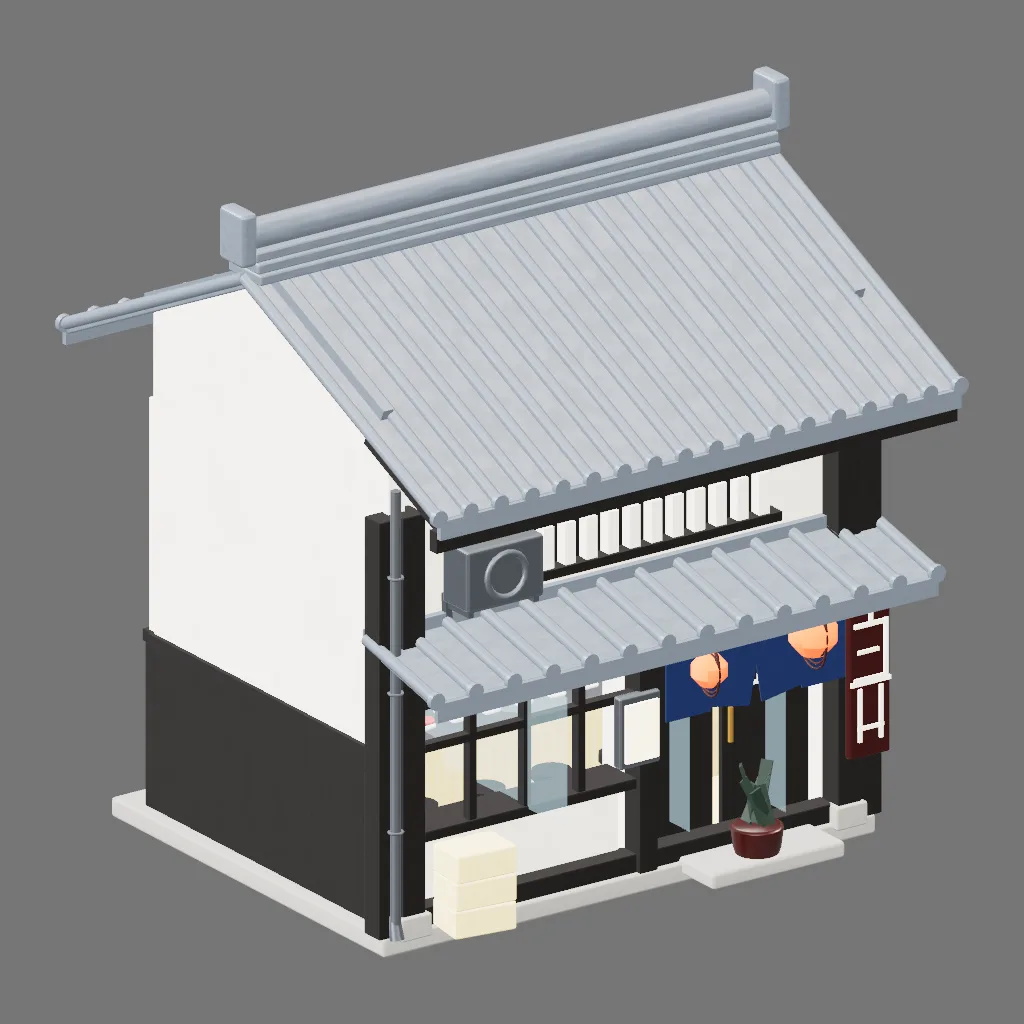
Drag to orbit after opening. The model starts stationary.
For your engine. The download is a standard glTF 2.0 binary (GLB) with PBR metallic-roughness materials. Optional extensions declared by this file: KHR_materials_emissive_strength. Importer support varies; see the Blender and Unity guide. glTF stores materials, not lighting or tone mapping, so your engine decides how they read. This 3D view tone-maps with Review Neutral, the Khronos PBR Neutral construction with a smaller glare offset (0.015 instead of 0.04), at exposure 0.9. Its Tone mapping control also shows ACES and Linear, for comparison.
Build measurements
- Triangles
- 24,010
- Estimated draws
- 389
- Materials
- 21
- Textures
- 10
- Animation clips
- 0
- Bounds X × Y × Z
- 5.31 × 5.97 × 5.4 m
- Build warnings
- 1
Measurements come from this build.
Download this build
Runtime: 2,252,828 bytes. Original: 2,252,604 bytes.
These GLBs are build outputs of the MIT-licensed example source; no separate terms are stated for the builds.
Runtime provenance metadataSHA-256 download hashes
- Runtime GLB
- 4fd771a84aea48acbf1ff02592de2e819c94b578f986b3b3263df5c1e52c0227
- Original GLB
- c3f1abe8751dcfe7954ed3fccda84f8212460845f6ed3a9c3e6945e663db5f0a
- Source
- fdd92c6e2ed8fb371d22f8c94c1f0e6ae932d915f0e75cd50c70b6f876bd0743
The example source is part of the Kiln repository. Repository licence: MIT.
These GLBs are build outputs of the MIT-licensed example source; no separate terms are stated for the builds.
Recorded authorship
Claude Opus 5 through Claude Code
Source-header credit
- Source access
- Not recorded
- Inherited context
- Not independently recorded; source-header declarations only
- Starting example
- Not recorded
- Human input
- Header declares no hand-authored source; other intervention not recorded
- Authoring review
- Not recorded
Gallery GPU render of this exact source. Source, artifact, image hashes and camera settings are recorded alongside the poster; the artifact hash names the GLB bytes the image was rendered from, which the downloadable rebuild reproduces byte for byte only on the platform that recorded it.
Poster camera and render recordThe source behind this build
// A sushi-ya: the shopfront, not the cart.
//
// Authored by: Claude Opus 5, via Claude Code. Every part below was written by
// the model itself, looking at its own renders through the Kiln tools and
// revising. Not a line of it is hand-authored.
//
// Every other hero in this set is an OBJECT. You can walk around it and its
// silhouette does the work. A shopfront is not an object, it is a PLANE that
// has to stop looking like a plane, and that is a completely different problem.
// A texture-mapped box with a window painted on it reads as a billboard from
// every angle except dead ahead, and the moment the camera moves 20 degrees the
// whole illusion collapses.
//
// The technique that fixes it is LAYERED DEPTH. Every real facade is a stack of
// surfaces at measurably different distances from the street, and the shadow
// lines between those layers are the entire reason it reads as architecture.
// So this asset does not have "a front wall". It has a declared depth table --
// see DEPTH below -- and every single part states which plane it lives on.
// Nothing is coplanar with anything else by accident. The glass is 34 cm behind
// the wall it sits in; the sill stands 9 cm proud of that wall; the lattice
// stands proud of the sill; the posts stand proud of the lattice; the signboard
// stands proud of the posts; the eave overhangs all of it by most of a metre.
// That ladder is what you are actually looking at when a facade "feels solid".
//
// The first pass of this asset got that ladder right and the BUILDING wrong: it
// was 1.4 m deep, which is a stage flat, not a shop. From above it was an open
// box and from the side it was a blank slab. A facade only reads as a building
// if there is a building behind it, so the plan here runs 3.2 m back, the roof
// is a real ridged kawara roof over the whole plan with gable ends, and the
// side walls get the same shitami-ita and plaster treatment as the front.
//
// The second lesson is that a shop is defined by what is BEHIND the glass. A
// dark window is a dead building. So there is a real interior -- counter,
// stools, refrigerated neta case, bottles, and the fish itself in rows -- built
// at full detail even though you only see it through a 2 m aperture, because
// the parallax of those parts sliding past the mullions as the camera moves is
// the single strongest signal that the building has an inside.
//
// The third is kawara. Roof tiles are not a texture. Japanese pantiles are a
// flat pan with a half-round cover tile over every joint, and that alternation
// throws a hard shadow stripe down the whole roof. Painting it on gives you a
// flat grey plane; building it gives you the roof.
const meta = { name: 'SushiStore', category: 'architecture', role: 'hero' };

async function build() {
  const root = createRoot('SushiStore');
  const uv = (g, r = 1024) => autoUnwrap(g, { resolution: r });
  const D = Math.PI / 180;

  // ---------- The depth table ----------
  // This is the asset. Read it as a section through the shopfront, from the
  // street inward. Every createPart below takes its x from one of these.
  const DEPTH = {
    EAVE_2: 1.16,   // upper roof, the deepest overhang
    EAVE_1: 0.98,   // shop canopy over the entrance
    LANTERN: 0.72,  // chochin, hanging clear of the fascia
    KANBAN: 0.40,   // the vertical signboard
    NOREN: 0.33,    // the split curtain, hanging in front of the door
    POST: 0.24,     // structural posts, the outermost part of the wall itself
    LATTICE: 0.16,  // koshi screen and window mullions
    SILL: 0.09,     // sills, lintels, the horizontal bands
    WALL: 0.00,     // the plaster plane -- the datum everything is measured from
    GLASS: -0.34,   // glazing, deep in its reveal
    STOOL: -0.86,   // where a customer sits
    COUNTER: -1.40, // the hinoki counter behind the glass
    KITCHEN: -2.36, // the itamae's side of the counter
    BACK: -3.16,    // interior back wall
  };

  // ---------- Dimensions ----------
  const HZ = 2.30;        // half the shopfront width
  const PLINTH_Y = 0.17;
  const HEAD_Y = 2.12;    // top of the ground-floor openings
  const BAND_Y = 2.42;    // top of the ground storey
  const UPPER_Y = 3.78;   // wall plate of the upper storey
  const RIDGE_X = -1.55;  // the roof ridge runs along Z, parallel to the street
  const RIDGE_Y = 5.30;
  const EAVE_Y = 4.10;
  const ROOF_HZ = HZ + 0.26;
  const POST_Z = 2.14;    // corner post centres
  const MID_Z = -0.18;    // the post that divides door bay from window bay
  const WALL_Z = HZ - 0.08;
  const PLAN_X0 = -3.24;  // outside face of the back wall
  const PLAN_MID = (PLAN_X0 + 0.10) / 2;
  const PLAN_LEN = 0.10 - PLAN_X0;

  // ---------- Materials ----------
  // Shikkui plaster. Warm, chalky, and a DIELECTRIC -- lime render has no metal
  // in it at all, and giving a wall even 0.1 metalness turns it grey and dead.
  const plasterAlbedo = proceduralTexture({
    schemaVersion: 2, size: 1024, usage: 'albedo', name: 'Shikkui',
    layers: [
      { op: 'solid', color: 0xdcd3c2 },
      { op: 'noise', colorA: 0xc6bca8, colorB: 0xeae3d5, scale: 34, octaves: 4, seed: 5, blend: 'overlay', opacity: 0.45 },
      { op: 'noise', colorA: 0xa79b85, colorB: 0xdcd3c2, scale: 9, octaves: 2, seed: 23, blend: 'multiply', opacity: 0.14 },
    ],
  });
  const plaster = pbrMaterial({
    albedo: plasterAlbedo, normal: normalMapFromHeight(plasterAlbedo, { strength: 1.3 }),
    roughness: 0.88, metalness: 0.0,
  });

  // Yakisugi: cedar charred black to preserve it. It is nearly value-zero, so
  // the grain has to come from the NORMAL, not from albedo contrast -- push the
  // albedo apart far enough to see grain and it stops reading as charred and
  // starts reading as dirty paint.
  const charAlbedo = proceduralTexture({
    schemaVersion: 2, size: 1024, usage: 'albedo', name: 'Yakisugi',
    layers: [
      { op: 'solid', color: 0x2b2622 },
      { op: 'stripes', colorA: 0x201c19, colorB: 0x3a332d, count: 110, angleDeg: 0, blend: 'overlay', opacity: 0.55 },
      { op: 'noise', colorA: 0x181513, colorB: 0x3f382f, scale: 40, octaves: 4, seed: 11, blend: 'overlay', opacity: 0.40 },
    ],
  });
  const char = pbrMaterial({
    albedo: charAlbedo, normal: normalMapFromHeight(charAlbedo, { strength: 2.6 }),
    roughness: 0.80, metalness: 0.02,
  });

  // Hinoki: the pale cypress the counter and the interior are made of. Same
  // stripe-not-noise rule as any sawn board -- noise gives you chipboard.
  const hinokiAlbedo = proceduralTexture({
    schemaVersion: 2, size: 1024, usage: 'albedo', name: 'Hinoki',
    layers: [
      { op: 'solid', color: 0xd8b98a },
      { op: 'stripes', colorA: 0xc7a473, colorB: 0xe6cda6, count: 84, angleDeg: 0, blend: 'overlay', opacity: 0.38 },
      { op: 'noise', colorA: 0xab8a5d, colorB: 0xe6cda6, scale: 22, octaves: 4, seed: 31, blend: 'overlay', opacity: 0.30 },
    ],
  });
  const hinoki = pbrMaterial({
    albedo: hinokiAlbedo, normal: normalMapFromHeight(hinokiAlbedo, { strength: 1.1 }),
    roughness: 0.55, metalness: 0.0,
  });

  // Ibushi-gawara: smoked clay roof tile. Silver-grey, faintly metallic because
  // the smoking process leaves a carbon film, and SMOOTH -- fired clay glaze is
  // one of the few architectural surfaces that is genuinely low-roughness.
  const tileAlbedo = proceduralTexture({
    schemaVersion: 2, size: 512, usage: 'albedo', name: 'Ibushi',
    layers: [
      { op: 'solid', color: 0x6e747a },
      { op: 'noise', colorA: 0x5a6066, colorB: 0x878d94, scale: 44, octaves: 4, seed: 17, blend: 'overlay', opacity: 0.42 },
    ],
  });
  const tile = pbrMaterial({
    albedo: tileAlbedo, normal: normalMapFromHeight(tileAlbedo, { strength: 1.4 }),
    roughness: 0.38, metalness: 0.22,
  });

  // Indigo noren. Woven cotton: matte, dielectric, and with a weave normal fine
  // enough that it never resolves into visible stripes at asset scale.
  const norenAlbedo = proceduralTexture({
    schemaVersion: 2, size: 512, usage: 'albedo', name: 'Aizome',
    layers: [
      { op: 'solid', color: 0x1e3a5c },
      { op: 'checker', colorA: 0x1a3352, colorB: 0x244366, squares: 160, blend: 'overlay', opacity: 0.45 },
      { op: 'noise', colorA: 0x152a44, colorB: 0x2b4d72, scale: 30, octaves: 3, seed: 13, blend: 'overlay', opacity: 0.25 },
    ],
  });
  const noren = pbrMaterial({
    albedo: norenAlbedo, normal: normalMapFromHeight(norenAlbedo, { strength: 0.9 }),
    roughness: 0.94, metalness: 0.0,
  });

  const concrete = gameMaterial(0x8d8a84, { roughness: 0.92, metalness: 0.0 });
  const steel = gameMaterial(0x6b7075, { roughness: 0.44, metalness: 0.82 });
  const brass = gameMaterial(0xb3893c, { roughness: 0.36, metalness: 0.90 });
  const cream = gameMaterial(0xf0e6d2, { roughness: 0.82, metalness: 0.0 });
  const lacquer = gameMaterial(0x3a1512, { roughness: 0.22, metalness: 0.12 });
  const glass = glassMaterial(0xa8c4cc, { opacity: 0.18, roughness: 0.03, metalness: 0.0 });
  const caseGlass = glassMaterial(0xc8dde2, { opacity: 0.14, roughness: 0.02, metalness: 0.0 });
  // The interior is the only lit thing here, and the temptation is to make it
  // bright. Resist it: a large emissive surface has no shape, it just clips to
  // white. These are narrow strips at modest intensity, and the interior reads
  // as lit because everything AROUND the window is dark timber.
  const lamp = gameMaterial(0xffeccb, { emissive: 0xffd9a0, emissiveIntensity: 1.05, roughness: 0.9 });
  const paper = gameMaterial(0xf2603a, { emissive: 0xd9421f, emissiveIntensity: 1.15, roughness: 0.85 });

  // Fish. Four neta colours, deliberately close in value and far apart in hue,
  // because a tray of sushi reads by hue and a tray of grey blocks reads as
  // gravel no matter how well it is modelled.
  const rice = gameMaterial(0xf5f0e6, { roughness: 0.86 });
  const tuna = gameMaterial(0xc03a3a, { roughness: 0.52 });
  const salmon = gameMaterial(0xe8804a, { roughness: 0.50 });
  const tamago = gameMaterial(0xf0c04a, { roughness: 0.66 });
  const nori = gameMaterial(0x1d2b22, { roughness: 0.74 });

  // ---------- Helpers ----------
  const box = async (name, w, h, d, position, mat, opts = {}) =>
    createPart(name, await uv(await roundedBoxGeo(w, h, d, opts.r ?? 0.012), opts.res ?? 512), mat, {
      position, rotation: opts.rotation, parent: opts.parent ?? root,
    });
  // Untextured trim does not need an atlas, and unwrapping two hundred small
  // boards is most of the build time in exchange for nothing.
  const bar = (name, w, h, d, position, mat, rotation) =>
    createPart(name, boxGeo(w, h, d), mat, { position, rotation, parent: root });

  // ---------- Shell ----------
  await box('Plinth', PLAN_LEN + 0.50, PLINTH_Y, HZ * 2 + 0.24, [PLAN_MID - 0.14, PLINTH_Y / 2, 0], concrete, { r: 0.03 });
  await box('BackBoard', 0.16, 1.42, HZ * 2, [DEPTH.BACK - 0.08, PLINTH_Y + 0.71, 0], char);
  await box('BackPlaster', 0.14, UPPER_Y - PLINTH_Y - 1.50, HZ * 2 - 0.06,
    [DEPTH.BACK - 0.08, PLINTH_Y + 1.42 + (UPPER_Y - PLINTH_Y - 1.50) / 2, 0], plaster);
  bar('BackBand', 0.22, 0.10, HZ * 2, [DEPTH.BACK - 0.08, PLINTH_Y + 1.47, 0], char);
  await box('Floor', PLAN_LEN, 0.08, HZ * 2 - 0.20, [PLAN_MID, PLINTH_Y + 0.04, 0], hinoki);
  await box('Ceiling', PLAN_LEN, 0.10, HZ * 2 - 0.20, [PLAN_MID, HEAD_Y + 0.20, 0], hinoki);

  // Side walls, treated the same way as the front: charred board below, plaster
  // above, with the band between them lining up with the shop's own nageshi. A
  // building whose sides are one blank material is a building that was only
  // ever designed from one camera.
  for (const sz of [-1, 1]) {
    const s = sz > 0 ? 'R' : 'L';
    await box(`SideBoard_${s}`, PLAN_LEN, 1.42, 0.16, [PLAN_MID, PLINTH_Y + 0.71, sz * WALL_Z], char);
    await box(`SidePlaster_${s}`, PLAN_LEN - 0.06, UPPER_Y - PLINTH_Y - 1.50, 0.14,
      [PLAN_MID, PLINTH_Y + 1.42 + (UPPER_Y - PLINTH_Y - 1.50) / 2, sz * WALL_Z], plaster);
    bar(`SideBand_${s}`, PLAN_LEN, 0.10, 0.22, [PLAN_MID, PLINTH_Y + 1.47, sz * WALL_Z], char);
    // Sode-kabe: the short return that wraps the corner post, so the front and
    // the side are joined by a piece of building rather than a hard edge.
    await box(`SideReturn_${s}`, 0.22, UPPER_Y - PLINTH_Y, 0.30,
      [DEPTH.POST - 0.13, (UPPER_Y + PLINTH_Y) / 2, sz * (HZ + 0.02)], char);
  }
  // One side gets two small upper windows. One side. That is the whole point.
  for (const wx of [-1.10, -2.10]) {
    bar(`SideWindow_${wx.toFixed(2)}`, 0.72, 0.82, 0.10, [wx, 2.90, -WALL_Z - 0.03], char);
    createPart(`SideGlass_${wx.toFixed(2)}`, planeGeo(0.52, 0.62), glass,
      { position: [wx, 2.90, -WALL_Z - 0.08], rotation: [90, 0, 0], parent: root });
    for (let i = 0; i < 4; i++) {
      bar(`SideBar_${wx.toFixed(2)}_${i}`, 0.05, 0.62, 0.055, [wx - 0.20 + i * 0.133, 2.90, -WALL_Z - 0.11], plaster);
    }
    bar(`SideMuntin_${wx.toFixed(2)}`, 0.52, 0.05, 0.05, [wx, 2.90, -WALL_Z - 0.11], char);
  }

  // ---------- Ground-floor wall, built around the openings ----------
  // Door bay spans z -2.04..-0.26, window bay z -0.10..2.04. The wall exists
  // only where the openings are not, which is what a reveal actually is.
  await box('WallHead', 0.30, BAND_Y - HEAD_Y, HZ * 2, [DEPTH.WALL - 0.15, (HEAD_Y + BAND_Y) / 2, 0], plaster);
  await box('WallSill', 0.30, 0.77, 2.14, [DEPTH.WALL - 0.15, PLINTH_Y + 0.385, 1.04], plaster);
  await box('WallPier', 0.30, HEAD_Y - PLINTH_Y, 0.16, [DEPTH.WALL - 0.15, (HEAD_Y + PLINTH_Y) / 2, MID_Z], plaster);
  for (const [zc, nm] of [[-2.04, 'DoorL'], [-0.26, 'DoorR'], [-0.10, 'WinL'], [2.04, 'WinR']]) {
    bar(`Reveal_${nm}`, 0.30, HEAD_Y - PLINTH_Y, 0.03, [DEPTH.WALL - 0.15, (HEAD_Y + PLINTH_Y) / 2, zc], plaster);
  }

  // ---------- Posts: the outermost layer of the wall itself ----------
  for (const sz of [-1, 1]) {
    const s = sz > 0 ? 'R' : 'L';
    await box(`CornerPost_${s}`, 0.24, UPPER_Y - PLINTH_Y, 0.22, [DEPTH.POST - 0.12, (UPPER_Y + PLINTH_Y) / 2, sz * POST_Z], char);
    // Stone footing under each post. Timber never touches the ground in this
    // tradition, and the little grey block at the base of a post is one of
    // those details nobody names and everybody misses.
    await box(`PostFooting_${s}`, 0.32, 0.20, 0.30, [DEPTH.POST - 0.12, PLINTH_Y + 0.06, sz * POST_Z], concrete, { r: 0.02 });
  }
  await box('MidPost', 0.22, HEAD_Y - PLINTH_Y + 0.30, 0.18, [DEPTH.POST - 0.13, (HEAD_Y + PLINTH_Y) / 2 + 0.15, MID_Z], char);
  // Nageshi: the horizontal tie over the openings that visually carries the
  // upper storey. On the SILL plane, not the post plane, so it reads as passing
  // BEHIND the posts rather than being notched into them.
  await box('Nageshi', 0.20, 0.20, HZ * 2 + 0.10, [DEPTH.SILL - 0.02, HEAD_Y + 0.11, 0], char);
  await box('BaseRail', 0.20, 0.16, HZ * 2 + 0.10, [DEPTH.SILL - 0.02, PLINTH_Y + 0.08, 0], char);

  // ---------- Display window ----------
  const WIN_Z0 = -0.10;
  const WIN_Z1 = 2.04;
  const SILL_Y = PLINTH_Y + 0.77;
  createPart('WindowGlass', planeGeo(HEAD_Y - SILL_Y - 0.04, WIN_Z1 - WIN_Z0 - 0.04), glass, {
    position: [DEPTH.GLASS, (SILL_Y + HEAD_Y) / 2, (WIN_Z0 + WIN_Z1) / 2], rotation: [0, 0, -90], parent: root,
  });
  // Sill: a real projecting board with a drip edge. This one part does more for
  // the facade than any amount of albedo detail, because it is the only thing
  // casting a horizontal shadow across the plaster below.
  await box('WindowSill', 0.42, 0.09, WIN_Z1 - WIN_Z0 + 0.24, [DEPTH.SILL - 0.13, SILL_Y, (WIN_Z0 + WIN_Z1) / 2], char);
  await box('WindowHead', 0.34, 0.10, WIN_Z1 - WIN_Z0 + 0.20, [DEPTH.SILL - 0.11, HEAD_Y - 0.04, (WIN_Z0 + WIN_Z1) / 2], char);
  // Mullions on the LATTICE plane. Four bays, an odd division, so the window
  // never reads as a mirrored pair of panes.
  for (let i = 1; i <= 3; i++) {
    bar(`Mullion_${i}`, 0.09, HEAD_Y - SILL_Y, 0.07,
      [DEPTH.LATTICE - 0.05, (SILL_Y + HEAD_Y) / 2, WIN_Z0 + (WIN_Z1 - WIN_Z0) * (i / 4)], char);
  }
  bar('WindowTransom', 0.09, 0.07, WIN_Z1 - WIN_Z0, [DEPTH.LATTICE - 0.05, HEAD_Y - 0.42, (WIN_Z0 + WIN_Z1) / 2], char);

  // ---------- Interior, visible through the glass ----------
  // A metre of parallax between the glass and the counter, which is what the
  // whole depth argument was for.
  await box('Counter', 0.72, 0.10, HZ * 2 - 0.70, [DEPTH.COUNTER, 1.06, 0.10], hinoki);
  await box('CounterApron', 0.10, 0.86, HZ * 2 - 0.70, [DEPTH.COUNTER + 0.31, 0.62, 0.10], hinoki);
  for (let i = 0; i < 5; i++) {
    const cz = -1.30 + i * 0.66;
    createPart(`StoolSeat_${i}`, cylinderGeo(0.17, 0.17, 0.07, 14), char,
      { position: [DEPTH.STOOL, 0.72, cz], parent: root });
    createPart(`StoolPost_${i}`, cylinderGeo(0.045, 0.055, 0.68, 10), steel,
      { position: [DEPTH.STOOL, 0.38, cz], parent: root });
    createPart(`StoolFoot_${i}`, torusGeo(0.15, 0.020, 6, 14), steel,
      { position: [DEPTH.STOOL, 0.22, cz], rotation: [90, 0, 0], parent: root });
  }
  // The neta case: a refrigerated glass box on the counter, canted toward the
  // customer the way a real one is so the fish faces the street.
  const CASE_Y = 1.11;
  await box('NetaCaseBase', 0.56, 0.10, 2.70, [DEPTH.COUNTER - 0.02, CASE_Y, 0.24], steel, { r: 0.02 });
  createPart('NetaCaseGlass', planeGeo(0.46, 2.66), caseGlass, {
    position: [DEPTH.COUNTER - 0.26, CASE_Y + 0.21, 0.24], rotation: [0, 0, -76], parent: root,
  });
  bar('NetaCaseTop', 0.54, 0.05, 2.70, [DEPTH.COUNTER - 0.02, CASE_Y + 0.44, 0.24], steel);
  for (const cz of [-1.04, 0.24, 1.36]) {
    bar(`NetaCaseRib_${cz.toFixed(2)}`, 0.52, 0.06, 0.05, [DEPTH.COUNTER - 0.12, CASE_Y + 0.23, cz], steel, [0, 0, -14]);
  }
  // The fish. Rows of nigiri on trays, hue-sorted into blocks the way a case is
  // actually laid out, with a nori-wrapped row breaking the run.
  const NETA = [tuna, salmon, tamago, tuna, salmon, tamago, tuna, salmon];
  for (let r = 0; r < 8; r++) {
    const cz = -0.98 + r * 0.32;
    for (let c = 0; c < 2; c++) {
      const cx = DEPTH.COUNTER + 0.08 - c * 0.20;
      createPart(`Rice_${r}_${c}`, await roundedBoxGeo(0.10, 0.05, 0.16, 0.022), rice,
        { position: [cx, CASE_Y + 0.08, cz], rotation: [0, (r * 37) % 14 - 7, 0], parent: root });
      createPart(`Neta_${r}_${c}`, await roundedBoxGeo(0.115, 0.026, 0.175, 0.012), NETA[r],
        { position: [cx, CASE_Y + 0.122, cz], rotation: [0, (r * 37) % 14 - 7, -4], parent: root });
    }
    if (r === 4) bar(`Nori_${r}`, 0.13, 0.09, 0.012, [DEPTH.COUNTER - 0.04, CASE_Y + 0.115, cz + 0.09], nori);
  }
  // The itamae's side: a working bench, a knife rack, and the back shelf. None
  // of it is fully visible and all of it moves against the mullions.
  await box('KitchenBench', 0.60, 0.90, HZ * 2 - 0.90, [DEPTH.KITCHEN, 0.62, 0], steel, { r: 0.02 });
  bar('KnifeRail', 0.06, 0.05, 0.90, [DEPTH.KITCHEN - 0.26, 1.34, -0.60], char);
  for (let i = 0; i < 4; i++) {
    bar(`Knife_${i}`, 0.012, 0.30, 0.05, [DEPTH.KITCHEN - 0.26, 1.16, -0.96 + i * 0.24], steel, [0, 0, (i % 2) * 4 - 2]);
  }
  await box('BackShelf', 0.30, 1.20, HZ * 2 - 0.80, [DEPTH.BACK + 0.24, 1.60, 0], char);
  for (let i = 0; i < 11; i++) {
    createPart(`Bottle_${i}`, cylinderGeo(0.035, 0.045, 0.24 + (i % 3) * 0.06, 10),
      i % 3 === 0 ? tamago : i % 3 === 1 ? nori : hinoki,
      { position: [DEPTH.BACK + 0.34, 1.86 + (i % 3) * 0.03, -1.60 + i * 0.32], parent: root });
  }
  // Two narrow strips, not one big panel. Emissive area is the enemy of shape.
  bar('CeilingLightA', 0.20, 0.06, 2.90, [DEPTH.COUNTER + 0.10, HEAD_Y + 0.12, 0.10], lamp);
  bar('CeilingLightB', 0.20, 0.06, 2.90, [DEPTH.KITCHEN, HEAD_Y + 0.12, 0.10], lamp);
  const caseLamp = gameMaterial(0xfff2d8, { emissive: 0xffe0ae, emissiveIntensity: 1.6, roughness: 0.9 });
  bar('CaseLight', 0.16, 0.05, 2.60, [DEPTH.COUNTER - 0.10, 1.74, 0.24], caseLamp);
  bar('CaseLightHood', 0.24, 0.06, 2.64, [DEPTH.COUNTER - 0.10, 1.82, 0.24], steel);
  // Shoji backdrop. Large but weak: it is there to be a value, not a light.
  const backGlow = gameMaterial(0xf6e6c8, { emissive: 0xe8cf9e, emissiveIntensity: 0.55, roughness: 0.95 });
  bar('ShojiBackdrop', 0.04, 1.30, HZ * 2 - 1.00, [DEPTH.BACK + 0.44, 1.62, 0], backGlow);

  // ---------- Entrance ----------
  const DOOR_Z0 = -2.04;
  const DOOR_Z1 = -0.26;
  // Sliding doors in a real track: two leaves, one pushed back past the other,
  // which is the only configuration that proves they slide.
  bar('DoorTrackTop', 0.20, 0.07, DOOR_Z1 - DOOR_Z0, [DEPTH.WALL - 0.10, HEAD_Y - 0.05, (DOOR_Z0 + DOOR_Z1) / 2], char);
  bar('DoorTrackBottom', 0.20, 0.06, DOOR_Z1 - DOOR_Z0, [DEPTH.WALL - 0.10, PLINTH_Y + 0.03, (DOOR_Z0 + DOOR_Z1) / 2], char);
  for (const [leafZ, leafX, nm] of [[-1.50, DEPTH.WALL - 0.06, 'A'], [-0.62, DEPTH.WALL - 0.15, 'B']]) {
    bar(`DoorLeaf_${nm}`, 0.05, HEAD_Y - PLINTH_Y - 0.14, 0.85, [leafX, (HEAD_Y + PLINTH_Y) / 2, leafZ], char);
    createPart(`DoorPane_${nm}`, planeGeo(HEAD_Y - PLINTH_Y - 0.34, 0.70), glass,
      { position: [leafX - 0.04, (HEAD_Y + PLINTH_Y) / 2 + 0.06, leafZ], rotation: [0, 0, -90], parent: root });
    // Muntins across the pane. Three, not four -- an even count centres a bar
    // on the handle and the door looks designed by a spreadsheet.
    for (let m = 0; m < 3; m++) {
      bar(`DoorMuntin_${nm}${m}`, 0.03, 0.035, 0.70, [leafX - 0.055, PLINTH_Y + 0.42 + m * 0.46, leafZ], char);
    }
  }
  await box('DoorStone', 0.54, 0.14, 1.30, [DEPTH.POST + 0.14, PLINTH_Y - 0.03, -1.16], concrete, { r: 0.03 });
  createPart('DoorHandle', cylinderGeo(0.022, 0.022, 0.30, 10), brass,
    { position: [DEPTH.WALL - 0.01, 1.16, -1.14], parent: root });

  // Noren. Four panels with the two centre ones swung apart, so it reads as
  // cloth someone just walked through rather than a printed board.
  const NOREN_TOP = HEAD_Y - 0.02;
  bar('NorenRod', 0.05, 0.05, DOOR_Z1 - DOOR_Z0 + 0.20, [DEPTH.NOREN, NOREN_TOP + 0.06, (DOOR_Z0 + DOOR_Z1) / 2], char);
  const NOREN_SWING = [0, 9, -11, 0];
  for (let i = 0; i < 4; i++) {
    await box(`NorenPanel_${i}`, 0.02, 0.62, 0.44, [DEPTH.NOREN, NOREN_TOP - 0.31, DOOR_Z0 + 0.22 + i * 0.445],
      noren, { rotation: [NOREN_SWING[i], 0, 0], r: 0.006 });
  }
  // The shop name across the noren, in cream. Three glyph cells, each a real
  // arrangement of strokes rather than a decal, so it survives being looked at.
  const glyphStrokes = [
    [[0, 0.24, 0.30, 0.035], [0, 0.10, 0.24, 0.035], [0, -0.06, 0.30, 0.035], [0.0, -0.02, 0.035, 0.34]],
    [[-0.13, 0.06, 0.035, 0.44], [0, 0.26, 0.28, 0.035], [0.02, 0.06, 0.18, 0.030], [0, -0.15, 0.28, 0.035]],
    [[0, 0.26, 0.34, 0.035], [-0.09, 0.02, 0.030, 0.40], [0.09, 0.02, 0.030, 0.40], [0, -0.08, 0.22, 0.030]],
  ];
  glyphStrokes.forEach((strokes, gi) => {
    const cz = -1.62 + gi * 0.56;
    strokes.forEach(([sz2, sy, sw, sh], si) => {
      bar(`NorenGlyph_${gi}_${si}`, 0.01, sh, sw, [DEPTH.NOREN - 0.012, NOREN_TOP - 0.32 + sy, cz + sz2], cream);
    });
  });

  // ---------- Kawara ----------
  // One helper, used three times: the shop canopy and both slopes of the main
  // roof. A building gets a consistent language from shared code; two roofs
  // hand-tuned separately give you two buildings.
  const kawaraSlope = async (name, xTop, yTop, xEave, yEave, halfZ, pitch, mat) => {
    const run = xEave - xTop;
    const sign = Math.sign(run);
    const len = Math.hypot(run, yTop - yEave);
    const angle = Math.atan2(yTop - yEave, Math.abs(run)) / D;
    const mid = [(xTop + xEave) / 2, (yTop + yEave) / 2, 0];
    await box(`${name}_Deck`, len, 0.07, halfZ * 2, mid, mat, { rotation: [0, 0, -sign * angle], r: 0.02 });
    for (let i = 0; i <= pitch; i++) {
      const cz = -halfZ + (halfZ * 2) * (i / pitch);
      // Cover tiles: the half-rounds over every pan joint. This is the element
      // that throws the shadow stripe, so it is the one that cannot be faked.
      createPart(`${name}_Cover_${i}`, cylinderXGeo(0.052, 0.052, len, 8), mat, {
        position: [mid[0], mid[1] + 0.06, cz], rotation: [0, 0, -sign * angle], parent: root,
      });
      // Gatou: the round cap that closes each cover tile at the eave. Tiny, and
      // the single most identifiable feature of a Japanese roof edge.
      createPart(`${name}_Gatou_${i}`, cylinderXGeo(0.075, 0.075, 0.05, 12), mat, {
        position: [xEave + sign * 0.02, yEave + 0.055, cz], parent: root,
      });
    }
    bar(`${name}_Fascia`, 0.05, 0.16, halfZ * 2, [xEave + sign * 0.02, yEave - 0.05, 0], mat);
  };

  await kawaraSlope('ShopEave', DEPTH.WALL + 0.02, BAND_Y + 0.24, DEPTH.EAVE_1, BAND_Y + 0.02, HZ + 0.16, 13, tile);
  bar('ShopEaveFlashing', 0.10, 0.14, (HZ + 0.16) * 2, [0.02, BAND_Y + 0.30, 0], tile);
  // Rafter tails under the canopy, an odd count against the tile pitch so the
  // two rhythms never line up. Aligned rhythms are what make architecture look
  // procedurally generated.
  for (let i = 0; i < 10; i++) {
    bar(`Rafter_${i}`, DEPTH.EAVE_1 - 0.06, 0.09, 0.07,
      [DEPTH.EAVE_1 / 2 - 0.03, BAND_Y + 0.10, -HZ + (HZ * 2) * (i / 9)], char, [0, 0, -12]);
  }

  // ---------- Upper storey ----------
  await box('UpperWall', 0.28, UPPER_Y - BAND_Y - 0.30, HZ * 2 - 0.30,
    [DEPTH.WALL - 0.14, (BAND_Y + UPPER_Y) / 2 + 0.16, 0], plaster);
  // Mushiko-mado: the barred insect-cage window. Bars on the LATTICE plane over
  // a recessed dark ground -- the shopfront's depth trick again, in miniature.
  // Eleven thick bars, not fifteen thin ones: at fifteen it stopped being
  // joinery and started being a radiator grille.
  const MU_Y0 = BAND_Y + 0.56;
  const MU_Y1 = UPPER_Y - 0.44;
  bar('MushikoGround', 0.06, MU_Y1 - MU_Y0, 2.30, [DEPTH.WALL + 0.01, (MU_Y0 + MU_Y1) / 2, -0.30], char);
  for (let i = 0; i < 11; i++) {
    bar(`MushikoBar_${i}`, 0.11, MU_Y1 - MU_Y0, 0.105, [DEPTH.LATTICE - 0.06, (MU_Y0 + MU_Y1) / 2, -1.36 + i * 0.212], plaster);
  }
  bar('MushikoSill', 0.26, 0.08, 2.46, [DEPTH.SILL - 0.06, MU_Y0 - 0.05, -0.30], char);
  bar('MushikoHead', 0.22, 0.08, 2.46, [DEPTH.SILL - 0.06, MU_Y1 + 0.05, -0.30], char);

  // ---------- Main roof ----------
  const REAR_EAVE_X = PLAN_X0 - 0.82;
  await kawaraSlope('RoofFront', RIDGE_X, RIDGE_Y, DEPTH.EAVE_2, EAVE_Y, ROOF_HZ, 17, tile);
  await kawaraSlope('RoofRear', RIDGE_X, RIDGE_Y, REAR_EAVE_X, EAVE_Y, ROOF_HZ, 17, tile);
  for (let i = 0; i < 3; i++) {
    await box(`RidgeNoshi_${i}`, 0.46 - i * 0.06, 0.09, ROOF_HZ * 2, [RIDGE_X, RIDGE_Y + 0.10 + i * 0.09, 0], tile, { r: 0.02 });
  }
  createPart('RidgeCap', cylinderZGeo(0.13, 0.13, ROOF_HZ * 2, 12), tile,
    { position: [RIDGE_X, RIDGE_Y + 0.42, 0], parent: root });
  for (const sz of [-1, 1]) {
    await box(`Onigawara_${sz > 0 ? 'R' : 'L'}`, 0.34, 0.46, 0.16,
      [RIDGE_X, RIDGE_Y + 0.44, sz * (ROOF_HZ + 0.06)], tile, { rotation: [0, 0, 0], r: 0.04, res: 256 });
  }
  // Gable ends. The roofline is COMPUTED at the wall face rather than guessed,
  // so the triangle meets the slope exactly instead of leaving a lit sliver.
  const roofYAt = (x) => x >= RIDGE_X
    ? RIDGE_Y - (x - RIDGE_X) * ((RIDGE_Y - EAVE_Y) / (DEPTH.EAVE_2 - RIDGE_X))
    : RIDGE_Y - (RIDGE_X - x) * ((RIDGE_Y - EAVE_Y) / (RIDGE_X - REAR_EAVE_X));
  const GABLE_X0 = PLAN_X0 + 0.04;
  const GABLE_X1 = DEPTH.WALL + 0.10;
  for (const sz of [-1, 1]) {
    const s = sz > 0 ? 'R' : 'L';
    createPart(`Gable_${s}`, await uv(await extrudeProfile([
      [GABLE_X1, UPPER_Y - 0.10], [GABLE_X1, roofYAt(GABLE_X1) - 0.04],
      [RIDGE_X, RIDGE_Y - 0.04], [GABLE_X0, roofYAt(GABLE_X0) - 0.04], [GABLE_X0, UPPER_Y - 0.10],
    ], { depth: 0.16, axis: 'z', bevel: 0.02 }), 512), plaster, {
      position: [0, 0, sz * WALL_Z], parent: root,
    });
    // Hafu: the barge boards that cap the gable, one per slope per end.
    for (const [xa, nm] of [[GABLE_X1, 'F'], [GABLE_X0, 'R']]) {
      const ya = roofYAt(xa);
      const len = Math.hypot(RIDGE_X - xa, RIDGE_Y - ya);
      bar(`Hafu_${s}${nm}`, len, 0.16, 0.10,
        [(xa + RIDGE_X) / 2, (ya + RIDGE_Y) / 2 + 0.06, sz * (WALL_Z + 0.10)], tile,
        [0, 0, Math.sign(RIDGE_X - xa) * (Math.atan2(RIDGE_Y - ya, Math.abs(RIDGE_X - xa)) / D)]);
    }
  }

  // The wall has to actually reach the roof. Front and back get a plaster
  // frieze whose top is computed from the slope; the side gables already carry
  // their own profile.
  const roofUnder = (x) => roofYAt(x) - 0.05;
  for (const [nm, wx, wz] of [['Front', DEPTH.WALL - 0.13, HZ * 2 - 0.34], ['Back', DEPTH.BACK - 0.07, HZ * 2 - 0.34]]) {
    const xf = nm === 'Front' ? GABLE_X1 : GABLE_X0;
    const y0 = UPPER_Y - 0.08;
    const y1 = roofUnder(xf);
    await box(`${nm}Frieze`, 0.26, y1 - y0, wz, [wx, (y0 + y1) / 2, 0], plaster);
  }
  // Exposed rafter tails under the main eave, the same detail as the canopy but
  // at the larger scale. A metre of unsupported overhang with a blank soffit is
  // the fastest way to make a roof look like it was dropped on from orbit.
  for (let i = 0; i < 13; i++) {
    const cz = -ROOF_HZ + 0.12 + (ROOF_HZ * 2 - 0.24) * (i / 12);
    bar(`EaveRafter_${i}`, 1.20, 0.10, 0.08, [0.58, roofUnder(0.58) - 0.09, cz], char, [0, 0, -23.9]);
  }
  bar('EaveKayaoi', 0.10, 0.18, ROOF_HZ * 2, [DEPTH.EAVE_2 - 0.06, roofUnder(DEPTH.EAVE_2) - 0.12, 0], char);

  // ---------- Fittings, each placed ONCE ----------
  // A shopfront is symmetric in its structure and never in its clutter. Every
  // part below is on exactly one side, chosen rather than mirrored.
  await box('Kanban', 0.07, 1.66, 0.40, [DEPTH.KANBAN, 1.62, -POST_Z - 0.06], lacquer, { r: 0.018 });
  bar('KanbanBracketTop', 0.20, 0.06, 0.06, [DEPTH.KANBAN - 0.10, 2.38, -POST_Z - 0.06], char);
  bar('KanbanBracketLow', 0.20, 0.06, 0.06, [DEPTH.KANBAN - 0.10, 0.92, -POST_Z - 0.06], char);
  glyphStrokes.forEach((strokes, gi) => {
    const cy = 2.14 - gi * 0.50;
    strokes.forEach(([sz2, sy, sw, sh], si) => {
      bar(`KanbanGlyph_${gi}_${si}`, 0.02, sh * 1.15, sw * 1.15,
        [DEPTH.KANBAN + 0.042, cy + sy * 1.15, -POST_Z - 0.06 + sz2 * 1.15], cream);
    });
  });

  // Two chochin, hung from the canopy at different heights on different cords.
  const chochin = async (name, cz, cordLen, r, h) => {
    bar(`${name}_Cord`, 0.012, cordLen, 0.012, [DEPTH.LANTERN, BAND_Y + 0.10 - cordLen / 2, cz], char);
    const cy = BAND_Y + 0.10 - cordLen - h / 2;
    createPart(`${name}_Body`, await uv(await revolveProfile([
      [0.00, 0.00], [r * 0.52, 0.02], [r, h * 0.34], [r, h * 0.66], [r * 0.52, h - 0.02], [0.00, h],
    ], { segments: 18, axis: 'y', smooth: true }), 256), paper, {
      position: [DEPTH.LANTERN, cy - h / 2, cz], parent: root,
    });
    for (let i = 0; i < 5; i++) {
      createPart(`${name}_Rib_${i}`, torusGeo(r * (0.72 + 0.28 * Math.sin(((i + 1) / 6) * Math.PI)), 0.010, 6, 16), lacquer, {
        position: [DEPTH.LANTERN, cy - h / 2 + h * ((i + 1) / 6), cz], rotation: [0, 0, 90], parent: root,
      });
    }
    bar(`${name}_Cap`, 0.02, r * 0.62, r * 0.62, [DEPTH.LANTERN, cy + h / 2 - 0.01, cz], lacquer);
  };
  await chochin('ChochinA', -1.44, 0.20, 0.20, 0.40);
  await chochin('ChochinB', -0.42, 0.34, 0.15, 0.30);

  // Lit menu case, right of the entrance only.
  await box('MenuCase', 0.10, 0.62, 0.40, [DEPTH.POST - 0.02, 1.44, -0.06], steel, { r: 0.02, res: 256 });
  bar('MenuFace', 0.03, 0.50, 0.32, [DEPTH.POST + 0.05, 1.44, -0.06], lamp);

  // Drainpipe down ONE corner, with hoppers and a shoe at the bottom.
  createPart('Downpipe', cylinderGeo(0.045, 0.045, EAVE_Y - PLINTH_Y - 0.10, 10), steel,
    { position: [DEPTH.POST + 0.02, (EAVE_Y + PLINTH_Y) / 2, POST_Z + 0.20], parent: root });
  for (const hy of [1.10, 2.30, 3.30]) {
    createPart(`PipeClip_${hy.toFixed(2)}`, torusGeo(0.058, 0.012, 6, 14), steel,
      { position: [DEPTH.POST + 0.02, hy, POST_Z + 0.20], rotation: [90, 0, 0], parent: root });
  }
  createPart('PipeShoe', cylinderGeo(0.045, 0.062, 0.20, 10), steel,
    { position: [DEPTH.POST + 0.02, PLINTH_Y + 0.10, POST_Z + 0.20], rotation: [0, 0, 12], parent: root });

  // Aircon on the upper wall, off centre, on a bracket. Nothing says "a real
  // person runs this shop" quite like the box they had to bolt on.
  await box('AcUnit', 0.36, 0.54, 0.76, [DEPTH.WALL + 0.20, 3.14, 1.34], steel, { r: 0.03, res: 256 });
  createPart('AcFan', torusGeo(0.19, 0.030, 6, 20), steel,
    { position: [DEPTH.WALL + 0.39, 3.14, 1.34], rotation: [0, 90, 0], parent: root });
  for (const bz of [1.02, 1.66]) bar(`AcBracket_${bz.toFixed(2)}`, 0.34, 0.05, 0.05, [DEPTH.WALL + 0.18, 2.85, bz], steel);
  bar('AcConduit', 0.06, 0.70, 0.06, [DEPTH.WALL + 0.06, 2.60, 1.68], steel, [0, 0, 6]);

  // Crates outside, opposite the menu case, each rotated a few degrees because
  // nobody stacks crates square.
  for (let i = 0; i < 3; i++) {
    await box(`Crate_${i}`, 0.40, 0.24, 0.56, [DEPTH.POST + 0.16, PLINTH_Y + 0.12 + i * 0.24, 1.66], hinoki,
      { rotation: [0, (i * 53) % 17 - 8, 0], r: 0.02, res: 256 });
  }
  // A potted plant by the door, on its own.
  createPart('PotBody', await uv(await revolveProfile([
    [0.00, 0.00], [0.17, 0.00], [0.20, 0.10], [0.22, 0.26], [0.19, 0.28], [0.00, 0.28],
  ], { segments: 16, axis: 'y', smooth: true }), 256), lacquer, {
    position: [DEPTH.POST + 0.18, PLINTH_Y, -1.10], parent: root,
  });
  for (let i = 0; i < 7; i++) {
    const a = i * 51 * D;
    bar(`Leaf_${i}`, 0.02, 0.34 + (i % 3) * 0.09, 0.10,
      [DEPTH.POST + 0.18 + Math.cos(a) * 0.06, PLINTH_Y + 0.44 + (i % 3) * 0.05, -1.10 + Math.sin(a) * 0.06],
      nori, [Math.cos(a) * 22, i * 26, Math.sin(a) * 22]);
  }

  // The back of the building is in the contact sheet, so it gets a service
  // door, an extract cowl and the gas bottles every small kitchen actually has.
  bar('ServiceDoor', 0.08, 1.90, 0.84, [DEPTH.BACK - 0.14, PLINTH_Y + 0.95, -1.10], char);
  createPart('ServiceHandle', cylinderZGeo(0.020, 0.020, 0.18, 8), steel,
    { position: [DEPTH.BACK - 0.20, 1.06, -0.78], parent: root });
  createPart('ExtractCowl', cylinderGeo(0.24, 0.30, 0.36, 14), steel,
    { position: [DEPTH.BACK - 0.24, 2.70, 0.90], rotation: [0, 0, 12], parent: root });
  bar('ExtractDuct', 0.30, 0.34, 0.34, [DEPTH.BACK - 0.06, 2.52, 0.90], steel);
  for (let i = 0; i < 2; i++) {
    createPart(`GasBottle_${i}`, cylinderGeo(0.13, 0.15, 0.82, 12), tuna,
      { position: [DEPTH.BACK - 0.28, PLINTH_Y + 0.41, 1.62 - i * 0.34], parent: root });
  }
  bar('BackWindow', 0.10, 0.78, 1.04, [DEPTH.BACK - 0.20, 2.86, -0.30], char);
  createPart('BackGlass', planeGeo(0.66, 0.92), glass,
    { position: [DEPTH.BACK - 0.26, 2.86, -0.30], rotation: [0, 0, -90], parent: root });
  for (let i = 0; i < 5; i++) {
    bar(`BackWindowBar_${i}`, 0.05, 0.66, 0.05, [DEPTH.BACK - 0.28, 2.86, -0.70 + i * 0.20], plaster);
  }
  await box('MeterBox', 0.18, 0.44, 0.34, [DEPTH.BACK - 0.24, 1.90, 1.46], steel, { r: 0.02, res: 256 });
  bar('MeterConduit', 0.06, 1.30, 0.06, [DEPTH.BACK - 0.20, 1.20, 1.46], steel);
  createPart('BackDownpipe', cylinderGeo(0.045, 0.045, 3.30, 10), steel,
    { position: [DEPTH.BACK - 0.22, 1.90, -1.94], parent: root });

  return root;
}Scroll code horizontally
Brief and retained revisions
No brief or earlier revisions are recorded. The source download contains the version built for this page.