Street lamp
Revolved metal profiles and glass lanterns
Earlier examples from earlier Kiln versions.
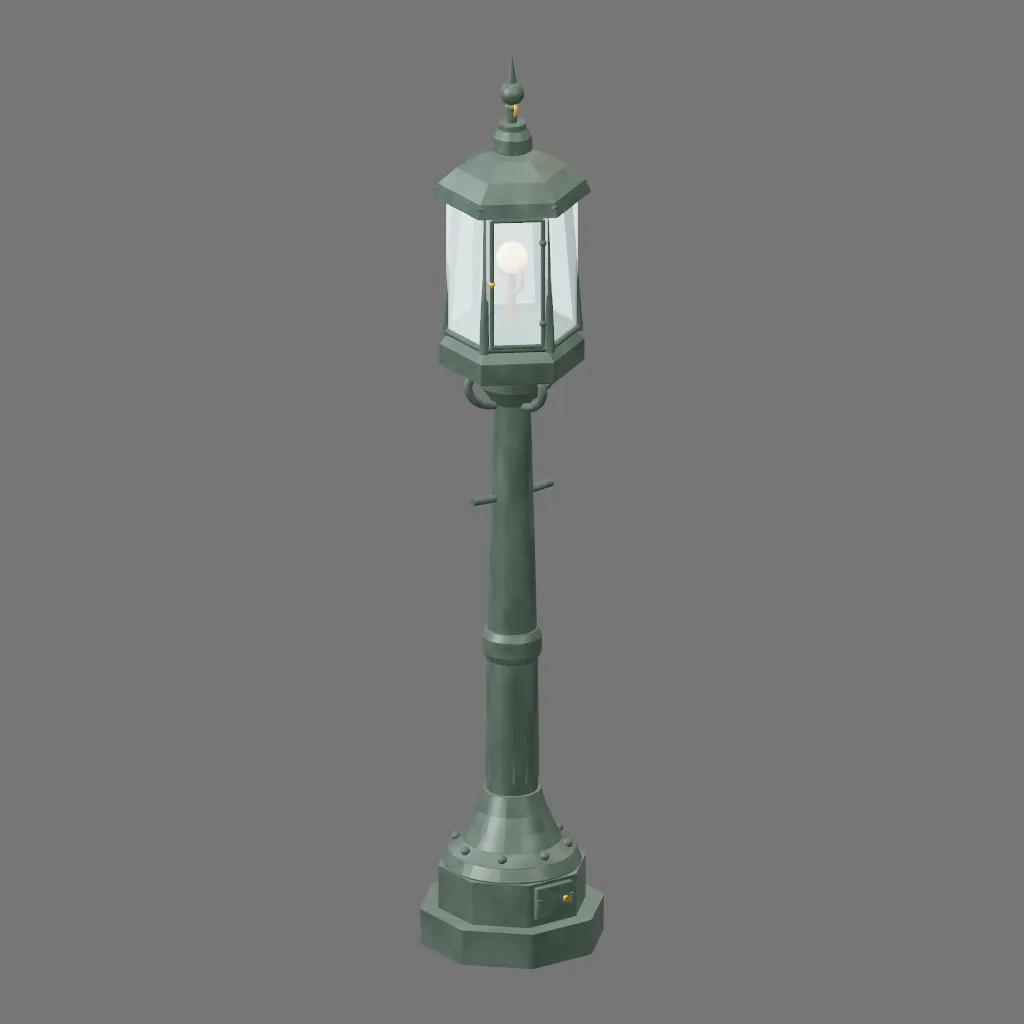
Drag to orbit after opening. The model starts stationary.
For your engine. The download is a standard glTF 2.0 binary (GLB) with PBR metallic-roughness materials. Optional extensions declared by this file: KHR_materials_emissive_strength. Importer support varies; see the Blender and Unity guide. glTF stores materials, not lighting or tone mapping, so your engine decides how they read. This 3D view tone-maps with Review Neutral, the Khronos PBR Neutral construction with a smaller glare offset (0.015 instead of 0.04), at exposure 0.9. Its Tone mapping control also shows ACES and Linear, for comparison.
Build measurements
- Triangles
- 12,940
- Estimated draws
- 83
- Materials
- 4
- Textures
- 4
- Animation clips
- 0
- Bounds X × Y × Z
- 0.85 × 4.61 × 0.85 m
- Build warnings
- 0
Measurements come from this build.
Download this build
Runtime: 674,472 bytes. Original: 674,244 bytes.
These GLBs are build outputs of the MIT-licensed example source; no separate terms are stated for the builds.
Runtime provenance metadataSHA-256 download hashes
- Runtime GLB
- 347511031962c96d057b90993597df987559d2f0c05a28b257eb713dd3355127
- Original GLB
- ae7c76cb78175c5da76a5e1103e2e41ea6a975a80409c66d353e5535e03dddff
- Source
- c1d24daf95c30f46b2d32f3c40c0ae6c08827e0a665b190ec499af83a928e1f6
The example source is part of the Kiln repository. Repository licence: MIT.
These GLBs are build outputs of the MIT-licensed example source; no separate terms are stated for the builds.
Recorded authorship
Claude Opus 5 through Claude Code
Source-header credit
- Source access
- Not recorded
- Inherited context
- Not independently recorded; source-header declarations only
- Starting example
- Not recorded
- Human input
- Not recorded
- Authoring review
- Not recorded
Gallery GPU render of this exact source. Source, artifact, image hashes and camera settings are recorded alongside the poster; the artifact hash names the GLB bytes the image was rendered from, which the downloadable rebuild reproduces byte for byte only on the platform that recorded it.
Poster camera and render recordThe source behind this build
// A Victorian cast-iron street lamp.
//
// Where the field gun is a study in booleans and arrays, this one is a study in
// revolved profiles: the plinth mouldings, the column entasis, the collar, the
// roof and the finial are all single revolves, because a turned or cast part
// gets its whole character from a silhouette curve that a stack of cylinders
// cannot reproduce.
//
// It is also the emissive/glass example for this repository. The lantern carries
// real BLEND glass over an emissive burner, which on the CPU rasterizer is
// invisible and on a GPU render is most of the asset.
//
// Two things were wrong in the first pass and both are worth recording.
//
// 1. Painted cast iron was authored at metalness 0.55 over a near-black albedo.
//    Paint is a DIELECTRIC. A dark metal is a black mirror: with no environment
//    to reflect it returns almost nothing, and the whole lamp rendered as a
//    featureless silhouette with the flutes, mouldings and scrollwork invisible.
//    The fix is metalness 0.08 and a lifted albedo value, not a brighter light.
// 2. The lantern was scaled off the column instead of off a person. A real gas
//    lamp head is roughly two feet tall and reads as the subject of the object;
//    a small one turns the whole asset into a pole.
//
// Authored by: Claude Opus 5, via Claude Code. Every part below was written by the model itself,
// looking at its own renders through the Kiln tools and revising.
const meta = { name: 'StreetLamp', category: 'prop', role: 'poi' };

async function build() {
  const root = createRoot('StreetLamp');
  const uv = (g) => autoUnwrap(g, { resolution: 512 });

  // ---------- Materials ----------
  // Painted cast iron: municipal near-black with a green cast. Value is lifted
  // well off black so the cast detail survives, and metalness stays low because
  // what the eye reads here is thick paint over iron, not bare metal.
  const ironAlbedo = proceduralTexture({
    schemaVersion: 2, size: 512, usage: 'albedo', name: 'CastIron',
    layers: [
      { op: 'solid', color: 0x4c574f },
      { op: 'noise', colorA: 0x36403a, colorB: 0x6c7972, scale: 12, octaves: 4, seed: 5, blend: 'overlay', opacity: 0.6 },
      { op: 'noise', colorA: 0x2a322e, colorB: 0x4c574f, scale: 3, octaves: 3, seed: 17, blend: 'multiply', opacity: 0.22 },
    ],
  });
  const castIron = pbrMaterial({
    albedo: ironAlbedo, normal: normalMapFromHeight(ironAlbedo, { strength: 3.5 }),
    roughness: 0.55, metalness: 0.08,
  });

  const brassAlbedo = proceduralTexture({
    schemaVersion: 2, size: 256, usage: 'albedo', name: 'Brass',
    layers: [
      { op: 'solid', color: 0xa8873f },
      { op: 'noise', colorA: 0x7e6430, colorB: 0xc9a75c, scale: 8, octaves: 3, seed: 9, blend: 'overlay', opacity: 0.5 },
    ],
  });
  const brass = pbrMaterial({
    albedo: brassAlbedo, normal: normalMapFromHeight(brassAlbedo, { strength: 1.6 }),
    roughness: 0.32, metalness: 0.9,
  });

  // Glass is BLEND, so it needs no UVs and must not be atlassed.
  const glass = glassMaterial(0xcfe4e8, { opacity: 0.20, roughness: 0.06, metalness: 0 });
  // The burner. Emissive is the one material cue a flat render cannot fake.
  const flame = gameMaterial(0xffd89a, { emissive: 0xffbb55, emissiveIntensity: 2.6, roughness: 0.4 });

  // ---------- Plinth ----------
  // Octagonal, as a real lamp base is, and stepped rather than a single block.
  // With vertices offset by half a segment the octagon puts a FLAT FACE on +X,
  // which is what the access door is mounted to below.
  const oct = (r) => Array.from({ length: 8 }, (_, i) => {
    const a = (i / 8) * Math.PI * 2 + Math.PI / 8;
    return [Math.cos(a) * r, Math.sin(a) * r];
  });
  createPart('PlinthLower', await uv(await extrudeProfile(oct(0.46), { depth: 0.18, axis: 'y', bevel: 0.022 })), castIron, {
    position: [0, 0.09, 0], parent: root,
  });
  createPart('PlinthUpper', await uv(await extrudeProfile(oct(0.37), { depth: 0.22, axis: 'y', bevel: 0.018 })), castIron, {
    position: [0, 0.29, 0], parent: root,
  });

  // Access door for the gas main, on the flat +X face. Real lamp bases have one
  // and it is the single detail that says the object was serviced by somebody.
  const doorFace = 0.37 * Math.cos(Math.PI / 8);
  createPart('AccessDoor', await uv(await roundedBoxGeo(0.030, 0.170, 0.220, 0.012)), castIron, {
    position: [doorFace + 0.010, 0.30, 0], parent: root,
  });
  for (const sz of [-1, 1]) {
    createPart(`DoorHinge_${sz > 0 ? 'R' : 'L'}`, cylinderGeo(0.014, 0.014, 0.048, 8), castIron, {
      position: [doorFace + 0.022, 0.30, sz * 0.098], parent: root,
    });
  }
  createPart('DoorBoss', cylinderXGeo(0.016, 0.016, 0.030, 10), brass, {
    position: [doorFace + 0.026, 0.30, -0.062], parent: root,
  });

  // Base moulding: the flare from plinth to column, in one revolve.
  createPart('BaseMoulding', await uv(await revolveProfile([
    [0.000, 0.40], [0.345, 0.40], [0.312, 0.47], [0.242, 0.52],
    [0.206, 0.60], [0.171, 0.68], [0.140, 0.78], [0.000, 0.78],
  ], { segments: 40, axis: 'y', bevel: 0.006 })), castIron, { parent: root });

  // Foundation bolts around the flare. Eight of them, the count a real casting
  // would use, arrayed rather than hand-placed.
  const bolt = createPart('Bolt0', sphereGeo(0.024, 10, 8), castIron, { position: [0.276, 0.505, 0], parent: root });
  arrayRadial('Bolt', bolt, 8, 'y', root);

  // ---------- Column ----------
  // Entasis: the shaft swells slightly low down and tapers to the collar. A
  // straight cylinder here is the single clearest tell of a generated lamppost.
  createPart('Column', await uv(await revolveProfile([
    [0.000, 0.78], [0.128, 0.78], [0.132, 1.00], [0.126, 1.45],
    [0.113, 2.00], [0.098, 2.55], [0.089, 2.92], [0.000, 2.92],
  ], { segments: 40, axis: 'y', smooth: true })), castIron, { parent: root });

  // Flutes. Twelve of them, and each is a beam between two points ON the taper
  // rather than a straight cylinder at a fixed radius, which is why they stay
  // half-buried the whole way up instead of sinking at the bottom and floating
  // at the top.
  for (let i = 0; i < 12; i++) {
    const a = (i / 12) * Math.PI * 2;
    beamBetween(`Flute_${i}`,
      [Math.cos(a) * 0.119, 0.84, Math.sin(a) * 0.119],
      [Math.cos(a) * 0.083, 2.60, Math.sin(a) * 0.083],
      0.015, castIron, { parent: root });
  }

  // A cast joint band partway up, where a real column comes in two sections.
  createPart('JointBand', await uv(await revolveProfile([
    [0.000, 1.46], [0.128, 1.46], [0.146, 1.50], [0.146, 1.58],
    [0.128, 1.62], [0.000, 1.62],
  ], { segments: 32, axis: 'y', bevel: 0.005 })), castIron, { parent: root });

  // Capital under the lantern. The lantern floor lands on top of it, so the
  // head reads as seated rather than stacked.
  createPart('Collar', await uv(await revolveProfile([
    [0.000, 2.80], [0.096, 2.80], [0.158, 2.89], [0.158, 2.96],
    [0.122, 3.01], [0.114, 3.04], [0.000, 3.04],
  ], { segments: 40, axis: 'y', bevel: 0.006 })), castIron, { parent: root });

  // Scroll brackets: four cast curls springing from the capital to the underside
  // of the lantern floor overhang. Bezier into a swept tube, which is the only
  // way to get a curl that reads as ironwork.
  //
  // The first pass bowed these out to 0.40 m across half a metre of column. Four
  // of them at that size overlap from every side view into one continuous torus,
  // and a hoop hanging off a lamppost is not a thing that exists. A bracket has
  // to be small enough to read as a bracket: it reaches less far than the thing
  // it supports, and it tucks under it.
  const scrollPath = bezierCurve([
    [0.105, 2.80, 0], [0.275, 2.83, 0], [0.300, 2.96, 0], [0.210, 3.00, 0],
  ], 26);
  const scroll = createPart('Scroll0', curveToMesh(scrollPath, 0.022, 26, 8), castIron, { parent: root });
  arrayRadial('Scroll', scroll, 4, 'y', root);

  // ---------- Lantern ----------
  // Hexagonal and deliberately large: about 0.7 m of glass on a 4.6 m lamp, so
  // the head reads as the subject and the column as its support. It is also a
  // little WIDER than it is tall, which is what separates a lamp head from a
  // lantern on a stick.
  const LANT_R0 = 0.325;   // radius at the lantern floor
  const LANT_R1 = 0.265;   // radius at the lantern shoulder
  const LANT_Y0 = 3.16;
  const LANT_Y1 = 3.92;

  createPart('LanternFloor', await uv(await revolveProfile([
    [0.000, 3.00], [0.355, 3.00], [0.355, 3.11], [0.298, 3.18], [0.000, 3.18],
  ], { segments: 6, axis: 'y', bevel: 0.008 })), castIron, { parent: root });

  // Six corner posts, leaning in with the taper, plus the shoulder and sill
  // rails they land on. Without the rails the posts read as six loose sticks.
  const corner = (i, r, y) => {
    const a = (i / 6) * Math.PI * 2;
    return [Math.cos(a) * r, y, Math.sin(a) * r];
  };
  for (let i = 0; i < 6; i++) {
    // beamBetween creates the part itself; it is not a geometry factory.
    beamBetween(`LanternPost_${i}`, corner(i, LANT_R0, LANT_Y0), corner(i, LANT_R1, LANT_Y1), 0.024, castIron, { parent: root });
    beamBetween(`ShoulderRail_${i}`, corner(i, LANT_R1, LANT_Y1), corner((i + 1) % 6, LANT_R1, LANT_Y1), 0.020, castIron, { parent: root });
    beamBetween(`SillRail_${i}`, corner(i, LANT_R0, LANT_Y0 + 0.02), corner((i + 1) % 6, LANT_R0, LANT_Y0 + 0.02), 0.018, castIron, { parent: root });
  }

  // Glass panels, inset just behind the posts so they do not z-fight the frame.
  for (let i = 0; i < 6; i++) {
    const a = (i / 6) * Math.PI * 2 + Math.PI / 6;
    const rMid = (LANT_R0 + LANT_R1) / 2 - 0.014;
    const pane = createPart(`Glass_${i}`, boxGeo(0.006, LANT_Y1 - LANT_Y0 - 0.06, 0.300), glass, {
      position: [Math.cos(a) * rMid, (LANT_Y0 + LANT_Y1) / 2, Math.sin(a) * rMid],
      parent: root,
    });
    pane.rotation.y = -a;
  }

  // One of the six lights is the hinged access pane the lamplighter opened to
  // reach the burner: a raised frame, two hinges down one edge and a brass latch
  // on the other. Six identical panes is the tell that nobody ever had to open
  // this thing, and asymmetry is most of what makes a repeated array read as a
  // manufactured object rather than a generated one.
  const aDoor = Math.PI / 6;
  const rDoor = (LANT_R0 + LANT_R1) / 2 + 0.008;
  const nx = Math.cos(aDoor), nz = Math.sin(aDoor);
  const tx = -Math.sin(aDoor), tz = Math.cos(aDoor);
  const halfW = 0.125, yLo = LANT_Y0 + 0.04, yHi = LANT_Y1 - 0.06;
  const cnr = (sw, y) => [nx * rDoor + tx * sw * halfW, y, nz * rDoor + tz * sw * halfW];
  beamBetween('PaneFrameBottom', cnr(-1, yLo), cnr(1, yLo), 0.011, castIron, { parent: root });
  beamBetween('PaneFrameTop', cnr(-1, yHi), cnr(1, yHi), 0.011, castIron, { parent: root });
  beamBetween('PaneFrameHingeSide', cnr(-1, yLo), cnr(-1, yHi), 0.011, castIron, { parent: root });
  beamBetween('PaneFrameLatchSide', cnr(1, yLo), cnr(1, yHi), 0.011, castIron, { parent: root });
  for (const s of [-1, 1]) {
    createPart(`PaneHinge_${s > 0 ? 'Upper' : 'Lower'}`, sphereGeo(0.019, 10, 8), castIron, {
      position: cnr(-1, (yLo + yHi) / 2 + s * 0.21), parent: root,
    });
  }
  createPart('PaneLatch', sphereGeo(0.017, 10, 8), brass, { position: cnr(1, (yLo + yHi) / 2), parent: root });

  // The burner inside: mantle, gallery ring and feed pipe. Small, bright, and
  // only visible through the glass.
  createPart('Burner', sphereGeo(0.078, 20, 14), flame, { position: [0, 3.55, 0], parent: root });
  createPart('BurnerGallery', torusGeo(0.086, 0.012, 8, 18), brass, { position: [0, 3.46, 0], parent: root });
  createPart('BurnerStem', cylinderGeo(0.020, 0.020, 0.34, 10), brass, { position: [0, 3.32, 0], parent: root });

  // ---------- Roof and finial ----------
  // An ogee: a near-vertical drip edge, then a slope that FLATTENS toward the
  // apex. The first pass was a 45-degree cone, and a cone with a tapered brass
  // point on top does not read as a lamp roof, it reads as a tiki torch.
  createPart('Roof', await uv(await revolveProfile([
    [0.000, 3.88], [0.385, 3.88], [0.362, 3.95], [0.272, 4.03],
    [0.145, 4.10], [0.000, 4.14],
  ], { segments: 6, axis: 'y', smooth: false })), castIron, { parent: root });

  // Six hip ribs on the roof, so it does not read as a smooth dome.
  for (let i = 0; i < 6; i++) {
    const a = (i / 6) * Math.PI * 2;
    beamBetween(`RoofRib_${i}`,
      [Math.cos(a) * 0.368, 3.92, Math.sin(a) * 0.368], [0, 4.13, 0], 0.015, castIron, { parent: root });
  }

  // Vent cowl. A gas lamp has to breathe, and the cowl is what stops the finial
  // from growing straight out of the roof like a spike.
  createPart('Cowl', await uv(await revolveProfile([
    [0.000, 4.10], [0.102, 4.12], [0.096, 4.19], [0.070, 4.23],
    [0.070, 4.26], [0.000, 4.26],
  ], { segments: 24, axis: 'y', bevel: 0.005 })), castIron, { parent: root });

  // Ball-and-spike finial, in CAST IRON. It was one tapered brass revolve and it
  // read as a flame: orange, pointed, sitting on the apex. That is the hazard of
  // putting the only warm material in the asset at the very top of the
  // silhouette. A ball with a waist under it is unmistakably cast, and the brass
  // collar keeps the gilded accent without the shape that read as fire.
  createPart('FinialStem', cylinderGeo(0.030, 0.024, 0.10, 12), castIron, { position: [0, 4.29, 0], parent: root });
  createPart('FinialCollar', torusGeo(0.036, 0.011, 8, 16), brass, { position: [0, 4.33, 0], parent: root });
  createPart('FinialBall', sphereGeo(0.060, 16, 12), castIron, { position: [0, 4.41, 0], parent: root });
  createPart('FinialSpike', coneGeo(0.026, 0.16, 10), castIron, { position: [0, 4.53, 0], parent: root });

  // Ladder rest: the pair of stub arms a lamplighter leaned a ladder against,
  // each with the short diagonal strut that carried the load. The kind of detail
  // that says the object had a job.
  //
  // Sized down twice. The first pass reached 0.36 m with a quarter-metre
  // diagonal strut under each arm, and from the front the four members drew a
  // downward chevron that made the lamp read as a crossbow. Shortening the arms
  // was not enough: the strut IS the chevron, so it is gone and only the two
  // stub lugs remain, which is what a real rest looks like anyway.
  for (const sz of [-1, 1]) {
    beamBetween(`LadderArm_${sz > 0 ? 'R' : 'L'}`,
      [0, 2.31, sz * 0.090], [0, 2.32, sz * 0.235], 0.020, castIron, { parent: root });
  }

  return root;
}Scroll code horizontally
Brief and retained revisions
No brief or earlier revisions are recorded. The source download contains the version built for this page.