Penny-farthing
Curved frame and radial wire spokes
Earlier examples from earlier Kiln versions.
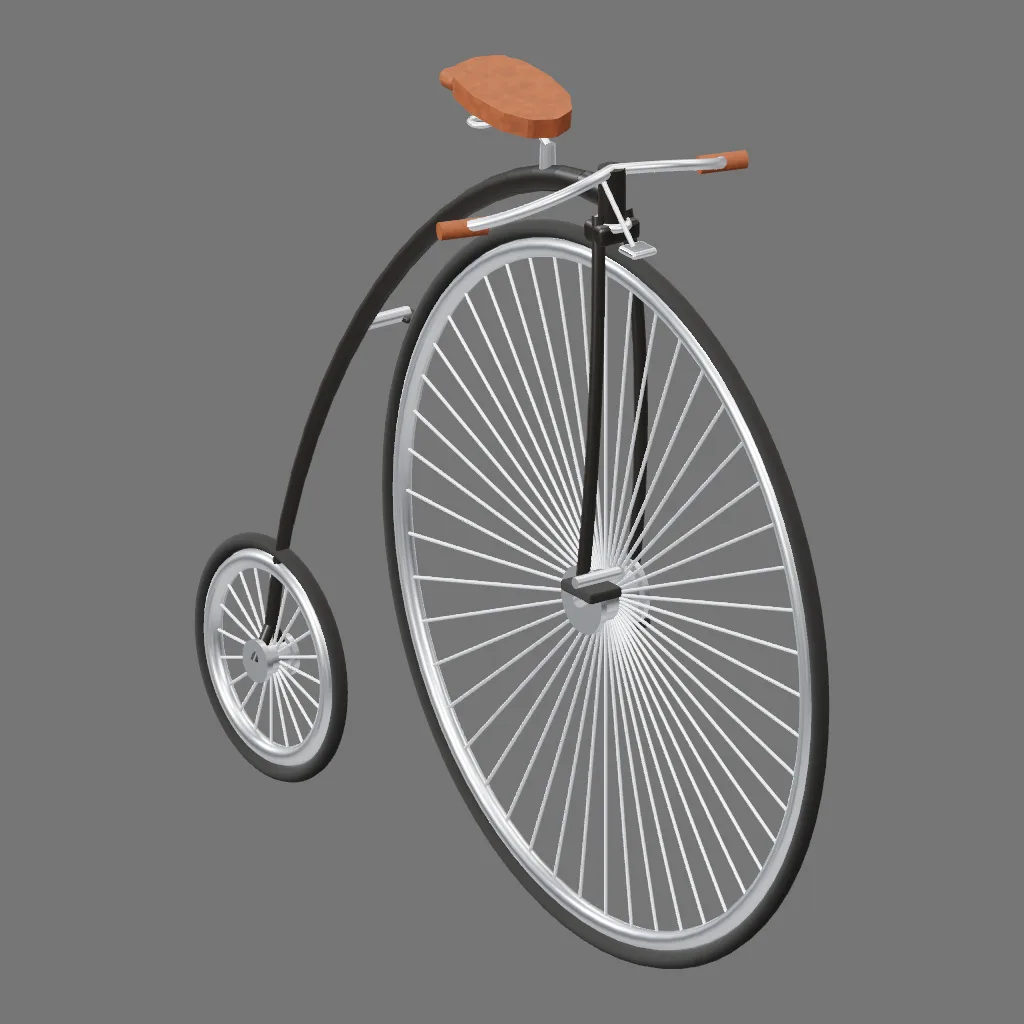
Drag to orbit after opening. The model starts stationary.
For your engine. The download is a standard glTF 2.0 binary (GLB) with PBR metallic-roughness materials. glTF stores materials, not lighting or tone mapping, so your engine decides how they read. This 3D view tone-maps with Review Neutral, the Khronos PBR Neutral construction with a smaller glare offset (0.015 instead of 0.04), at exposure 0.9. Its Tone mapping control also shows ACES and Linear, for comparison.
Build measurements
- Triangles
- 12,392
- Estimated draws
- 123
- Materials
- 4
- Textures
- 6
- Animation clips
- 0
- Bounds X × Y × Z
- 1.99 × 1.61 × 0.67 m
- Build warnings
- 0
Measurements come from this build.
Download this build
Runtime: 815,116 bytes. Original: 814,888 bytes.
These GLBs are build outputs of the MIT-licensed example source; no separate terms are stated for the builds.
Runtime provenance metadataSHA-256 download hashes
- Runtime GLB
- 1a9d84bf5547203e8ffb1c7c9ddc9eb8633f19a53c306cd33fd5119dbe344ac2
- Original GLB
- 4b258d46c58ff13efa2de9f3cb5353247bc311aa1ebe6034c71d12f2107ac17d
- Source
- a243562feabdc46ea5b2d084b723d50b71c0ba801ecf24572d3da0341f1b9544
The example source is part of the Kiln repository. Repository licence: MIT.
These GLBs are build outputs of the MIT-licensed example source; no separate terms are stated for the builds.
Recorded authorship
Claude Opus 5 through Claude Code
Source-header credit
- Source access
- Not recorded
- Inherited context
- Not independently recorded; source-header declarations only
- Starting example
- Not recorded
- Human input
- Not recorded
- Authoring review
- Not recorded
Gallery GPU render of this exact source. Source, artifact, image hashes and camera settings are recorded alongside the poster; the artifact hash names the GLB bytes the image was rendered from, which the downloadable rebuild reproduces byte for byte only on the platform that recorded it.
Poster camera and render recordThe source behind this build
// An 1885 Ordinary bicycle -- a penny-farthing.
//
// The other heroes are massive objects: a gun carriage, a lamp column, a helmet.
// This one is almost entirely AIR. Its whole character is a 1.4 m wheel, a
// hairline backbone curving around it, and sixty-eight spokes you can see the
// background through, and none of that survives being approximated with boxes.
//
// It is therefore the curves-and-arrays example. The backbone, the fork legs and
// the handlebars are bezier paths swept into tubes; both wheels are radial
// arrays under a pivot at the hub, which is the only way to array something
// around a centre that is not the world origin.
//
// The clearance between the backbone and the tyre is 20 mm and that is not an
// accident -- a real Ordinary hugs its wheel. Every control point below was
// checked against the wheel radius at t = 0.25, 0.5 and 0.75 before it was
// rendered once, because a spline that passes through a 1.4 m wheel is not
// something a six-view contact sheet will necessarily show you.
//
// Authored by: Claude Opus 5, via Claude Code. Every part below was written by the model itself,
// looking at its own renders through the Kiln tools and revising.
const meta = { name: 'PennyFarthing', category: 'vehicle', role: 'hero' };

async function build() {
  const root = createRoot('PennyFarthing');
  const uv = (g) => autoUnwrap(g, { resolution: 512 });

  // ---------- Materials ----------
  // Black japanned steel. Enamel is a DIELECTRIC over metal, so metalness stays
  // low; at 0.9 this would be a black mirror and the frame would vanish.
  const enamelAlbedo = proceduralTexture({
    schemaVersion: 2, size: 512, usage: 'albedo', name: 'Japanned',
    layers: [
      { op: 'solid', color: 0x2b2723 },
      { op: 'noise', colorA: 0x201d1a, colorB: 0x453f38, scale: 40, octaves: 4, seed: 7, blend: 'overlay', opacity: 0.55 },
    ],
  });
  const enamel = pbrMaterial({
    albedo: enamelAlbedo, normal: normalMapFromHeight(enamelAlbedo, { strength: 1.1 }),
    roughness: 0.38, metalness: 0.12,
  });

  // Nickel plate: the spokes, rims, hubs and pedal irons. This is the bright
  // metal, and it is the reason the asset reads at all on a GPU render -- a
  // wheel of dark spokes against a dark frame is a smudge.
  const nickelAlbedo = proceduralTexture({
    schemaVersion: 2, size: 256, usage: 'albedo', name: 'Nickel',
    layers: [
      { op: 'solid', color: 0xbcc0c4 },
      { op: 'noise', colorA: 0xa2a7ab, colorB: 0xd6dade, scale: 36, octaves: 3, seed: 13, blend: 'overlay', opacity: 0.45 },
    ],
  });
  const nickel = pbrMaterial({
    albedo: nickelAlbedo, normal: normalMapFromHeight(nickelAlbedo, { strength: 1.0 }),
    roughness: 0.20, metalness: 0.94,
  });

  // Solid rubber tyre and a tanned leather saddle. Both dielectric.
  const rubber = gameMaterial(0x1a1917, { roughness: 0.92, metalness: 0.0 });
  const leatherAlbedo = proceduralTexture({
    schemaVersion: 2, size: 512, usage: 'albedo', name: 'Leather',
    layers: [
      { op: 'solid', color: 0x6d4526 },
      { op: 'noise', colorA: 0x54341c, colorB: 0x8d5f36, scale: 34, octaves: 4, seed: 19, blend: 'overlay', opacity: 0.6 },
    ],
  });
  const leather = pbrMaterial({
    albedo: leatherAlbedo, normal: normalMapFromHeight(leatherAlbedo, { strength: 2.4 }),
    roughness: 0.68, metalness: 0.0,
  });

  // ---------- Wheels ----------
  // A wheel is a radial array about its own hub, so it has to live under a pivot
  // AT that hub. arrayRadial turns copies about the axis through its parent
  // origin, not about the world origin, and building the wheel at the world
  // origin and translating it afterwards is the version of this that produces a
  // sunflower instead of a bicycle.
  const wheel = (name, at, rimR, tyreTube, spokes, spokeR, hubR, hubHalf) => {
    const p = createPivot(name, at, root);
    // torusGeo lies in the XY plane with its hole on Z, which is exactly the
    // plane a wheel rolling along +X turns in. No rotation needed.
    createPart(`${name}Rim`, torusGeo(rimR, 0.018, 10, 72), nickel, { parent: p });
    createPart(`${name}Tyre`, torusGeo(rimR + 0.019 + tyreTube, tyreTube, 10, 72), rubber, { parent: p });
    createPart(`${name}Hub`, cylinderZGeo(hubR, hubR, hubHalf * 2, 20), nickel, { parent: p });
    for (const sz of [-1, 1]) {
      createPart(`${name}Flange${sz > 0 ? 'R' : 'L'}`, cylinderZGeo(hubR * 1.35, hubR * 1.35, 0.012, 20), nickel, {
        position: [0, 0, sz * hubHalf], parent: p,
      });
    }
    const len = rimR - hubR * 0.9;
    const spoke = createPart(`${name}Spoke0`, cylinderGeo(spokeR, spokeR, len, 6), nickel, {
      position: [0, hubR * 0.9 + len / 2, 0], parent: p,
    });
    arrayRadial(`${name}Spoke`, spoke, spokes, 'z', p);
    return p;
  };

  // A 52-inch driver and a 17-inch trailer. The whole machine is sized off the
  // big wheel, so it is placed first and everything else is derived from it.
  const FR = 0.645, FT = 0.017;          // front rim radius, tyre tube
  const FY = FR + 0.019 + FT * 2;        // hub height = outside radius of the tyre
  wheel('FrontWheel', [0, FY, 0], FR, FT, 48, 0.0035, 0.048, 0.048);

  const RR = 0.184, RT = 0.015;
  const RY = RR + 0.019 + RT * 2;
  const RX = -1.06;
  wheel('RearWheel', [RX, RY, 0], RR, RT, 20, 0.0032, 0.030, 0.030);

  // ---------- Fork ----------
  // Two legs up the sides of the driver to the steering head above the tyre.
  // They carry the rider, the cranks and the whole front of the machine.
  const HEAD = [0.020, FY + FR + 0.128, 0];
  for (const sz of [-1, 1]) {
    const legPath = bezierCurve([
      [0.000, FY, sz * 0.056], [0.052, FY + 0.30, sz * 0.058],
      [0.046, FY + 0.58, sz * 0.046], [HEAD[0], HEAD[1] - 0.02, sz * 0.030],
    ], 22);
    createPart(`ForkLeg_${sz > 0 ? 'R' : 'L'}`, curveToMesh(legPath, 0.013, 22, 8), enamel, { parent: root });
  }
  createPart('SteeringHead', cylinderGeo(0.026, 0.026, 0.115, 16), enamel, {
    position: [HEAD[0], HEAD[1] + 0.010, 0], parent: root,
  });
  createPart('HeadCollar', torusGeo(0.030, 0.009, 8, 20), nickel, {
    position: [HEAD[0], HEAD[1] - 0.042, 0], rotation: [90, 0, 0], parent: root,
  });

  // ---------- Backbone ----------
  // The signature curve: off the head, round the back of the driver, down to the
  // trailing fork. Checked against the wheel at t = 0.25 / 0.50 / 0.75 -- see the
  // header. The clearance is deliberately small; a backbone standing off the
  // wheel reads as a chopper, not an Ordinary.
  const BB = [
    [0.010, HEAD[1] + 0.010, 0], [-0.400, 1.500, 0],
    [-0.960, 0.950, 0], [RX, 0.300, 0],
  ];
  // Evaluate the backbone analytically to hang things off it. Guessing a height
  // and hoping it lands on a spline is how parts end up floating 30 mm off the
  // frame in a render nobody looks at closely enough to catch.
  const onBackbone = (t) => {
    const u = 1 - t;
    const w = [u * u * u, 3 * u * u * t, 3 * u * t * t, t * t * t];
    return [0, 1, 2].map((k) => BB.reduce((s, p, i) => s + w[i] * p[k], 0));
  };

  // Chained beams down the spline rather than one curveToMesh, because the tube
  // sweep is a CONSTANT radius and a constant-radius backbone is what makes the
  // whole machine read as a line drawing. A real one is a forging: thick where
  // it takes the rider at the head, drawn down to little more than a rod at the
  // trailing fork. Eighteen segments over 1.7 m are short enough that the joints
  // do not read, and the taper is worth far more than the smoothness it costs.
  const SEGS = 18;
  let prev = onBackbone(0);
  for (let i = 1; i <= SEGS; i++) {
    const cur = onBackbone(i / SEGS);
    const r = 0.027 - 0.015 * ((i - 0.5) / SEGS);
    beamBetween(`Backbone_${i}`, prev, cur, r, enamel, { parent: root });
    prev = cur;
  }

  // Trailing fork down to the small hub.
  for (const sz of [-1, 1]) {
    beamBetween(`RearFork_${sz > 0 ? 'R' : 'L'}`,
      [RX, 0.300, 0], [RX, RY, sz * 0.034], 0.011, enamel, { parent: root });
  }

  // ---------- Saddle ----------
  const seatAt = onBackbone(0.19);
  createPart('SaddlePost', cylinderGeo(0.014, 0.016, 0.075, 12), nickel, {
    position: [seatAt[0] + 0.052, seatAt[1] + 0.048, 0], parent: root,
  });
  // The long leaf spring an Ordinary hangs its saddle from, swept as one tube.
  // Four stacked rings were tried here for a coil and disappeared entirely at
  // asset scale: a detail smaller than the render can resolve is not detail, it
  // is triangles. The leaf is legible because it spans 220 mm.
  const springPath = bezierCurve([
    [seatAt[0] + 0.052, seatAt[1] + 0.082, 0], [seatAt[0] - 0.010, seatAt[1] + 0.132, 0],
    [seatAt[0] - 0.118, seatAt[1] + 0.126, 0], [seatAt[0] - 0.166, seatAt[1] + 0.070, 0],
  ], 22);
  createPart('SaddleSpring', curveToMesh(springPath, 0.008, 22, 8), nickel, { parent: root });
  createPart('SpringClip', torusGeo(0.020, 0.006, 6, 16), nickel, {
    position: [seatAt[0] - 0.160, seatAt[1] + 0.060, 0], rotation: [90, 0, 0], parent: root,
  });

  const saddleOutline = [
    [0.130, 0.000], [0.112, 0.045], [0.060, 0.076], [-0.020, 0.086],
    [-0.092, 0.076], [-0.132, 0.045], [-0.142, 0.000],
    [-0.132, -0.045], [-0.092, -0.076], [-0.020, -0.086],
    [0.060, -0.076], [0.112, -0.045],
  ];
  const saddle = createPart('Saddle', await uv(await extrudeProfile(saddleOutline, {
    depth: 0.038, axis: 'y', bevel: 0.014,
  })), leather, { position: [seatAt[0] - 0.048, seatAt[1] + 0.140, 0], parent: root });
  saddle.rotation.z = (-7 * Math.PI) / 180;
  // The cantle. Without a raised back edge a sling saddle photographs as a
  // pancake, which is what the first render of this one looked like.
  createPart('SaddleCantle', await uv(await roundedBoxGeo(0.052, 0.036, 0.150, 0.016)), leather, {
    position: [seatAt[0] - 0.170, seatAt[1] + 0.152, 0], parent: root,
  });

  // ---------- Handlebars ----------
  // Mustache bars: they sweep forward, out and back down to the grips.
  for (const sz of [-1, 1]) {
    const barPath = bezierCurve([
      [HEAD[0], HEAD[1] + 0.062, 0], [HEAD[0] + 0.070, HEAD[1] + 0.070, sz * 0.130],
      [HEAD[0] + 0.020, HEAD[1] + 0.020, sz * 0.250], [HEAD[0] - 0.075, HEAD[1] - 0.010, sz * 0.290],
    ], 24);
    createPart(`Handlebar_${sz > 0 ? 'R' : 'L'}`, curveToMesh(barPath, 0.011, 24, 8), nickel, { parent: root });
    createPart(`Grip_${sz > 0 ? 'R' : 'L'}`, cylinderXGeo(0.017, 0.017, 0.090, 14), leather, {
      position: [HEAD[0] - 0.062, HEAD[1] - 0.008, sz * 0.288], rotation: [0, 74, 0], parent: root,
    });
  }
  // Spoon brake: a lever on the right bar, a rod down the front of the head, and
  // the spoon itself bearing on the crown of the tyre. The spoon on its own was
  // an unexplained metal tab hovering near the wheel -- a mechanism reads as a
  // mechanism only when the linkage back to the hand that works it is there.
  const TYRE_TOP = FY + FR + 0.019 + FT * 2;
  createPart('ForkCrown', await uv(await roundedBoxGeo(0.062, 0.040, 0.090, 0.010)), enamel, {
    position: [HEAD[0], HEAD[1] - 0.054, 0], parent: root,
  });
  beamBetween('BrakeLever',
    [HEAD[0] + 0.012, HEAD[1] + 0.056, 0.026], [HEAD[0] + 0.026, HEAD[1] + 0.046, 0.140], 0.007, nickel, { parent: root });
  beamBetween('BrakeRod',
    [HEAD[0] + 0.016, HEAD[1] + 0.050, 0.030], [0.102, TYRE_TOP + 0.016, 0.010], 0.005, nickel, { parent: root });
  createPart('BrakeSpoon', await uv(await roundedBoxGeo(0.052, 0.014, 0.054, 0.006)), nickel, {
    position: [0.102, TYRE_TOP + 0.006, 0], parent: root,
  });

  // ---------- Cranks and pedals ----------
  // Fixed to the driver hub, one crank up and forward, the other down and back,
  // because two cranks in line is a tricycle mistake that reads instantly.
  const CRANK = 0.168;
  let crankIndex = 0;
  for (const [dir, sz] of [[1, 1], [-1, -1]]) {
    const i = crankIndex++;
    const px = dir * CRANK * 0.80, py = FY + dir * CRANK * 0.60;
    beamBetween(`Crank_${i}`, [0, FY, sz * 0.058], [px, py, sz * 0.066], 0.014, nickel, { parent: root });
    createPart(`PedalSpindle_${i}`, cylinderZGeo(0.011, 0.011, 0.096, 12), nickel, {
      position: [px, py, sz * 0.114], parent: root,
    });
    createPart(`PedalBlock_${i}`, await uv(await roundedBoxGeo(0.098, 0.020, 0.072, 0.005)), rubber, {
      position: [px, py - 0.018, sz * 0.126], parent: root,
    });
  }

  // Mounting step on the backbone, where the rider put a foot to vault on.
  const stepAt = onBackbone(0.62);
  createPart('MountingStep', cylinderZGeo(0.013, 0.013, 0.090, 12), nickel, {
    position: [stepAt[0], stepAt[1], -0.062], parent: root,
  });
  createPart('StepPlate', await uv(await roundedBoxGeo(0.052, 0.012, 0.038, 0.005)), enamel, {
    position: [stepAt[0], stepAt[1] - 0.005, -0.106], parent: root,
  });

  return root;
}Scroll code horizontally
Brief and retained revisions
No brief or earlier revisions are recorded. The source download contains the version built for this page.