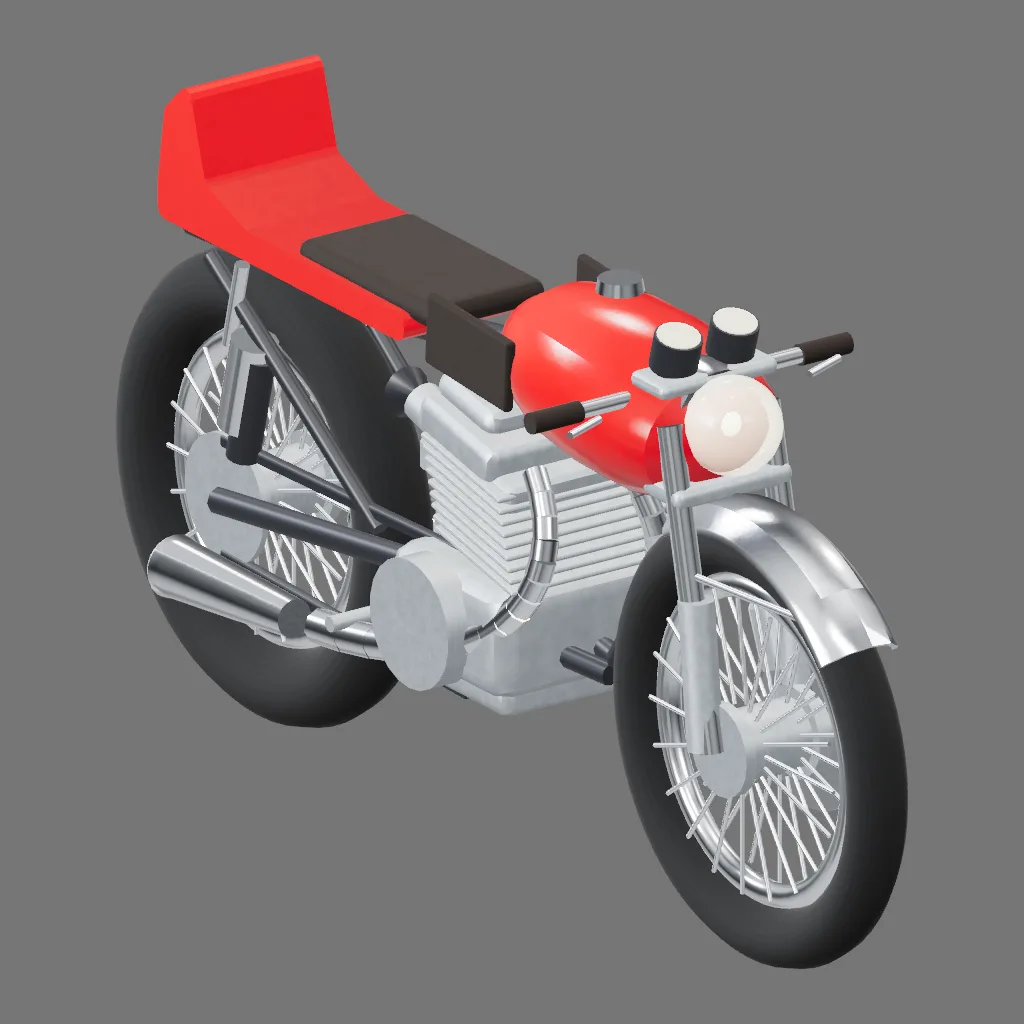
Cafe racer
Curved frame tubes and a tapered fuel tank
Earlier examples from earlier Kiln versions.
Drag to orbit after opening. The model starts stationary.
For your engine. The download is a standard glTF 2.0 binary (GLB) with PBR metallic-roughness materials. Optional extensions declared by this file: KHR_materials_emissive_strength. Importer support varies; see the Blender and Unity guide. glTF stores materials, not lighting or tone mapping, so your engine decides how they read. This 3D view tone-maps with Review Neutral, the Khronos PBR Neutral construction with a smaller glare offset (0.015 instead of 0.04), at exposure 0.9. Its Tone mapping control also shows ACES and Linear, for comparison.
Build measurements
- Triangles
- 16,848
- Estimated draws
- 202
- Materials
- 8
- Textures
- 10
- Animation clips
- 0
- Bounds X × Y × Z
- 2.23 × 1.14 × 0.65 m
- Build warnings
- 0
Measurements come from this build.
Download this build
Runtime: 1,330,936 bytes. Original: 1,330,712 bytes.
These GLBs are build outputs of the MIT-licensed example source; no separate terms are stated for the builds.
Runtime provenance metadataSHA-256 download hashes
- Runtime GLB
- 753985b09a1aa2c9004cc05d4a374b0a1a47e3804cae707a88bffd9ed0d647d9
- Original GLB
- 485f94593159809a4acc5cc3d87ddcd568052f80fd62be82e5faa7b3ac37b91c
- Source
- 17553756d649fbd5d49b67cfa8a2d3b1918d1d331fd58b6783b6ea4e06f58006
The example source is part of the Kiln repository. Repository licence: MIT.
These GLBs are build outputs of the MIT-licensed example source; no separate terms are stated for the builds.
Recorded authorship
Claude Opus 5 through Claude Code
Source-header credit
- Source access
- Not recorded
- Inherited context
- Not independently recorded; source-header declarations only
- Starting example
- Not recorded
- Human input
- Header declares no hand-authored source; other intervention not recorded
- Authoring review
- Not recorded
Gallery GPU render of this exact source. Source, artifact, image hashes and camera settings are recorded alongside the poster; the artifact hash names the GLB bytes the image was rendered from, which the downloadable rebuild reproduces byte for byte only on the platform that recorded it.
Poster camera and render recordThe source behind this build
// A 1970s cafe racer.
//
// Authored by: Claude Opus 5, via Claude Code. Every part below was written by
// the model itself, looking at its own renders through the Kiln tools and
// revising. Not a line of it is hand-authored.
//
// This is the hardest silhouette in the set, because a motorcycle is the one
// object here that almost everyone can draw from memory and nobody can draw
// correctly. The read depends on four measurements and very little else:
//
//   wheelbase, seat height, the tank's break line, and the fork rake.
//
// Get those right and it reads as a bike even in flat grey. Get them wrong and
// no amount of chrome rescues it, which is why every node below is a named
// constant at the top rather than a number buried in a call. The frame, the
// forks, the exhaust and the swingarm are all built by naming two nodes and
// running a beam between them, so changing the wheelbase moves everything that
// should move and nothing that should not.
//
// The technique this file exists for is the TAPERED SWEEP. beamBetween runs a
// constant radius, so a header pipe built from one call reads as electrical
// conduit. A real exhaust leaves the head narrow, swells through the bend and
// opens into the megaphone, so the pipes here are chains of short beams down a
// sampled bezier with the radius interpolated along the run. That is the same
// trick the penny-farthing uses on its backbone, applied to a curve that turns
// in all three axes instead of lying in a plane.
const meta = { name: 'CafeRacer', category: 'vehicle', role: 'hero' };

async function build() {
  const root = createRoot('CafeRacer');
  const uv = (g) => autoUnwrap(g, { resolution: 1024 });

  // ---------- Nodes ----------
  // Everything is placed off these. A 1970s 750 has a 1.42 m wheelbase and sits
  // on 18-inch wheels, so the axles are 0.33 m up and 1.42 m apart.
  const FRONT_AXLE = [0.71, 0.33, 0];
  const REAR_AXLE = [-0.71, 0.33, 0];
  const STEER_TOP = [0.52, 0.94, 0];     // top of the steering head
  const STEER_BOT = [0.58, 0.66, 0];     // bottom of the steering head
  const SPINE_BACK = [-0.30, 0.76, 0];   // where the backbone meets the seat loop
  const ENGINE = [0.03, 0.46, 0];
  const SWING_PIVOT = [-0.16, 0.40, 0];

  const mid = (a, b) => [(a[0] + b[0]) / 2, (a[1] + b[1]) / 2, (a[2] + b[2]) / 2];
  const lerp3 = (a, b, f) => [0, 1, 2].map((k) => a[k] + (b[k] - a[k]) * f);

  // ---------- Materials ----------
  // Tank paint. A painted tank is a DIELECTRIC with a clearcoat: low roughness
  // for the gloss, metalness at zero. Run it metallic and the tank turns into a
  // mirror and the single most recognisable shape on the bike disappears.
  const paintAlbedo = proceduralTexture({
    schemaVersion: 2, size: 1024, usage: 'albedo', name: 'TankPaint',
    layers: [
      { op: 'solid', color: 0x8f1f24 },
      { op: 'gradient', from: 0xb03038, to: 0x6d1519, angleDeg: 90, blend: 'overlay', opacity: 0.55 },
      { op: 'noise', colorA: 0x7a1a1f, colorB: 0xa32a30, scale: 48, octaves: 3, seed: 11, blend: 'overlay', opacity: 0.20 },
    ],
  });
  const paint = pbrMaterial({
    albedo: paintAlbedo, normal: normalMapFromHeight(paintAlbedo, { strength: 0.5 }),
    roughness: 0.18, metalness: 0.0,
  });

  // Chrome: the rims, the pipes, the fork stanchions. This is the one place
  // metalness belongs at the top of its range.
  const chromeAlbedo = proceduralTexture({
    schemaVersion: 2, size: 512, usage: 'albedo', name: 'Chrome',
    layers: [
      { op: 'solid', color: 0xc7ccd2 },
      { op: 'noise', colorA: 0xb2b8be, colorB: 0xdfe4e9, scale: 60, octaves: 2, seed: 3, blend: 'overlay', opacity: 0.30 },
    ],
  });
  const chrome = pbrMaterial({
    albedo: chromeAlbedo, normal: normalMapFromHeight(chromeAlbedo, { strength: 0.4 }),
    roughness: 0.12, metalness: 0.98,
  });

  // Cast alloy: the engine cases and the hubs. Sandcast aluminium is metallic
  // but ROUGH, which is what separates it from the chrome next to it.
  const alloyAlbedo = proceduralTexture({
    schemaVersion: 2, size: 512, usage: 'albedo', name: 'CastAlloy',
    layers: [
      { op: 'solid', color: 0x9ea3a6 },
      { op: 'noise', colorA: 0x82878a, colorB: 0xb4b9bc, scale: 34, octaves: 4, seed: 17, blend: 'overlay', opacity: 0.55 },
      { op: 'noise', colorA: 0x6d7275, colorB: 0x9ea3a6, scale: 11, octaves: 2, seed: 29, blend: 'multiply', opacity: 0.18 },
    ],
  });
  const alloy = pbrMaterial({
    albedo: alloyAlbedo, normal: normalMapFromHeight(alloyAlbedo, { strength: 1.8 }),
    roughness: 0.58, metalness: 0.82,
  });

  // Frame enamel: near-black, but NOT black. A true black frame reads as a hole
  // in the render and the whole middle of the bike falls out.
  const frameEnamel = gameMaterial(0x24262a, { roughness: 0.38, metalness: 0.20 });

  const leatherAlbedo = proceduralTexture({
    schemaVersion: 2, size: 512, usage: 'albedo', name: 'SeatLeather',
    layers: [
      { op: 'solid', color: 0x2b211b },
      { op: 'noise', colorA: 0x1e1713, colorB: 0x3d2f26, scale: 52, octaves: 4, seed: 7, blend: 'overlay', opacity: 0.60 },
    ],
  });
  const leather = pbrMaterial({
    albedo: leatherAlbedo, normal: normalMapFromHeight(leatherAlbedo, { strength: 2.4 }),
    roughness: 0.86, metalness: 0.0,
  });

  const rubberAlbedo = proceduralTexture({
    schemaVersion: 2, size: 512, usage: 'albedo', name: 'Tyre',
    layers: [
      { op: 'solid', color: 0x191a1c },
      { op: 'stripes', colorA: 0x101113, colorB: 0x242629, count: 56, angleDeg: 90, blend: 'overlay', opacity: 0.45 },
    ],
  });
  const rubber = pbrMaterial({
    albedo: rubberAlbedo, normal: normalMapFromHeight(rubberAlbedo, { strength: 2.0 }),
    roughness: 0.95, metalness: 0.0,
  });

  const lens = glassMaterial(0xf2ead2, { opacity: 0.42, roughness: 0.06, metalness: 0 });
  const bulb = gameMaterial(0xfff3d0, { emissive: 0xffdca0, emissiveIntensity: 1.8, roughness: 0.4 });

  // ---------- Helpers ----------
  const box = async (name, w, h, d, r, position, mat, rotation) =>
    createPart(name, await uv(await roundedBoxGeo(w, h, d, r)), mat, { position, rotation, parent: root });

  // A bezier sampled into a chain of beams whose radius interpolates. This is
  // the whole reason the pipes read as pipes and not as conduit.
  const taperedSweep = async (name, pts, r0, r1, segs, mat) => {
    const curve = bezierCurve(pts, segs + 1);
    for (let i = 1; i <= segs; i++) {
      const f = (i - 0.5) / segs;
      beamBetween(`${name}_${i}`, curve[i - 1], curve[i], r0 + (r1 - r0) * f, mat, { parent: root });
    }
    return curve;
  };

  // ---------- Wheels ----------
  const wheel = (name, at, rimR, tyreTube, spokes) => {
    const p = createPivot(name, at, root);
    createPart(`${name}Rim`, torusGeo(rimR, 0.022, 10, 60), chrome, { parent: p });
    createPart(`${name}Tyre`, torusGeo(rimR + 0.021 + tyreTube, tyreTube, 12, 60), rubber, { parent: p });
    createPart(`${name}Hub`, cylinderZGeo(0.062, 0.062, 0.16, 20), alloy, { parent: p });
    createPart(`${name}HubFlangeA`, cylinderZGeo(0.082, 0.082, 0.022, 20), alloy, { position: [0, 0, 0.075], parent: p });
    createPart(`${name}HubFlangeB`, cylinderZGeo(0.082, 0.082, 0.022, 20), alloy, { position: [0, 0, -0.075], parent: p });
    // Spokes lace from hub flange to rim, so they are angled, not radial. Two
    // opposed sets is what makes a laced wheel read as laced.
    for (const sz of [-1, 1]) {
      const len = rimR - 0.070;
      const s = createPart(`${name}Spoke${sz > 0 ? 'A' : 'B'}0`,
        cylinderGeo(0.0045, 0.0045, len, 5), chrome, {
        position: [0, 0.070 + len / 2, sz * 0.038],
        rotation: [sz * 5.5, 0, 0], parent: p,
      });
      arrayRadial(`${name}Spoke${sz > 0 ? 'A' : 'B'}`, s, spokes, 'z', p);
    }
    return p;
  };
  // The tyre's outer radius is declared once here and shared with the mudguard,
  // so the guard's clearance is derived from the tyre it has to clear instead of
  // being typed a second time and left free to drift away from it.
  const FRONT_RIM_R = 0.268;
  const FRONT_TUBE = 0.052;
  const FRONT_TYRE_OUTER = FRONT_RIM_R + 0.021 + FRONT_TUBE * 2;
  const frontWheel = wheel('Front', FRONT_AXLE, FRONT_RIM_R, FRONT_TUBE, 20);
  const rearWheel = wheel('Rear', REAR_AXLE, 0.258, 0.068, 20);
  // Brake disc and caliper, front only, on the left as it should be.
  createPart('BrakeDisc', cylinderZGeo(0.145, 0.145, 0.010, 30), chrome,
    { position: [0, 0, -0.105], parent: frontWheel });
  createPart('BrakeCarrier', cylinderZGeo(0.070, 0.070, 0.016, 20), alloy,
    { position: [0, 0, -0.100], parent: frontWheel });
  await box('BrakeCaliper', 0.07, 0.13, 0.05, 0.016, [0.60, 0.46, -0.105], alloy, [0, 0, 22]);
  // Rear sprocket and chain run.
  createPart('Sprocket', cylinderZGeo(0.115, 0.115, 0.012, 34), alloy,
    { position: [0, 0, 0.098], parent: rearWheel });
  for (const sy of [-1, 1]) {
    await box(`ChainRun_${sy > 0 ? 'T' : 'B'}`, 0.72, 0.022, 0.020, 0.006,
      [-0.36, 0.33 + sy * 0.113, 0.098], frameEnamel, [0, 0, sy * 1.6]);
  }

  // ---------- Frame ----------
  // Steering head, then the two tubes that define a 1970s twin-cradle frame:
  // a backbone over the engine and a downtube in front of it.
  createPart('SteerHead', cylinderGeo(0.042, 0.042, 0.30, 18), frameEnamel, {
    position: mid(STEER_TOP, STEER_BOT), rotation: [0, 0, 26], parent: root,
  });
  beamBetween('Backbone', [0.50, 0.90, 0], SPINE_BACK, 0.030, frameEnamel, { parent: root });
  beamBetween('Downtube', [0.56, 0.70, 0], [0.30, 0.34, 0], 0.026, frameEnamel, { parent: root });
  for (const sz of [-1, 1]) {
    // Twin cradle rails under the engine, and the seat loop above.
    beamBetween(`Cradle_${sz > 0 ? 'R' : 'L'}`,
      [0.30, 0.32, sz * 0.02], [-0.24, 0.34, sz * 0.10], 0.020, frameEnamel, { parent: root });
    beamBetween(`SeatRail_${sz > 0 ? 'R' : 'L'}`,
      SPINE_BACK, [-0.80, 0.80, sz * 0.11], 0.019, frameEnamel, { parent: root });
    beamBetween(`SubStrut_${sz > 0 ? 'R' : 'L'}`,
      [-0.26, 0.42, sz * 0.10], [-0.74, 0.76, sz * 0.11], 0.016, frameEnamel, { parent: root });
    // Swingarm and shock.
    beamBetween(`Swingarm_${sz > 0 ? 'R' : 'L'}`,
      [SWING_PIVOT[0], SWING_PIVOT[1], sz * 0.115], [REAR_AXLE[0], REAR_AXLE[1], sz * 0.115],
      0.024, frameEnamel, { parent: root });
    createPart(`ShockBody_${sz > 0 ? 'R' : 'L'}`, cylinderGeo(0.030, 0.030, 0.20, 14), frameEnamel, {
      position: [-0.615, 0.53, sz * 0.115], rotation: [0, 0, -14], parent: root,
    });
    createPart(`ShockRod_${sz > 0 ? 'R' : 'L'}`, cylinderGeo(0.013, 0.013, 0.16, 10), chrome, {
      position: [-0.66, 0.70, sz * 0.115], rotation: [0, 0, -14], parent: root,
    });
    createPart(`ShockSpring_${sz > 0 ? 'R' : 'L'}`, cylinderGeo(0.042, 0.042, 0.17, 14), chrome, {
      position: [-0.625, 0.57, sz * 0.115], rotation: [0, 0, -14], parent: root,
    });
    // Footpeg.
    createPart(`Footpeg_${sz > 0 ? 'R' : 'L'}`, cylinderZGeo(0.014, 0.014, 0.11, 10), alloy, {
      position: [-0.20, 0.30, sz * 0.19], parent: root,
    });
  }

  // ---------- Engine ----------
  // A parallel twin: crankcase, barrels with cooling fins, a head and a rocker
  // cover. The fins are the detail that makes an engine an engine, and they are
  // an array of thin discs, which is exactly what the real casting is.
  await box('Crankcase', 0.34, 0.20, 0.36, 0.045, [ENGINE[0], ENGINE[1] - 0.10, 0], alloy);
  await box('Sump', 0.26, 0.07, 0.28, 0.025, [ENGINE[0], ENGINE[1] - 0.21, 0], alloy);
  createPart('ClutchCover', cylinderZGeo(0.115, 0.115, 0.055, 22), alloy,
    { position: [ENGINE[0] - 0.03, ENGINE[1] - 0.10, 0.195], parent: root });
  createPart('AltCover', cylinderZGeo(0.098, 0.098, 0.050, 22), alloy,
    { position: [ENGINE[0] - 0.03, ENGINE[1] - 0.10, -0.195], parent: root });
  // Barrels, inclined forward the way a British twin sits.
  const BARREL_TILT = 12;
  await box('Barrels', 0.20, 0.19, 0.30, 0.020, [ENGINE[0] + 0.04, ENGINE[1] + 0.11, 0], alloy, [0, 0, -BARREL_TILT]);
  for (let i = 0; i < 9; i++) {
    const t = i / 8;
    await box(`Fin_${i}`, 0.235, 0.011, 0.335, 0.005,
      [ENGINE[0] + 0.078 - t * 0.040, ENGINE[1] + 0.035 + t * 0.155, 0], alloy, [0, 0, -BARREL_TILT]);
  }
  await box('Head', 0.22, 0.075, 0.32, 0.022, [ENGINE[0] + 0.005, ENGINE[1] + 0.225, 0], alloy, [0, 0, -BARREL_TILT]);
  await box('RockerCover', 0.17, 0.055, 0.26, 0.024, [ENGINE[0] - 0.008, ENGINE[1] + 0.278, 0], alloy, [0, 0, -BARREL_TILT]);
  // Carburettors behind the barrels, with float bowls.
  for (const sz of [-1, 1]) {
    createPart(`Carb_${sz > 0 ? 'R' : 'L'}`, cylinderGeo(0.036, 0.036, 0.10, 14), alloy, {
      position: [ENGINE[0] - 0.155, ENGINE[1] + 0.20, sz * 0.075], rotation: [0, 0, 74], parent: root,
    });
    createPart(`FloatBowl_${sz > 0 ? 'R' : 'L'}`, cylinderGeo(0.032, 0.032, 0.045, 12), alloy, {
      position: [ENGINE[0] - 0.153, ENGINE[1] + 0.135, sz * 0.075], parent: root,
    });
    createPart(`AirTrumpet_${sz > 0 ? 'R' : 'L'}`, coneGeo(0.046, 0.055, 14), frameEnamel, {
      position: [ENGINE[0] - 0.222, ENGINE[1] + 0.215, sz * 0.075], rotation: [0, 0, -90], parent: root,
    });
  }

  // ---------- Exhaust ----------
  // Two pipes, each swelling from 0.021 at the head to 0.032 into the megaphone.
  // The bend turns in X, Y and Z at once, which is why this cannot be one beam.
  for (const sz of [-1, 1]) {
    await taperedSweep(`Header_${sz > 0 ? 'R' : 'L'}`, [
      [ENGINE[0] + 0.14, ENGINE[1] + 0.20, sz * 0.085],
      [ENGINE[0] + 0.34, ENGINE[1] + 0.02, sz * 0.125],
      [ENGINE[0] + 0.10, ENGINE[1] - 0.20, sz * 0.190],
      [-0.38, 0.255, sz * 0.205],
    ], 0.021, 0.032, 16, chrome);
    // Megaphone silencer: a revolve, so the taper and the rolled tip are real.
    // revolveProfile on axis 'x' grows in +X, which is FORWARD here -- the first
    // pass buried both silencers inside the crankcase and the bike had no
    // visible exhaust at all. The 180 turn is what points them out the back.
    createPart(`Megaphone_${sz > 0 ? 'R' : 'L'}`, await uv(await revolveProfile([
      [0.000, 0.00], [0.034, 0.00], [0.044, 0.17], [0.052, 0.33],
      [0.056, 0.35], [0.050, 0.36], [0.000, 0.36],
    ], { segments: 24, axis: 'x', smooth: true })), chrome, {
      position: [-0.36, 0.250, sz * 0.205], rotation: [0, 180, -3], parent: root,
    });
  }

  // ---------- Tank ----------
  // A body of revolution about X, then squashed. A real teardrop tank is not a
  // solid of revolution -- it has a flat top and knee scallops -- but the
  // proportion and the break line do the recognising, and this gets both.
  const tank = new THREE.Mesh(await revolveProfile([
    [0.000, 0.000], [0.070, 0.000], [0.128, 0.075], [0.158, 0.185],
    [0.166, 0.300], [0.160, 0.420], [0.132, 0.510], [0.080, 0.560],
    [0.000, 0.570],
  ], { segments: 34, axis: 'x', smooth: true }), paint);
  tank.geometry = await uv(tank.geometry);
  tank.position.set(0.06, 0.865, 0);
  tank.rotation.z = -4 * Math.PI / 180;
  tank.scale.set(1.0, 0.86, 1.06);
  tank.name = 'Tank';
  root.add(tank);
  createPart('TankCap', cylinderGeo(0.038, 0.042, 0.022, 18), chrome,
    { position: [0.30, 1.02, 0], parent: root });
  // Knee pads: the one bit of non-red on the tank, and they break the gloss.
  for (const sz of [-1, 1]) {
    await box(`KneePad_${sz > 0 ? 'R' : 'L'}`, 0.24, 0.13, 0.02, 0.008,
      [0.08, 0.86, sz * 0.153], leather, [0, 0, -4]);
  }

  // ---------- Seat ----------
  // The cafe racer signature: a single seat with a humped rear cowl. Without
  // the hump this is just an old motorcycle.
  const seatPan = [
    [0.30, 0.00], [0.30, 0.05], [-0.16, 0.055], [-0.28, 0.10],
    [-0.33, 0.27], [-0.40, 0.20], [-0.42, 0.06], [-0.42, 0.00],
  ];
  createPart('SeatCowl', await uv(await extrudeProfile(seatPan, {
    depth: 0.27, axis: 'z', bevel: 0.018,
  })), paint, { position: [-0.44, 0.80, 0], parent: root });
  await box('SeatPad', 0.40, 0.045, 0.24, 0.020, [-0.28, 0.855, 0], leather);
  await box('TailLight', 0.045, 0.05, 0.10, 0.014, [-0.86, 0.80, 0], frameEnamel);

  // ---------- Front end ----------
  // Fork legs are raked with the steering head, and the clip-ons sit BELOW the
  // top yoke -- that is what makes it a cafe racer rather than a standard.
  const RAKE = 26;
  for (const sz of [-1, 1]) {
    beamBetween(`ForkLeg_${sz > 0 ? 'R' : 'L'}`,
      [0.585, 0.88, sz * 0.10], [FRONT_AXLE[0], FRONT_AXLE[1], sz * 0.10], 0.023, chrome, { parent: root });
    createPart(`ForkSlider_${sz > 0 ? 'R' : 'L'}`, cylinderGeo(0.032, 0.032, 0.26, 16), alloy, {
      position: [0.678, 0.46, sz * 0.10], rotation: [0, 0, RAKE - 20], parent: root,
    });
    // Clip-on bar, angled down and back.
    createPart(`ClipOn_${sz > 0 ? 'R' : 'L'}`, cylinderZGeo(0.014, 0.014, 0.17, 10), chrome, {
      position: [0.50, 0.905, sz * 0.20], rotation: [0, 0, -6], parent: root,
    });
    createPart(`Grip_${sz > 0 ? 'R' : 'L'}`, cylinderZGeo(0.019, 0.019, 0.10, 12), leather, {
      position: [0.50, 0.905, sz * 0.275], parent: root,
    });
    createPart(`Lever_${sz > 0 ? 'R' : 'L'}`, cylinderZGeo(0.007, 0.007, 0.09, 8), chrome, {
      position: [0.545, 0.895, sz * 0.245], rotation: [0, 22, 0], parent: root,
    });
  }
  await box('TopYoke', 0.10, 0.028, 0.24, 0.012, [0.545, 0.94, 0], alloy, [0, 0, RAKE - 26]);
  await box('LowerYoke', 0.11, 0.036, 0.24, 0.014, [0.585, 0.76, 0], alloy, [0, 0, RAKE - 26]);
  // Headlight: a bucket, a lens and a filament, not a grey disc.
  createPart('HeadlampShell', await uv(await revolveProfile([
    [0.000, 0.000], [0.086, 0.010], [0.094, 0.055], [0.090, 0.105],
    [0.062, 0.135], [0.000, 0.140],
  ], { segments: 26, axis: 'x', smooth: true })), chrome, {
    position: [0.60, 0.87, 0], rotation: [0, 0, 180], parent: root,
  });
  createPart('HeadlampLens', sphereGeo(0.086, 20, 12), lens, { position: [0.628, 0.87, 0], parent: root });
  createPart('HeadlampBulb', sphereGeo(0.030, 12, 8), bulb, { position: [0.605, 0.87, 0], parent: root });
  // Twin clocks over the yoke.
  for (const sz of [-1, 1]) {
    createPart(`Clock_${sz > 0 ? 'R' : 'L'}`, cylinderGeo(0.042, 0.042, 0.062, 18), frameEnamel, {
      position: [0.545, 0.99, sz * 0.058], rotation: [0, 0, -16], parent: root,
    });
    createPart(`ClockFace_${sz > 0 ? 'R' : 'L'}`, cylinderGeo(0.038, 0.038, 0.006, 18), lens, {
      position: [0.553, 1.019, sz * 0.058], rotation: [0, 0, -16], parent: root,
    });
  }
  // ---------- Front mudguard ----------
  // A mudguard is the TYRE'S OWN SURFACE, offset outward. That one sentence is
  // the whole construction: the tyre is a torus, so the guard is a concentric
  // torus shell standing off it by a declared clearance, cut to an arc and to
  // the wrap angle it covers. Nothing about it is plotted by hand, so it cannot
  // drift away from the wheel it belongs to.
  //
  // Two earlier versions got this wrong in two different ways, and both are
  // worth naming because they are the two ways a guard usually fails:
  //
  //   1. A typed outline. Its radii ran 0.26 to 0.41 against a tyre whose outer
  //      radius is 0.393, and it was positioned 0.02 m off the axle -- so it was
  //      not hovering over the tyre, it was buried in it, and not concentric.
  //   2. A generated arc, but extruded FLAT along z. Concentric and correctly
  //      clear, and still wrong: a guard bent in one direction only is a plank
  //      lying on the tread. What makes it read as a guard is the CHANNEL
  //      section -- edges that curve down over the tyre's shoulders.
  //
  // Offsetting the tyre torus gives both at once, for free.
  const RAD = Math.PI / 180;
  const GUARD_GAP = 0.026;    // clearance over the tyre, the same everywhere
  const GUARD_THICK = 0.009;  // sheet
  const GUARD_WRAP = 135;     // degrees of the tyre's section the blade covers
  const GUARD_A0 = 40;        // leading edge, CCW from straight ahead
  const GUARD_A1 = 118;       // trailing edge, roughly on the fork axis
  const TYRE_MAJOR = FRONT_RIM_R + 0.021 + FRONT_TUBE;
  const GUARD_R = TYRE_MAJOR + FRONT_TUBE + GUARD_GAP;   // outer edge, at the crown
  {
    const shellTube = (t) => new THREE.Mesh(torusGeo(TYRE_MAJOR, t, 12, 72), chrome);
    // Cutting the inner part of the section away is what sets the wrap: keep
    // only the material further from the axle than the chord at WRAP/2.
    const coreR = TYRE_MAJOR + (FRONT_TUBE + GUARD_GAP) * Math.cos((GUARD_WRAP / 2) * RAD);
    const core = new THREE.Mesh(cylinderZGeo(coreR, coreR, 0.60, 72), chrome);
    // Each wedge is a half-space whose cut face lies exactly on a ray from the
    // axle: the box is pushed one half-size along its own rotated +/-Y, so the
    // face lands on the origin however the ray is angled.
    const wedge = (deg, sign) => {
      const a = deg * RAD;
      const m = new THREE.Mesh(boxGeo(2.4, 2.4, 0.8), chrome);
      m.position.set(sign * Math.sin(a) * 1.2, -sign * Math.cos(a) * 1.2, 0);
      m.rotation.z = a;
      return m;
    };
    const blade = await boolDiff('Mudguard',
      shellTube(FRONT_TUBE + GUARD_GAP + GUARD_THICK),
      shellTube(FRONT_TUBE + GUARD_GAP),
      core, wedge(GUARD_A0, 1), wedge(GUARD_A1, -1),
      { smooth: true });
    blade.name = 'Mudguard';
    blade.geometry = await uv(blade.geometry);
    blade.position.set(FRONT_AXLE[0], FRONT_AXLE[1], FRONT_AXLE[2]);
    root.add(blade);
  }
  // Stays. A guard is not cantilevered off thin air -- it is bolted to the fork
  // legs, and with the clearance corrected the blade reads as floating without
  // them. Each stay lands on the fork leg at its own height, solved off the same
  // two nodes the leg itself is built from rather than measured off the render.
  for (const sz of [-1, 1]) {
    for (const deg of [52, 108]) {
      const r = TYRE_MAJOR + (FRONT_TUBE + GUARD_GAP) * Math.cos((GUARD_WRAP / 2 - 8) * RAD);
      const gx = FRONT_AXLE[0] + Math.cos(deg * RAD) * r;
      const gy = FRONT_AXLE[1] + Math.sin(deg * RAD) * r;
      const t = (0.88 - gy) / (0.88 - FRONT_AXLE[1]);
      const fx = 0.585 + (FRONT_AXLE[0] - 0.585) * t;
      beamBetween(`GuardStay_${deg}_${sz > 0 ? 'R' : 'L'}`,
        [gx, gy, sz * 0.062], [fx, gy, sz * 0.100], 0.0065, chrome, { parent: root });
    }
  }

  return root;
}Scroll code horizontally
Brief and retained revisions
No brief or earlier revisions are recorded. The source download contains the version built for this page.