Vending machine
Recessed product rows and illuminated controls
Earlier examples from earlier Kiln versions.
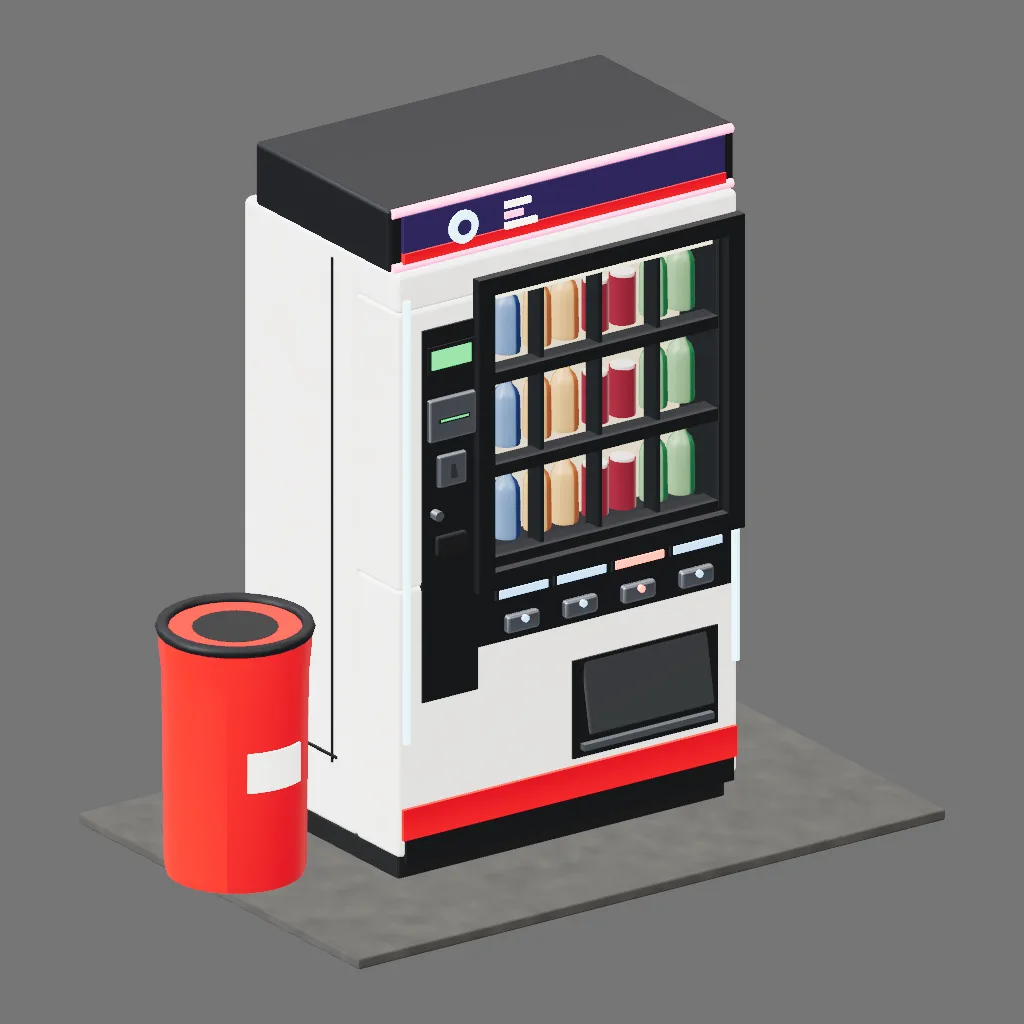
Drag to orbit after opening. The model starts stationary.
For your engine. The download is a standard glTF 2.0 binary (GLB) with PBR metallic-roughness materials. Optional extensions declared by this file: KHR_materials_emissive_strength. Importer support varies; see the Blender and Unity guide. glTF stores materials, not lighting or tone mapping, so your engine decides how they read. This 3D view tone-maps with Review Neutral, the Khronos PBR Neutral construction with a smaller glare offset (0.015 instead of 0.04), at exposure 0.9. Its Tone mapping control also shows ACES and Linear, for comparison.
Build measurements
- Triangles
- 12,440
- Estimated draws
- 169
- Materials
- 22
- Textures
- 9
- Animation clips
- 0
- Bounds X × Y × Z
- 1.3 × 1.94 × 2 m
- Build warnings
- 0
Measurements come from this build.
Download this build
Runtime: 787,716 bytes. Original: 787,484 bytes.
These GLBs are build outputs of the MIT-licensed example source; no separate terms are stated for the builds.
Runtime provenance metadataSHA-256 download hashes
- Runtime GLB
- 018fce8d235ade5349a31960730b9566fe4c6279db8dfc07f97b76b05d9b8ce7
- Original GLB
- c36b14f96871efbda2fdec421a33fda23d0a7d6492551c12d9edbb2ef9207854
- Source
- 4ea4db40981f8021107381b739300b4d184d42664eb4c8cf2b7aae756c8f2599
The example source is part of the Kiln repository. Repository licence: MIT.
These GLBs are build outputs of the MIT-licensed example source; no separate terms are stated for the builds.
Recorded authorship
Claude Opus 5 through Claude Code
Source-header credit
- Source access
- Not recorded
- Inherited context
- Not independently recorded; source-header declarations only
- Starting example
- Not recorded
- Human input
- Header declares no hand-authored source; other intervention not recorded
- Authoring review
- Not recorded
Gallery GPU render of this exact source. Source, artifact, image hashes and camera settings are recorded alongside the poster; the artifact hash names the GLB bytes the image was rendered from, which the downloadable rebuild reproduces byte for byte only on the platform that recorded it.
Poster camera and render recordThe source behind this build
// A Japanese street vending machine, at night.
//
// Authored by: Claude Opus 5, via Claude Code. Every part below was written by
// the model itself, looking at its own renders through the Kiln tools and
// revising. Not a line of it is hand-authored.
//
// This is the EMISSIVE example, and the thing it exists to demonstrate is the
// rule that keeps catching people out:
//
//   EMISSIVE AREA IS THE ENEMY OF SHAPE.
//
// There is no global illumination here. An emissive surface does not light the
// room, it only makes its own pixels bright -- so a large panel at a high
// intensity does not read as "a glowing sign", it reads as a white rectangle
// with nothing in it, and anything standing in front of it is a black
// silhouette against a blown-out ground. The first pass of this file ran the
// display backlight at intensity 2.4 across 0.76 x 0.62 m and every bottle in
// the machine disappeared into it.
//
// So the emissive here is allocated the other way round:
//
//   large area, LOW intensity   the display backlight, which only has to be
//                               brighter than the cabinet around it
//   small area, HIGH intensity  the price tags, the button LEDs, the two neon
//                               tubes -- narrow enough that clipping to white
//                               is what you want, because that is what a real
//                               tube does to a camera
//
// and the contrast that sells all of it comes from the DARK: near-black bezel,
// near-black mullions between the columns, a black delivery port. Put a bright
// thing next to a black thing and the bright thing glows. Put it next to
// another bright thing and you have a lightbox.
//
// The second rule this asset is built on is that the machine is a FACE. Every
// element is on a declared plane measured forward from the cabinet front, and
// the ones a customer touches -- buttons, coin slot, the flap -- stand proud of
// the ones they only look at. A vending machine modelled flat looks like a
// poster of a vending machine.
//
// Known limit: no text anywhere. proceduralTexture has no text op, so the
// price tags are colour fields, the brand banner is a stripe, and the hot/cold
// labels are the red and blue bands they sit on rather than the words. At asset
// scale that reads correctly -- Japanese machines really do code hot and cold
// by colour first -- but it would not survive a close-up.
const meta = { name: 'VendingMachine', category: 'prop', role: 'poi' };

async function build() {
  const root = createRoot('VendingMachine');
  const uv = (g) => autoUnwrap(g, { resolution: 1024 });

  // ---------- Plan ----------
  const HZ = 0.55; // half width, across Z
  const CAB_Y0 = 0.10; // top of the plinth
  const CAB_Y1 = 1.76; // top of the cabinet
  const CROWN_Y = 1.94; // top of the illuminated banner

  // Depth planes, forward from the machine's back. Every part states which one
  // it lives on, so nothing is coplanar by accident and the fascia has real
  // relief instead of decals.
  const P = {
    NEON: 0.400,
    BUTTON: 0.386,
    BEZEL: 0.374,
    FASCIA: 0.360, // the cabinet's own front face
    TAG: 0.350,
    GLASS: 0.344,
    SHELF: 0.260,
    CANS: 0.245,
    BACKLIGHT: 0.172,
    WELL_BACK: 0.160, // front face of the carcass = back wall of the display
    BACK: -0.360,
  };

  // The well is 0.20 m deep, and that number is load-bearing. Cutting the
  // opening at the previous 0.32 m turned the display into a cave: the mullions
  // and shelves stood far enough forward to occlude the lit panel from any
  // angle but dead-on, so the machine went straight from a white lightbox to a
  // black hole without ever passing through "shop window". A real display is a
  // shallow diorama -- the dummy products sit about 10 cm behind the glass and
  // about 6 cm in front of the light, and that is the whole trick.

  // The display: four columns, three shelves, and all four of them stocked.
  // Column 2 was an unlit sold-out column for a while, on the theory that one
  // dead cell stops a 4 x 3 grid reading as a texture. It does, but not the way
  // it was supposed to: everything in that column -- the dim panel, the bezel
  // shelves, the rails -- is near-black, so instead of an empty rack behind a
  // switched-off light it came out as a solid black rectangle with no shape in
  // it at all, and against three lit columns that reads as a hole in the model
  // rather than as a sold-out slot. The asymmetry that actually works is the one
  // that is still here: cans in column 1, bottles in the other three.
  const COL_Z = [-0.400, -0.212, -0.024, 0.164];
  const COL_W = 0.176;
  const SHELF_Y = [0.885, 1.148, 1.411];
  const DISP_Z0 = -0.500;
  const DISP_Z1 = 0.256;
  const DISP_Y0 = 0.860;
  const DISP_Y1 = 1.650;

  // ---------- Materials ----------
  // Cabinet enamel. Painted sheet steel: dielectric, and slightly off-white,
  // because a pure white body under a warm sign turns grey in the shadows and
  // reads as plastic.
  const shellAlbedo = proceduralTexture({
    schemaVersion: 2, size: 1024, usage: 'albedo', name: 'Shell',
    layers: [
      { op: 'solid', color: 0xd8d5cd },
      { op: 'gradient', from: 0xe6e3db, to: 0x9d9a94, angleDeg: 90, blend: 'overlay', opacity: 0.50 },
      // Vertical brushing plus grime that only reaches up the lower panels --
      // a machine on a street is filthy at ankle height and clean at eye level.
      { op: 'stripes', colorA: 0xd8d5cd, colorB: 0xcbc8c0, count: 90, angleDeg: 90, blend: 'overlay', opacity: 0.22 },
      { op: 'noise', colorA: 0x8e8b83, colorB: 0xd8d5cd, scale: 22, octaves: 4, seed: 5, blend: 'multiply', opacity: 0.16 },
    ],
  });
  const shell = pbrMaterial({
    albedo: shellAlbedo,
    normal: normalMapFromHeight(shellAlbedo, { strength: 0.55 }),
    roughness: 0.44, metalness: 0.18,
  });

  // The red band. Same paint, different colour, and still dielectric.
  const bandAlbedo = proceduralTexture({
    schemaVersion: 2, size: 512, usage: 'albedo', name: 'Band',
    layers: [
      { op: 'solid', color: 0xb01f26 },
      { op: 'gradient', from: 0xd0272f, to: 0x87161c, angleDeg: 90, blend: 'overlay', opacity: 0.55 },
      { op: 'noise', colorA: 0x9a1a20, colorB: 0xc0232b, scale: 60, octaves: 3, seed: 23, blend: 'overlay', opacity: 0.18 },
    ],
  });
  const band = pbrMaterial({
    albedo: bandAlbedo,
    normal: normalMapFromHeight(bandAlbedo, { strength: 0.4 }),
    roughness: 0.38, metalness: 0.10,
  });

  // The dark. This material is doing more work than any of the emissives: it is
  // the ground everything bright is measured against.
  const bezel = gameMaterial(0x18191c, { roughness: 0.52, metalness: 0.30 });
  const black = gameMaterial(0x0d0e10, { roughness: 0.70, metalness: 0.05 });
  const steel = gameMaterial(0x767b82, { roughness: 0.36, metalness: 0.92 });
  const rubber = gameMaterial(0x232527, { roughness: 0.90, metalness: 0.0 });

  const glass = glassMaterial(0x0e1a22, { opacity: 0.22, roughness: 0.03, metalness: 0.0 });

  // Large area, LOW intensity. This panel is 0.76 x 0.68 m; at anything above
  // about 1.0 it stops being a backlight and becomes a hole in the machine.
  // Note the albedo: a near-WHITE albedo under an emissive is what actually
  // clips. Lit surface plus emitted light both land in the same pixel, so a
  // panel painted 0xfff3dc is already most of the way to 1.0 before the
  // emissive is added. Paint it mid-grey and let the emission do the work.
  // ...and then measured, which moved it the other way again. Once the shelves
  // are stocked, the panel is not a 0.76 x 0.68 m emitter at all: the products
  // cover most of it and what actually reaches the camera is a set of slivers
  // between bottles. Small visible area, so it wants a HIGH intensity, by the
  // same rule that keeps the neon at 3.6. The area that matters is the area you
  // can see, not the area you built.
  const backlight = gameMaterial(0x9a9284, {
    emissive: 0xffe6b4, emissiveIntensity: 2.30, roughness: 0.60,
  });
  // Small area, HIGH intensity. These are allowed to clip -- a fluorescent tube
  // photographed at night is clipped, and refusing to let it clip is what makes
  // CG neon look like painted plastic.
  const neonPink = gameMaterial(0xff9ecb, {
    emissive: 0xff2f8e, emissiveIntensity: 3.6, roughness: 0.25,
  });
  const neonCyan = gameMaterial(0xa8f0ff, {
    emissive: 0x1fd4ff, emissiveIntensity: 3.2, roughness: 0.25,
  });
  const hotTag = gameMaterial(0xff8a80, {
    emissive: 0xe8231a, emissiveIntensity: 2.4, roughness: 0.35,
  });
  const coldTag = gameMaterial(0x8ec5ff, {
    emissive: 0x1f6fe0, emissiveIntensity: 2.4, roughness: 0.35,
  });
  const signFace = gameMaterial(0xfff6e4, {
    emissive: 0xffe6b0, emissiveIntensity: 1.15, roughness: 0.55,
  });
  const signGround = gameMaterial(0x1a1430, {
    emissive: 0x241c46, emissiveIntensity: 0.55, roughness: 0.55,
  });
  const binLabel = gameMaterial(0xe8e4dc, { roughness: 0.70 });
  const readout = gameMaterial(0x143c22, {
    emissive: 0x35ff86, emissiveIntensity: 2.0, roughness: 0.30,
  });

  // Drinks. Four columns, four different products, and the labels are stripes
  // and gradients rather than artwork -- see the known limit in the header.
  //
  // All four are DIELECTRIC, the printed can included. A can is aluminium, but
  // what a customer sees is the printing on it, and print is a coating over the
  // metal -- only the bare lid is exposed aluminium, and that is what capMat is
  // for. Modelling the whole can as metal at 0.78 is what made it disappear:
  // a metal has no diffuse term, so its entire appearance is a specular
  // reflection tinted by its albedo, and a near-black albedo under a neutral
  // studio dome returns almost nothing. The cans rendered as black rectangles
  // and their column read as empty stock.
  //
  // They still must not be PALE. Everything in the display stands in front of a
  // lit panel, and a pale product against a backlight is the one thing
  // guaranteed to vanish. Mid-tone and saturated is the window that works.
  const drink = (base, top, metal, rough = 0.34) => pbrMaterial({
    albedo: proceduralTexture({
      schemaVersion: 2, size: 256, usage: 'albedo', name: `Drink${base.toString(16)}`,
      layers: [
        { op: 'solid', color: base },
        { op: 'stripes', colorA: base, colorB: top, count: 3, angleDeg: 0, blend: 'normal', opacity: 0.55 },
      ],
    }),
    roughness: rough, metalness: metal,
  });
  const drinks = [
    drink(0x1c6b39, 0xcfc7a4, 0.0),        // PET, deep green
    drink(0x8f2733, 0xe4d9c6, 0.12, 0.27), // printed can, cola red over foil
    drink(0xa8541c, 0xf0dcae, 0.0),        // PET, amber
    drink(0x123566, 0xb9cee8, 0.0),        // PET, deep blue
  ];
  const capMat = gameMaterial(0xd9d4c8, { roughness: 0.35, metalness: 0.15 });

  const concrete = pbrMaterial({
    albedo: proceduralTexture({
      schemaVersion: 2, size: 512, usage: 'albedo', name: 'Concrete',
      layers: [
        { op: 'solid', color: 0x4c4b48 },
        { op: 'noise', colorA: 0x3a3937, colorB: 0x5e5d59, scale: 40, octaves: 5, seed: 31, blend: 'overlay', opacity: 0.7 },
      ],
    }),
    roughness: 0.92, metalness: 0.0,
  });

  const box = async (name, w, h, d, position, mat, opts = {}) =>
    createPart(name, await uv(await roundedBoxGeo(w, h, d, opts.r ?? 0.006), opts.res ?? 512), mat, {
      position, rotation: opts.rotation, parent: opts.parent ?? root,
    });
  const slab = (name, w, h, d, position, mat, rotation) =>
    createPart(name, boxGeo(w, h, d), mat, { position, rotation, parent: root });

  // ---------- Ground ----------
  // A machine with nothing under it floats. The pad also gives the neon
  // something to sit against in the bottom of the frame.
  await box('Pad', 1.30, 0.030, 1.90, [0.10, 0.015, 0], concrete, { r: 0.006, res: 512 });

  // ---------- Cabinet ----------
  await box('Plinth', 0.66, CAB_Y0, 1.06, [0, CAB_Y0 / 2, 0], black, { r: 0.010 });
  // The cabinet is a CARCASS plus a fascia with a hole in it, not one solid
  // box. The first pass built it as one box from x = -0.36 to +0.36 and then
  // placed the backlight, the shelves, the mullions and every bottle at x
  // between 0.05 and 0.25 -- which is to say, sealed inside it. The render
  // showed a clean white rectangle where the display should be and it took a
  // zoom to work out that the white rectangle was the cabinet's own front
  // panel, with the entire display standing behind it. Nothing was wrong with
  // the emissive at all.
  //
  // A machine with a window in it needs the window to be an absence.
  const CARCASS_X = P.WELL_BACK;
  await box('Carcass', 0.36 + CARCASS_X, CAB_Y1 - CAB_Y0, 1.10,
    [(CARCASS_X - 0.36) / 2, (CAB_Y0 + CAB_Y1) / 2, 0], shell, { r: 0.018, res: 1024 });
  {
    // Fascia, in four pieces around the opening. Depth runs from the carcass
    // face to the machine's front, so the display well is a genuine 0.32 m deep
    // recess and the products sit inside it rather than on it.
    const fx = (CARCASS_X + P.FASCIA) / 2;
    const fd = P.FASCIA - CARCASS_X;
    await box('FasciaTop', fd, CAB_Y1 - DISP_Y1, 1.10,
      [fx, (DISP_Y1 + CAB_Y1) / 2, 0], shell, { r: 0.014, res: 1024 });
    await box('FasciaBottom', fd, DISP_Y0 - CAB_Y0, 1.10,
      [fx, (CAB_Y0 + DISP_Y0) / 2, 0], shell, { r: 0.014, res: 1024 });
    await box('FasciaLeft', fd, DISP_Y1 - DISP_Y0, DISP_Z0 + HZ,
      [fx, (DISP_Y0 + DISP_Y1) / 2, (-HZ + DISP_Z0) / 2], shell, { r: 0.012, res: 512 });
    await box('FasciaRight', fd, DISP_Y1 - DISP_Y0, HZ - DISP_Z1,
      [fx, (DISP_Y0 + DISP_Y1) / 2, (DISP_Z1 + HZ) / 2], shell, { r: 0.012, res: 512 });
  }
  // Levelling feet, visible under the plinth's inset.
  for (const sx of [-1, 1]) {
    for (const sz of [-1, 1]) {
      createPart(`Foot_${sx}${sz}`, cylinderGeo(0.026, 0.026, 0.034, 10), steel,
        { position: [sx * 0.28, 0.020, sz * 0.46], parent: root });
    }
  }
  // Side vents and the compressor grille, on the machine's left flank.
  for (let i = 0; i < 9; i++) {
    slab(`Vent_${i}`, 0.30, 0.010, 0.006, [-0.10, 0.34 + i * 0.026, -HZ - 0.001], bezel);
  }
  // Panel seams on the flanks. A 1.9 m sheet-steel side with no joint in it
  // reads as a solid block of plastic.
  for (const sz of [-1, 1]) {
    slab(`FlankSeam_${sz > 0 ? 'R' : 'L'}`, 0.006, 1.44, 0.008, [0.058, 1.00, sz * (HZ + 0.002)], bezel);
    slab(`FlankSeamH_${sz > 0 ? 'R' : 'L'}`, 0.40, 0.008, 0.008, [-0.12, 0.300, sz * (HZ + 0.002)], bezel);
  }
  slab('BackPanel', 0.008, CAB_Y1 - CAB_Y0 - 0.10, 1.02, [P.BACK - 0.004, 0.94, 0], bezel);
  // The back is where the refrigeration lives, and it was one black rectangle.
  // A sixth view that is a solid field of one colour reads as an unfinished
  // model even when nothing is actually missing.
  {
    const bx = P.BACK - 0.012;
    createPart('CondenserRing', torusGeo(0.150, 0.016, 8, 28), steel,
      { position: [bx, 0.520, -0.230], rotation: [0, 90, 0], parent: root });
    createPart('CondenserHub', cylinderXGeo(0.048, 0.048, 0.030, 16), bezel,
      { position: [bx - 0.008, 0.520, -0.230], parent: root });
    for (let i = 0; i < 4; i++) {
      slab(`CondenserGuard_${i}`, 0.006, 0.290, 0.010,
        [bx - 0.014, 0.520, -0.230 + (i - 1.5) * 0.075], steel);
    }
    for (let i = 0; i < 11; i++) {
      slab(`Louvre_${i}`, 0.012, 0.014, 0.420,
        [bx - 0.004, 0.320 + i * 0.030, 0.190], bezel);
    }
    slab('DataPlate', 0.006, 0.130, 0.180, [bx - 0.006, 1.320, 0.140], steel);
    slab('CompressorBox', 0.070, 0.240, 0.300, [P.BACK + 0.040, 0.230, 0.150], bezel);
    createPart('SuctionLine', cylinderGeo(0.014, 0.014, 0.330, 10), steel,
      { position: [P.BACK + 0.020, 0.480, 0.150], parent: root });
  }

  // ---------- Crown ----------
  // The illuminated banner. Bright, but only 0.18 m tall: the whole point of
  // putting the biggest emissive at the TOP of a tall object is that it lights
  // the frame rather than competing with the product display.
  await box('CrownBody', 0.62, CROWN_Y - CAB_Y1, 1.12,
    [0.02, (CAB_Y1 + CROWN_Y) / 2, 0], bezel, { r: 0.012 });
  // 0.336, not 0.318: the crown body's front face is at 0.330, so the first
  // placement put the entire illuminated banner INSIDE the box it lights.
  {
    // The sign is the machine's face and it was a blank white plank. A lit sign
    // is a DARK ground with a small bright mark on it -- that is what makes it
    // read as illuminated rather than as a sheet of paper, and it is the same
    // trade as the neon: contrast comes from the surround, not the intensity.
    const cy = (CAB_Y1 + CROWN_Y) / 2;
    slab('CrownFace', 0.014, 0.136, 1.04, [0.336, cy, 0], signGround);
    createPart('CrownMark', cylinderXGeo(0.046, 0.046, 0.008, 24), neonCyan,
      { position: [0.347, cy, 0.330], parent: root });
    createPart('CrownMarkCore', cylinderXGeo(0.022, 0.022, 0.010, 20), signGround,
      { position: [0.349, cy, 0.330], parent: root });
    const bar = [0.084, 0.060, 0.104];
    for (let i = 0; i < bar.length; i++) {
      slab(`CrownBar_${i}`, 0.008, 0.018, bar[i],
        [0.345, cy + 0.030 - i * 0.030, 0.196 - bar[i] / 2], i === 1 ? neonPink : signFace);
    }
  }
  slab('CrownStripe', 0.016, 0.030, 1.04, [0.340, CAB_Y1 + 0.038, 0], band);
  // Two tubes framing the banner. Narrow and hot, which is the whole recipe.
  for (const ny of [CAB_Y1 + 0.012, CROWN_Y - 0.012]) {
    createPart(`NeonTop_${ny.toFixed(3)}`, cylinderZGeo(0.013, 0.013, 1.10, 12), neonPink,
      { position: [0.330, ny, 0], parent: root });
  }
  // Vertical tubes down both edges of the fascia. Cyan against the pink reads
  // as two separate light sources rather than one wash.
  for (const sz of [-1, 1]) {
    createPart(`NeonSide_${sz > 0 ? 'R' : 'L'}`, cylinderGeo(0.011, 0.011, 1.26, 12), neonCyan,
      { position: [P.NEON - 0.026, 1.06, sz * (HZ - 0.018)], parent: root });
  }

  // ---------- Display ----------
  const dispW = DISP_Z1 - DISP_Z0;
  const dispH = DISP_Y1 - DISP_Y0;
  const dispCz = (DISP_Z0 + DISP_Z1) / 2;
  const dispCy = (DISP_Y0 + DISP_Y1) / 2;
  // Recessed well. The interior is lined black so the only bright things inside
  // are the backlight panel and the products it is behind.
  const wellD = P.FASCIA - P.WELL_BACK;
  const wellX = (P.WELL_BACK + P.FASCIA) / 2;
  slab('WellTop', wellD, 0.012, dispW, [wellX, DISP_Y1 - 0.006, dispCz], black);
  slab('WellBot', wellD, 0.012, dispW, [wellX, DISP_Y0 + 0.006, dispCz], black);
  for (const sz of [-1, 1]) {
    slab(`WellSide_${sz > 0 ? 'R' : 'L'}`, wellD, dispH, 0.012,
      [wellX, dispCy, dispCz + sz * (dispW / 2 - 0.006)], black);
  }
  slab('Backlight', 0.010, dispH - 0.02, dispW - 0.02, [P.BACKLIGHT, dispCy, dispCz], backlight);

  // Shelves and mullions. The mullions matter more than they look: without a
  // dark divider between columns the four products merge into one bright band.
  // Shelves 65 mm deep with a lit front rail, not 150 mm deep plain plates.
  // Depth was the whole problem: at the hero elevation a 150 mm shelf hides
  // 73 mm of the cell below it, and the gap above a 204 mm bottle in a 263 mm
  // cell is 59 mm -- so the backlight was occluded by the shelf, not by the
  // products, and no amount of emissive intensity was going to reach the
  // camera. The rail is the second half of the fix and the more honest one:
  // a chiller lights its shelf fronts, and a light at the front of the well
  // cannot be occluded by anything in the well.
  for (const sy of SHELF_Y) {
    const k = sy.toFixed(3);
    slab(`Shelf_${k}`, 0.065, 0.010, dispW - 0.03, [0.328, sy, dispCz], bezel);
    slab(`ShelfRail_${k}`, 0.014, 0.026, dispW - 0.03, [0.353, sy - 0.017, dispCz], bezel);
    slab(`ShelfLed_${k}`, 0.010, 0.009, dispW - 0.06, [0.350, sy - 0.006, dispCz], backlight);
  }
  slab('CanopyLed', 0.010, 0.009, dispW - 0.06, [0.350, DISP_Y1 - 0.022, dispCz], backlight);
  for (let i = 0; i <= COL_Z.length; i++) {
    const z = i < COL_Z.length
      ? COL_Z[i] - COL_W / 2 - 0.006
      : COL_Z[COL_Z.length - 1] + COL_W / 2 + 0.006;
    // 60 mm deep, at the glass. The previous 160 mm ran the full depth of the
    // well, and at a 3/4 view a divider that deep occludes 112 mm of a 176 mm
    // cell -- so the lit panel behind was geometrically unreachable from any
    // angle a hero shot is taken at. A divider only has to divide at the front.
    slab(`Mullion_${i}`, 0.060, dispH - 0.02, 0.012, [0.310, dispCy, z], black);
  }

  // Product columns. 0.186 m to the neck, 0.204 to the top of the cap, in a
  // 0.222 m cell. The
  // first sizing ran 0.236 and every bottle grew through the shelf above it.
  const bottleGeo = await uv(await revolveProfile([
    [0.000, 0.000], [0.037, 0.000], [0.039, 0.014], [0.038, 0.104],
    [0.037, 0.134], [0.031, 0.152], [0.016, 0.170], [0.014, 0.186], [0.000, 0.186],
  ], { segments: 20, axis: 'y', smooth: true }));
  for (let c = 0; c < COL_Z.length; c++) {
    const z = COL_Z[c];
    const mat = drinks[c];
    for (let s = 0; s < SHELF_Y.length; s++) {
      const y = SHELF_Y[s] + 0.005;
      for (const dz of [-0.044, 0.044]) {
        const nm = `Prod_${c}_${s}_${dz > 0 ? 'a' : 'b'}`;
        if (c === 1) {
          // Cans in column 1, bottles elsewhere. Two silhouettes rather than
          // one is most of what keeps the display from reading as wallpaper.
          createPart(nm, cylinderGeo(0.037, 0.037, 0.136, 18), mat,
            { position: [P.CANS, y + 0.068, z + dz], parent: root });
          createPart(`${nm}_Lid`, cylinderGeo(0.033, 0.033, 0.009, 18), capMat,
            { position: [P.CANS, y + 0.139, z + dz], parent: root });
        } else {
          createPart(nm, bottleGeo, mat, { position: [P.CANS, y, z + dz], parent: root });
          createPart(`${nm}_Cap`, cylinderGeo(0.016, 0.016, 0.018, 12), capMat,
            { position: [P.CANS, y + 0.194, z + dz], parent: root });
        }
      }
    }
  }

  // Glazing, then the bezel that frames it. The frame is proud of the glass by
  // 30 mm, which is what puts the display INTO the machine.
  slab('Glass', 0.008, dispH - 0.006, dispW - 0.006, [P.GLASS, dispCy, dispCz], glass);
  const frameT = 0.052;
  slab('BezelTop', 0.030, frameT, dispW + frameT * 2, [P.BEZEL, DISP_Y1 + frameT / 2, dispCz], bezel);
  slab('BezelBot', 0.030, frameT, dispW + frameT * 2, [P.BEZEL, DISP_Y0 - frameT / 2, dispCz], bezel);
  for (const sz of [-1, 1]) {
    slab(`BezelSide_${sz > 0 ? 'R' : 'L'}`, 0.030, dispH, frameT,
      [P.BEZEL, dispCy, dispCz + sz * (dispW / 2 + frameT / 2)], bezel);
  }

  // ---------- Selection row ----------
  // Under each column: a price tag on its hot/cold band, and the button. The
  // tags are the second-brightest thing on the machine and they are 20 mm tall,
  // which is exactly the trade the header describes.
  const TAG_Y = 0.792;
  const BTN_Y = 0.700;
  slab('SelectionPanel', 0.020, 0.180, DISP_Z1 - DISP_Z0 + 0.104,
    [P.FASCIA - 0.004, 0.738, dispCz], bezel);
  for (let c = 0; c < COL_Z.length; c++) {
    const z = COL_Z[c];
    const tag = c === 1 ? hotTag : coldTag;
    slab(`Tag_${c}`, 0.008, 0.022, COL_W - 0.020, [P.TAG + 0.036, TAG_Y, z], tag);
    slab(`TagWell_${c}`, 0.010, 0.034, COL_W - 0.006, [P.TAG + 0.030, TAG_Y, z], black);
    await box(`Button_${c}`, 0.024, 0.050, 0.104, [P.BUTTON - 0.006, BTN_Y, z],
      steel, { r: 0.008, res: 256 });
    createPart(`ButtonLamp_${c}`, cylinderXGeo(0.010, 0.010, 0.014, 12), tag,
      { position: [P.BUTTON + 0.008, BTN_Y + 0.012, z], parent: root });
  }

  // ---------- Money column ----------
  const MZ = 0.386;
  slab('MoneyPanel', 0.018, 1.06, 0.180, [P.FASCIA - 0.002, 1.06, MZ], bezel);
  slab('Readout', 0.008, 0.052, 0.126, [P.FASCIA + 0.010, 1.500, MZ], readout);
  slab('ReadoutWell', 0.012, 0.076, 0.150, [P.FASCIA + 0.004, 1.500, MZ], black);
  // Note acceptor: a slot with a lit throat, which is the detail that makes it
  // read as a mechanism rather than a printed rectangle.
  await box('NoteBezel', 0.026, 0.120, 0.150, [P.FASCIA + 0.008, 1.330, MZ], steel, { r: 0.006, res: 256 });
  slab('NoteSlot', 0.010, 0.014, 0.098, [P.FASCIA + 0.022, 1.330, MZ], black);
  slab('NoteLamp', 0.006, 0.006, 0.090, [P.FASCIA + 0.024, 1.330, MZ], readout);
  // Coin slot, angled the way a real one is so a coin can fall into it.
  await box('CoinBezel', 0.024, 0.090, 0.090, [P.FASCIA + 0.008, 1.180, MZ], steel, { r: 0.006, res: 256 });
  slab('CoinSlot', 0.014, 0.044, 0.014, [P.FASCIA + 0.018, 1.180, MZ], black, [0, 0, 18]);
  // Coin return and its cup.
  createPart('ReturnLever', cylinderXGeo(0.014, 0.014, 0.030, 12), steel,
    { position: [P.FASCIA + 0.018, 1.062, MZ + 0.052], parent: root });
  await box('CoinCup', 0.034, 0.056, 0.098, [P.FASCIA + 0.002, 0.968, MZ], black, { r: 0.008, res: 256 });

  // ---------- Delivery port ----------
  // The bottom-left flap. It is black, deep, and hinged slightly open, because
  // a closed flush flap on a flat panel is invisible and this is the one part of
  // the machine a person actually reaches into.
  const PORT_Z = -0.246;
  slab('PortSurround', 0.020, 0.280, 0.470, [P.FASCIA - 0.004, 0.400, PORT_Z], bezel);
  slab('PortVoid', 0.070, 0.226, 0.412, [P.FASCIA - 0.030, 0.396, PORT_Z], black);
  // Hinged a few degrees open. A flush flap on a flat panel is invisible, and
  // this is the one part of the machine a person actually puts a hand into.
  await box('PortFlap', 0.016, 0.212, 0.400, [P.FASCIA + 0.016, 0.436, PORT_Z], rubber,
    { r: 0.006, rotation: [0, 0, 11], res: 512 });
  slab('PortLip', 0.030, 0.018, 0.420, [P.FASCIA + 0.010, 0.292, PORT_Z], steel);
  // Lower fascia, and the red band that carries the machine's colour down to
  // the ground so the bottom half is not a blank white slab.
  slab('LowerBand', 0.012, 0.088, 1.08, [P.FASCIA + 0.006, 0.196, 0], band);
  slab('KickPlate', 0.014, 0.084, 1.06, [P.FASCIA + 0.004, 0.128, 0], bezel);

  // ---------- Recycling bin ----------
  // Every one of these machines on every street in Japan has a bin bolted to
  // its flank. It is here for scale as much as for company: a 1.9 m cabinet
  // photographed alone could be any size at all.
  const binZ = HZ + 0.29;
  createPart('Bin', await uv(await revolveProfile([
    [0.000, 0.000], [0.185, 0.000], [0.190, 0.030], [0.196, 0.560],
    [0.204, 0.640], [0.204, 0.690], [0.176, 0.690], [0.000, 0.690],
  ], { segments: 26, axis: 'y', smooth: true })), band, { position: [0.02, 0.03, binZ], parent: root });
  createPart('BinRim', torusGeo(0.196, 0.018, 8, 26), bezel,
    { position: [0.02, 0.722, binZ], rotation: [90, 0, 0], parent: root });
  createPart('BinHole', cylinderGeo(0.116, 0.116, 0.030, 20), black,
    { position: [0.02, 0.706, binZ], parent: root });
  // The sorting label, and it cannot be a slab. A flat plate 0.24 m across a
  // 0.39 m drum only touches it along one line: the middle sinks in and the two
  // ends stand 40 mm proud of the curve, which from the front reads as a white
  // wing sticking out of the bin. A label on a round bin is a curved plate, so
  // this is an annular sector -- the same wedge trick the well's curb stones
  // use -- swept up through the label's height and sitting 6 mm proud all the
  // way round.
  const labelArc = (r, t) => [r * Math.cos(t), r * Math.sin(t)];
  const LABEL_HALF = 0.44;
  const labelProfile = [];
  for (let i = 0; i <= 6; i++) {
    labelProfile.push(labelArc(0.1925, -LABEL_HALF + (i / 6) * 2 * LABEL_HALF));
  }
  for (let i = 6; i >= 0; i--) {
    labelProfile.push(labelArc(0.2005, -LABEL_HALF + (i / 6) * 2 * LABEL_HALF));
  }
  createPart(
    'BinLabel',
    await extrudeProfile(labelProfile, { depth: 0.110, axis: 'y' }),
    binLabel,
    { position: [0.02, 0.375, binZ], parent: root },
  );
  // The bracket that actually holds it to the machine. Short, dark and tucked
  // behind the bin's shoulder -- the first version was a pale slab long enough
  // to pass straight through the bin and out the far side.
  slab('BinBracket', 0.050, 0.026, 0.130, [-0.10, 0.585, HZ + 0.10], bezel);
  slab('BinBracketPad', 0.016, 0.070, 0.020, [-0.10, 0.585, HZ + 0.028], bezel);

  return root;
}Scroll code horizontally
Brief and retained revisions
No brief or earlier revisions are recorded. The source download contains the version built for this page.