Robot arm
Animated chain of articulated joints
Earlier examples from earlier Kiln versions.
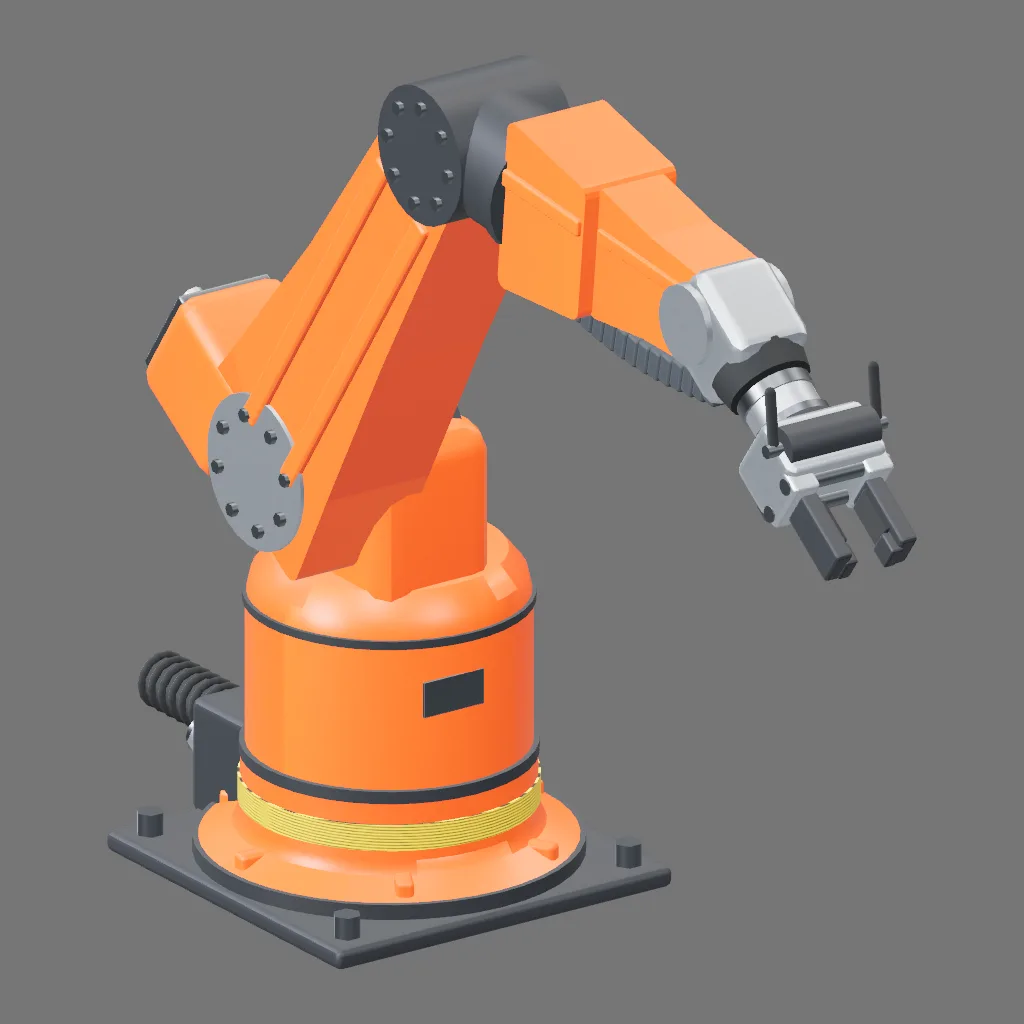
Drag to orbit after opening. The model starts stationary.
For your engine. The download is a standard glTF 2.0 binary (GLB) with PBR metallic-roughness materials. Optional extensions declared by this file: KHR_materials_emissive_strength. Importer support varies; see the Blender and Unity guide. glTF stores materials, not lighting or tone mapping, so your engine decides how they read. This 3D view tone-maps with Review Neutral, the Khronos PBR Neutral construction with a smaller glare offset (0.015 instead of 0.04), at exposure 0.9. Its Tone mapping control also shows ACES and Linear, for comparison.
Build measurements
- Triangles
- 15,176
- Estimated draws
- 140
- Materials
- 8
- Textures
- 5
- Animation clips
- 1
- Bounds X × Y × Z
- 1.93 × 1.33 × 0.56 m
- Build warnings
- 0
Measurements come from this build.
Download this build
Runtime: 1,228,624 bytes. Original: 1,228,400 bytes.
These GLBs are build outputs of the MIT-licensed example source; no separate terms are stated for the builds.
Runtime provenance metadataSHA-256 download hashes
- Runtime GLB
- 3fdd53f7e80dd14819977635c90f408a7b108446802260a17a3bcbab5b760762
- Original GLB
- 03dd7027d99935da2f2480ea99f71ef54ea59453f58034fe0b9d4db2ecb2149d
- Source
- a09a2ba7cd96a937e092028162d49dbbf76330b94023b11bb0b15ce3d7f4ac31
The example source is part of the Kiln repository. Repository licence: MIT.
These GLBs are build outputs of the MIT-licensed example source; no separate terms are stated for the builds.
Recorded authorship
Claude Opus 5 through Claude Code
Source-header credit
- Source access
- Not recorded
- Inherited context
- Not independently recorded; source-header declarations only
- Starting example
- Not recorded
- Human input
- Header declares no hand-authored source; other intervention not recorded
- Authoring review
- Not recorded
Gallery GPU render of this exact source. Source, artifact, image hashes and camera settings are recorded alongside the poster; the artifact hash names the GLB bytes the image was rendered from, which the downloadable rebuild reproduces byte for byte only on the platform that recorded it.
Poster camera and render recordThe source behind this build
// A six-axis industrial robot arm.
//
// Authored by: Claude Opus 5, via Claude Code. Every part below was written by
// the model itself, looking at its own renders through the Kiln tools and
// revising. Not a line of it is hand-authored.
//
// This is the ANIMATION example, and the reason it is an arm rather than
// something with one moving part is that a robot is the case where the rig is
// the asset. Six joints, each one hanging off the last, and the only thing the
// animation says is what angle each joint is at. Every position in the clip
// below falls out of that chain -- there is not one world-space coordinate in
// `animate()`, because there cannot be: the tool flange's position is whatever
// five joints upstream of it decided, and if a link length changes here the
// whole cycle still works.
//
// That is the difference between a rig and a set of moving parts. The beam
// engine this replaced solved its linkage numerically and then drove five parts
// with five separate answers; break one and the mechanism comes apart on
// screen. Here the parts cannot come apart, because none of them knows where it
// is.
//
// The chain, shoulder outward, is the standard 6R wrist-partitioned layout:
//
//   J1 waist    about Y   the whole robot swings
//   J2 shoulder about Z   upper arm pitches
//   J3 elbow    about Z   forearm pitches
//   J4 roll     about Y   forearm rotates about its own axis
//   J5 wrist    about Z   tool pitches
//   J6 flange   about Y   tool rotates about its own axis
//
// Axes alternate perpendicular / parallel in exactly that pattern on every
// articulated arm ever built, because it is what puts three axes through one
// point at the wrist and makes the inverse kinematics solvable in closed form.
// Nothing here solves IK, but getting the axis assignment right is what makes
// the motion read as a robot instead of as a puppet.
//
// Proportions are off a mid-size floor-standing arm in the 1.5 m / 20 kg class
// -- a Fanuc M-20 or an ABB IRB 1600. The tell on those is not the arm, it is
// the COUNTERWEIGHT: a mass hung behind the shoulder so J2 is not fighting the
// whole arm at every angle. Robots that do not have it look like toys, and the
// first pass of this file did not have it and did.
//
// Verified by walking the clip and reading the tool flange's world position
// rather than by looking at it, because "the arm reaches down" is exactly the
// kind of claim a 3/4 render will let you get away with being wrong about. It
// was: the first pass's pick pose put the flange at y = 1.231 against a home of
// y = 1.088, so the robot reached UP to pick and the six-frame filmstrip looked
// entirely convincing doing it. Corrected, the cycle now reads
//
//   home 1.088 -> pick 0.616 -> lift 1.214 -> traverse 1.251
//        -> place 0.661 -> withdraw 1.214 -> home 1.088
//
// and returns to (1.109, 1.088, 0.135) at t = DUR, bit for bit the pose it
// started in, so the clip loops without a jump. All 8 tracks bind.
//
// Known limit: the dress pack is rigid. On a real arm the cable loop between
// the base and the upper arm flexes through the whole cycle, and doing that
// properly needs the conduit re-solved per keyframe. Everything that moves here
// is parented to exactly one link, so the loop lives on the forearm where one
// link's motion carries it honestly, and the base cable stops at the turret.
const meta = { name: 'RobotArm', category: 'prop', role: 'hero' };

// Link geometry. `animate()` poses the same chain `build()` assembled, so the
// numbers that define it live at module scope rather than inside either one.
const PLINTH_Y = 0.178; // top of the cast pedestal, where J1 sits
const SHOULDER = [0, 0.455, 0.135]; // J2, relative to J1
const L_UPPER = 0.72; // J2 to J3
const L_FORE = 0.60; // J3 to J5
const L_WRIST = 0.135; // J5 to the tool flange
const JAW_OPEN = 0.062; // jaw centres, fully open
const JAW_SHUT = 0.031;
const JAW_Y = 0.150; // jaw centres above the flange face

// The pose the asset is stored in, and the pose the cycle starts and ends at.
// Reaching forward and slightly down, elbow well bent -- a robot parked at any
// angle looks broken, and a robot standing straight up looks like a lamp post.
const HOME = { j1: 0, j2: -34, j3: -62, j4: 0, j5: -30, j6: 0 };

async function build() {
  const root = createRoot('RobotArm');
  const uv = (g) => autoUnwrap(g, { resolution: 1024 });
  const RAD = Math.PI / 180;

  // ---------- Materials ----------
  // The body enamel. A painted machine is a DIELECTRIC with a clearcoat: the
  // gloss comes from low roughness, not from metalness. Run an orange body at
  // metalness 0.8 and it stops being orange and starts being a mirror that
  // happens to be tinted, which is how a robot ends up looking like a toy made
  // of foil. Metalness stays at zero and the paint stays paint.
  const enamelAlbedo = proceduralTexture({
    schemaVersion: 2, size: 1024, usage: 'albedo', name: 'Enamel',
    layers: [
      { op: 'solid', color: 0xc4550f },
      { op: 'gradient', from: 0xd66a1c, to: 0x97400b, angleDeg: 90, blend: 'overlay', opacity: 0.42 },
      // Orange peel. Real machine enamel is sprayed, not poured, and the very
      // fine texture is most of what stops a large flat casting reading as
      // plastic under a hard light.
      { op: 'noise', colorA: 0xb24c0e, colorB: 0xd2601a, scale: 220, octaves: 4, seed: 7, blend: 'overlay', opacity: 0.28 },
    ],
  });
  const enamel = pbrMaterial({
    albedo: enamelAlbedo,
    normal: normalMapFromHeight(enamelAlbedo, { strength: 0.35 }),
    roughness: 0.43, metalness: 0.0,
  });

  // Machined aluminium: the joint housings, bearing covers and the flange. This
  // one IS metal, and it is the contrast that tells the reader which parts are
  // structure and which are skin.
  const alloyAlbedo = proceduralTexture({
    schemaVersion: 2, size: 512, usage: 'albedo', name: 'Alloy',
    layers: [
      { op: 'solid', color: 0x9aa0a6 },
      { op: 'noise', colorA: 0x848a90, colorB: 0xb2b8be, scale: 130, octaves: 4, seed: 19, blend: 'overlay', opacity: 0.35 },
    ],
  });
  const alloy = pbrMaterial({
    albedo: alloyAlbedo,
    normal: normalMapFromHeight(alloyAlbedo, { strength: 1.1 }),
    roughness: 0.44, metalness: 0.88,
  });

  const steel = gameMaterial(0x6f757b, { roughness: 0.32, metalness: 0.95 });
  // Rubber boots and cable. Dielectric, and rough enough that it never picks up
  // a highlight -- black plastic that shines reads as wet.
  const rubber = gameMaterial(0x232527, { roughness: 0.88, metalness: 0.0 });
  const chainMat = gameMaterial(0x33383d, { roughness: 0.62, metalness: 0.0 });
  const darkTrim = gameMaterial(0x2c2f33, { roughness: 0.55, metalness: 0.1 });
  const beacon = gameMaterial(0xffbe4d, {
    emissive: 0xff9b1a, emissiveIntensity: 2.4, roughness: 0.35,
  });

  // Hazard banding on the pedestal skirt. Real cells put it exactly here, at
  // the height a person walks into.
  const hazard = pbrMaterial({
    albedo: proceduralTexture({
      schemaVersion: 2, size: 512, usage: 'albedo', name: 'Hazard',
      layers: [
        { op: 'solid', color: 0xf0c419 },
        { op: 'stripes', colorA: 0xf0c419, colorB: 0x1b1c1e, count: 22, angleDeg: 52 },
      ],
    }),
    roughness: 0.55, metalness: 0.0,
  });

  const box = async (name, w, h, d, position, mat, opts = {}) =>
    createPart(name, await uv(await roundedBoxGeo(w, h, d, opts.r ?? 0.008), opts.res ?? 512), mat, {
      position, rotation: opts.rotation, parent: opts.parent ?? root,
    });
  const plain = (name, geo, mat, position, parent, rotation) =>
    createPart(name, geo, mat, { position, rotation, parent });

  // A ring of fasteners round a bearing cover. Every joint on a real arm has
  // one, and their absence is the single loudest thing about an untextured
  // robot: the housings look moulded rather than bolted.
  const boltCircle = (name, count, radius, z, mat, parent, y = 0) => {
    for (let i = 0; i < count; i++) {
      const a = (i / count) * Math.PI * 2;
      plain(`${name}_${i}`, cylinderZGeo(0.010, 0.010, 0.012, 6), mat,
        [Math.cos(a) * radius, y + Math.sin(a) * radius, z], parent);
    }
  };

  // ---------- Base ----------
  // Anchor plate, pedestal casting and the connector box, all static.
  await box('AnchorPlate', 0.56, 0.030, 0.56, [0, 0.015, 0], darkTrim, { r: 0.010 });
  for (const sx of [-1, 1]) {
    for (const sz of [-1, 1]) {
      plain(`Anchor_${sx}${sz}`, cylinderGeo(0.020, 0.020, 0.048, 6), steel,
        [sx * 0.235, 0.038, sz * 0.235], root);
    }
  }
  // The base is a SQUAT DRUM, not a taper. The first pass revolved a smooth
  // cone from the anchor plate to the turret and the whole machine read as a
  // traffic cone with an arm on it. A real base is nearly cylindrical, sits on
  // a cast flange, and gets its shape from ribs rather than from draft.
  createPart('Pedestal', await uv(await revolveProfile([
    [0.000, 0.026], [0.266, 0.026], [0.266, 0.050], [0.216, 0.074],
    [0.206, 0.092], [0.204, 0.178], [0.000, 0.178],
  ], { segments: 44, axis: 'y', smooth: true })), enamel, { position: [0, 0, 0], parent: root });
  // Cast ribs round the flange. Six of them, which is what carries the moment
  // out to the anchor bolts and what stops the drum reading as a bucket.
  for (let i = 0; i < 6; i++) {
    const a = (i / 6) * Math.PI * 2 + Math.PI / 6;
    await box(`BaseRib_${i}`, 0.090, 0.052, 0.026,
      [Math.cos(a) * 0.208, 0.052, Math.sin(a) * 0.208], enamel,
      { r: 0.008, res: 256, rotation: [0, -(a * 180) / Math.PI, 0] });
  }
  // Black skirt at the parting line. Two-tone at the base is the cheapest
  // value break on the whole machine and the one a photograph always shows.
  plain('BaseSkirt', cylinderGeo(0.270, 0.270, 0.026, 44), darkTrim, [0, 0.039, 0], root);
  plain('HazardBand', cylinderGeo(0.208, 0.208, 0.038, 44), hazard, [0, 0.126, 0], root);
  // Controller umbilical: connector panel on the back with cable glands, and
  // the trunk cable running out of frame the way it does in a real cell.
  await box('ConnectorBox', 0.16, 0.17, 0.26, [-0.212, 0.104, 0], darkTrim, { r: 0.014 });
  await box('ConnectorFace', 0.020, 0.13, 0.21, [-0.296, 0.104, 0], steel, { r: 0.005 });
  for (const cz of [-0.072, 0, 0.072]) {
    plain(`Gland_${cz.toFixed(2)}`, cylinderXGeo(0.028, 0.028, 0.062, 12), steel,
      [-0.312, 0.104, cz], root);
    plain(`GlandNut_${cz.toFixed(2)}`, cylinderXGeo(0.034, 0.034, 0.018, 6), alloy,
      [-0.322, 0.104, cz], root);
  }
  plain('Umbilical', capsuleXGeo(0.034, 0.22, 10), rubber, [-0.430, 0.104, 0], root);
  // Corrugation on the trunk, so it reads as flexible conduit and not as pipe.
  for (let i = 0; i < 9; i++) {
    plain(`UmbRib_${i}`, torusGeo(0.036, 0.006, 6, 14), rubber,
      [-0.348 - i * 0.024, 0.104, 0], root, [0, 90, 0]);
  }

  // ---------- J1: waist ----------
  const waist = createPivot('Waist', [0, PLINTH_Y, 0], root);
  // A DRUM, not a cone. The first two passes revolved a continuous taper from
  // the anchor plate to the shoulder, and the whole lower half read as a
  // traffic cone: the eye sees one uninterrupted draft angle and stops
  // believing there is a rotating joint anywhere in it. A real J1 housing is
  // near-cylindrical and the shape comes from the STEP where it meets the base.
  createPart('Turret', await uv(await revolveProfile([
    [0.000, 0.000], [0.198, 0.000], [0.198, 0.226], [0.190, 0.262],
    [0.164, 0.294], [0.000, 0.300],
  ], { segments: 44, axis: 'y', smooth: true })), enamel, { position: [0, 0, 0], parent: waist });
  // The J1 gearbox seam. A turret with no visible joint line looks turned from
  // one billet; the seam is what says it rotates.
  plain('WaistSeam', cylinderGeo(0.206, 0.206, 0.018, 44), darkTrim, [0, 0.006, 0], waist);
  // Cable riser up the back of the turret. It stops at the turret because that
  // is the last link it can be rigidly parented to without lying about how a
  // dress pack behaves across a joint.
  plain('Riser', capsuleGeo(0.030, 0.20, 10), rubber, [-0.176, 0.150, -0.058], waist, [0, 0, -4]);
  for (let i = 0; i < 7; i++) {
    plain(`RiserRib_${i}`, torusGeo(0.032, 0.005, 6, 12), rubber,
      [-0.178 + i * 0.0022, 0.062 + i * 0.030, -0.058], waist, [90, 0, 4]);
  }
  await box('RiserClamp', 0.048, 0.030, 0.052, [-0.174, 0.258, -0.058], alloy,
    { r: 0.006, parent: waist, res: 256 });
  // Shoulder yoke: the casting that carries J2 up and out to one side. The
  // offset is the whole reason a robot can fold its arm past its own base.
  await box('Yoke', 0.30, 0.30, 0.20, [0, 0.360, 0.020], enamel,
    { r: 0.045, parent: waist, res: 1024 });
  plain('YokeBoss', cylinderZGeo(0.118, 0.118, 0.110, 28), darkTrim, [0, 0.455, 0.008], waist);
  boltCircle('YokeBolt', 8, 0.086, 0.066, steel, waist, 0.455);
  // The step where the housing narrows into its top cap. Without a crisp ring
  // here the drum blends into the yoke and the turret reads as one blob.
  plain('TurretStep', cylinderGeo(0.202, 0.202, 0.012, 44), darkTrim, [0, 0.228, 0], waist);
  // Maker's plate. Blank, because proceduralTexture has no text op -- but a
  // machine with nowhere for a serial number to live looks like a render.
  await box('NamePlate', 0.004, 0.052, 0.100, [0.196, 0.150, 0.030], steel,
    { r: 0.001, parent: waist, res: 128 });
  plain('Beacon', sphereGeo(0.040, 14, 8), beacon, [-0.086, 0.318, -0.076], waist);
  plain('BeaconBase', cylinderGeo(0.034, 0.040, 0.030, 12), darkTrim, [-0.086, 0.296, -0.076], waist);

  // ---------- J2: upper arm ----------
  const shoulder = createPivot('Shoulder', SHOULDER, waist);
  shoulder.rotation.z = HOME.j2 * RAD;
  // The casting, as a side silhouette extruded across. An arm modelled as a box
  // reads as scaffolding; what makes it read as a casting is that the section
  // narrows toward the joint it has less load at.
  createPart('UpperArm', await uv(await extrudeProfile([
    [-0.165, -0.070], [0.150, -0.070], [0.132, 0.100], [0.106, 0.380],
    [0.086, L_UPPER], [-0.086, L_UPPER], [-0.106, 0.380], [-0.140, 0.100],
  ], { depth: 0.170, axis: 'z', bevel: 0.016 })), enamel, { position: [0, 0, 0], parent: shoulder });
  // Ribs. Two raised strips down the outer face, which is what a real casting
  // uses instead of thickness.
  for (const sz of [-1, 1]) {
    for (const rx of [-0.054, 0.054]) {
      await box(`ArmRib_${sz}_${rx.toFixed(3)}`, 0.034, 0.58, 0.016, [rx, 0.340, sz * 0.086], enamel,
        { r: 0.007, parent: shoulder, res: 256 });
    }
  }
  plain('ShoulderCover', cylinderZGeo(0.112, 0.112, 0.182, 28), alloy, [0, 0, 0], shoulder);
  boltCircle('ShoulderBolt', 8, 0.082, 0.094, steel, shoulder);
  // The counterweight. Without it the arm is a lever with nothing on the short
  // end and the machine reads as underbuilt -- but hung off the casting as a
  // separate dark brick, as the first pass had it, it reads as luggage. It is
  // part of the SAME casting: enamel body continuous with the arm, and only the
  // machined ballast plates on the back face are a different material.
  await box('CounterHousing', 0.20, 0.185, 0.176, [-0.168, -0.030, 0], enamel,
    { r: 0.026, parent: shoulder, res: 512 });
  for (const px of [-0.252, -0.268]) {
    await box(`Ballast_${px.toFixed(3)}`, 0.016, 0.150, 0.150, [px, -0.030, 0], steel,
      { r: 0.004, parent: shoulder, res: 256 });
  }
  plain('CounterBolt', cylinderXGeo(0.016, 0.016, 0.070, 8), alloy, [-0.282, -0.030, 0], shoulder);

  // ---------- J3: elbow, and J4: forearm roll ----------
  const elbow = createPivot('Elbow', [0, L_UPPER, 0], shoulder);
  elbow.rotation.z = HOME.j3 * RAD;
  plain('ElbowCover', cylinderZGeo(0.100, 0.100, 0.192, 28), darkTrim, [0, 0, 0], elbow);
  boltCircle('ElbowBolt', 8, 0.072, 0.098, steel, elbow);

  const roll = createPivot('Roll', [0, 0, 0], elbow);
  // The J4 barrel. It is a plain cylinder on purpose: a rotating section reads
  // as rotating only if it is a surface of revolution about its own axis, and
  // any feature on it that is not would give the roll away as a cheat.
  plain('RollBarrel', cylinderGeo(0.092, 0.092, 0.180, 28), darkTrim, [0, 0.075, 0], roll);
  plain('RollCollar', cylinderGeo(0.100, 0.100, 0.022, 24), darkTrim, [0, 0.164, 0], roll);
  createPart('ForearmA', await uv(await extrudeProfile([
    [-0.128, 0.170], [0.128, 0.170], [0.116, 0.250], [0.100, 0.360],
    [-0.100, 0.360], [-0.116, 0.250],
  ], { depth: 0.152, axis: 'z', bevel: 0.014 })), enamel, { position: [0, 0, 0], parent: roll });
  createPart('ForearmB', await uv(await extrudeProfile([
    [-0.100, 0.352], [0.100, 0.352], [0.078, 0.480], [0.070, L_FORE],
    [-0.070, L_FORE], [-0.078, 0.480],
  ], { depth: 0.104, axis: 'z', bevel: 0.012 })), enamel, { position: [0, 0, 0], parent: roll });
  for (const sz of [-1, 1]) {
    await box(`ForeRib_${sz}`, 0.026, 0.185, 0.014, [-0.040, 0.262, sz * 0.076], enamel,
      { r: 0.005, parent: roll, res: 256 });
    await box(`ForeRib2_${sz}`, 0.022, 0.210, 0.012, [-0.030, 0.470, sz * 0.052], enamel,
      { r: 0.004, parent: roll, res: 256 });
  }
  // Dress pack: an energy chain clipped along the top of the forearm. Sixteen
  // discrete links rather than a tube, because the thing that makes a cable
  // carrier recognisable is that it is made of repeated rigid links.
  for (let i = 0; i < 16; i++) {
    const f = i / 15;
    const y = 0.190 + f * 0.400;
    const x = 0.118 + Math.sin(f * Math.PI) * 0.022;
    await box(`Chain_${i}`, 0.044, 0.026, 0.070, [x, y, -0.020], chainMat,
      { r: 0.005, parent: roll, res: 256, rotation: [0, 0, -6] });
  }
  plain('ChainAnchor', cylinderZGeo(0.026, 0.026, 0.086, 10), darkTrim, [0.124, 0.180, -0.020], roll);

  // ---------- J5: wrist, J6: flange ----------
  const wrist = createPivot('Wrist', [0, L_FORE, 0], roll);
  wrist.rotation.z = HOME.j5 * RAD;
  await box('WristHousing', 0.142, 0.150, 0.128, [0, 0.028, 0], alloy,
    { r: 0.022, parent: wrist, res: 512 });
  for (const sz of [-1, 1]) {
    plain(`WristBoss_${sz > 0 ? 'R' : 'L'}`, cylinderZGeo(0.058, 0.058, 0.024, 20), alloy,
      [0, 0, sz * 0.062], wrist);
  }
  plain('WristBoot', cylinderGeo(0.062, 0.070, 0.040, 20), rubber, [0, 0.108, 0], wrist);

  const flange = createPivot('Flange', [0, L_WRIST, 0], wrist);
  plain('Flange', cylinderGeo(0.056, 0.056, 0.020, 24), steel, [0, 0.010, 0], flange);
  for (let i = 0; i < 6; i++) {
    const a = (i / 6) * Math.PI * 2;
    plain(`FlangeBolt_${i}`, cylinderGeo(0.007, 0.007, 0.026, 6), darkTrim,
      [Math.cos(a) * 0.040, 0.014, Math.sin(a) * 0.040], flange);
  }
  // Tool: a two-finger parallel gripper. In a hero shot the eye lands on the
  // end of the arm and stops there, so the tool carries proportionally more
  // detail than anything else on the machine. The first pass gave it a 98 mm
  // body and it read as a stub -- a real gripper on a 20 kg arm is a fist-sized
  // block with a visible actuator, hoses and hard-anodised fingers.
  plain('ToolChanger', cylinderGeo(0.052, 0.052, 0.046, 24), alloy, [0, 0.043, 0], flange);
  plain('ToolCollar', cylinderGeo(0.058, 0.058, 0.012, 24), steel, [0, 0.062, 0], flange);
  await box('GripperBody', 0.116, 0.092, 0.168, [0, 0.116, 0], alloy,
    { r: 0.014, parent: flange, res: 512 });
  // Pneumatic actuator across the back of the body, and the two hoses that
  // drive it. Fittings are what stop a gripper reading as a moulded blob.
  plain('GripCyl', cylinderZGeo(0.030, 0.030, 0.150, 20), darkTrim, [-0.052, 0.116, 0], flange);
  for (const sz of [-1, 1]) {
    plain(`GripFitting_${sz > 0 ? 'R' : 'L'}`, cylinderZGeo(0.010, 0.010, 0.026, 8), steel,
      [-0.052, 0.116, sz * 0.086], flange);
    plain(`GripHose_${sz > 0 ? 'R' : 'L'}`, capsuleXGeo(0.008, 0.075, 6), rubber,
      [-0.086, 0.086, sz * 0.086], flange, [0, 0, 42]);
  }
  // Sensor block: the little inductive switch that tells the cell the jaws
  // closed. Small, and the kind of thing only present when someone looked.
  await box('GripSensor', 0.024, 0.030, 0.036, [0.062, 0.140, 0.052], darkTrim,
    { r: 0.004, parent: flange, res: 256 });
  plain('GripLed', sphereGeo(0.008, 8, 6), beacon, [0.072, 0.152, 0.052], flange);
  plain('GripRail', cylinderZGeo(0.012, 0.012, 0.172, 14), steel, [0.034, 0.164, 0], flange);
  plain('GripRail2', cylinderZGeo(0.012, 0.012, 0.172, 14), steel, [-0.030, 0.164, 0], flange);

  for (const [nm, sz] of [['JawA', 1], ['JawB', -1]]) {
    const jaw = createPivot(nm, [0, JAW_Y, sz * JAW_OPEN], flange);
    await box(`${nm}_Carriage`, 0.092, 0.052, 0.044, [0, 0.008, 0], alloy,
      { r: 0.007, parent: jaw });
    await box(`${nm}_Finger`, 0.058, 0.112, 0.028, [0, 0.086, sz * -0.008], darkTrim,
      { r: 0.006, parent: jaw });
    // Stepped jaw. A flat finger grips nothing; the step is the part that
    // actually locates a workpiece, and it is the silhouette that says so.
    await box(`${nm}_Step`, 0.040, 0.034, 0.020, [0.006, 0.128, sz * -0.024], darkTrim,
      { r: 0.004, parent: jaw, res: 256 });
    await box(`${nm}_Pad`, 0.044, 0.070, 0.008, [0, 0.078, sz * -0.026], rubber,
      { r: 0.003, parent: jaw, res: 256 });
  }

  return root;
}

// The cycle: pick left, traverse right, place, come home. Written as joint
// angles at times, which is the only thing a rig should ever be given -- the
// tool never appears in this function, because where the tool goes is an
// OUTPUT of the chain, not an input to it. Which is also why the poses below
// have to be checked by reading the flange back out of the posed scene: you
// cannot tell from a column of angles whether the arm is reaching down.
function animate() {
  const DUR = 7.2;

  // Each row is one pose of the whole arm. Reading down a column shows one
  // joint's motion; reading across a row shows the robot at one instant, which
  // is the view that catches a pose that collides with the machine's own base.
  //         t     j1    j2    j3    j4    j5    j6   jaw
  const POSE = [
    [0.00, HOME.j1, HOME.j2, HOME.j3, HOME.j4, HOME.j5, HOME.j6, JAW_OPEN],
    [0.80, -52, -38, -56, 0, -28, -20, JAW_OPEN], // swing over the pick, arm high
    [1.45, -52, -46, -84, 0, -36, -20, JAW_OPEN], // descend onto it
    [1.90, -52, -46, -84, 0, -36, -20, JAW_SHUT], // close
    [2.55, -52, -30, -58, 0, -30, -20, JAW_SHUT], // lift clear
    [3.60, 46, -32, -56, 74, -28, 40, JAW_SHUT], // traverse, rolling the part over
    [4.35, 46, -46, -84, 74, -36, 40, JAW_SHUT], // set down
    [4.80, 46, -46, -84, 74, -36, 40, JAW_OPEN], // release
    [5.45, 46, -30, -58, 74, -30, 40, JAW_OPEN], // withdraw
    [6.50, 8, -34, -60, 12, -30, 6, JAW_OPEN], // sweep back
    [DUR, HOME.j1, HOME.j2, HOME.j3, HOME.j4, HOME.j5, HOME.j6, JAW_OPEN],
  ];

  const at = (col, axis) => POSE.map((p) => ({
    time: p[0],
    rotation: axis === 'y' ? [0, p[col], 0] : [0, 0, p[col]],
  }));

  return [createClip('PickAndPlace', DUR, [
    rotationTrack('Joint_Waist', at(1, 'y')),
    rotationTrack('Joint_Shoulder', at(2, 'z')),
    rotationTrack('Joint_Elbow', at(3, 'z')),
    rotationTrack('Joint_Roll', at(4, 'y')),
    rotationTrack('Joint_Wrist', at(5, 'z')),
    rotationTrack('Joint_Flange', at(6, 'y')),
    // The jaws are the one thing driven by position rather than angle, and the
    // track carries the FULL local position, not an offset from where the pivot
    // was created -- a position track replaces the pivot's transform outright.
    positionTrack('Joint_JawA', POSE.map((p) => ({ time: p[0], position: [0, JAW_Y, p[7]] }))),
    positionTrack('Joint_JawB', POSE.map((p) => ({ time: p[0], position: [0, JAW_Y, -p[7]] }))),
  ])];
}Scroll code horizontally
Brief and retained revisions
No brief or earlier revisions are recorded. The source download contains the version built for this page.