Diving helmet
Brass housing, glass ports and copper fittings
Earlier examples from earlier Kiln versions.
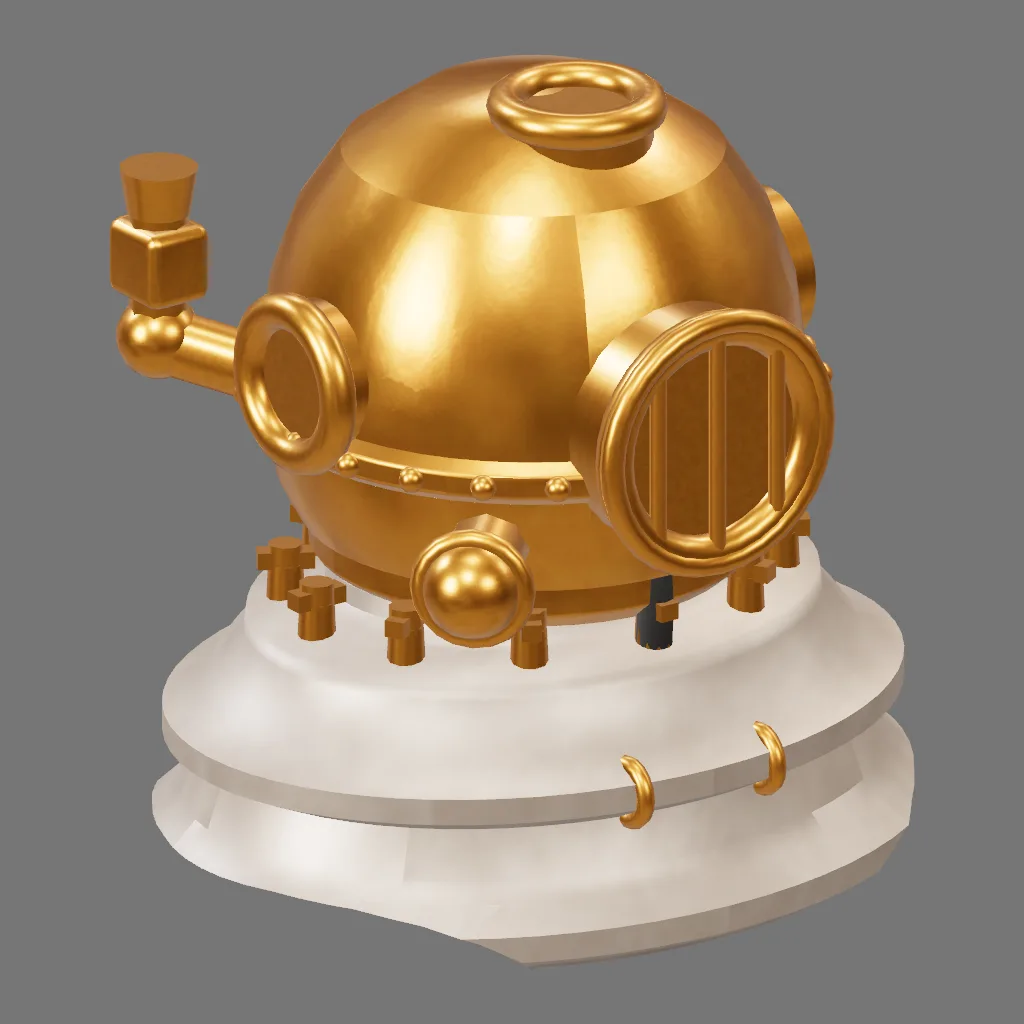
Drag to orbit after opening. The model starts stationary.
For your engine. The download is a standard glTF 2.0 binary (GLB) with PBR metallic-roughness materials. glTF stores materials, not lighting or tone mapping, so your engine decides how they read. This 3D view tone-maps with Review Neutral, the Khronos PBR Neutral construction with a smaller glare offset (0.015 instead of 0.04), at exposure 0.9. Its Tone mapping control also shows ACES and Linear, for comparison.
Build measurements
- Triangles
- 16,420
- Estimated draws
- 96
- Materials
- 4
- Textures
- 4
- Animation clips
- 0
- Bounds X × Y × Z
- 0.47 × 0.52 × 0.5 m
- Build warnings
- 0
Measurements come from this build.
Download this build
Runtime: 1,470,920 bytes. Original: 1,470,692 bytes.
These GLBs are build outputs of the MIT-licensed example source; no separate terms are stated for the builds.
Runtime provenance metadataSHA-256 download hashes
- Runtime GLB
- 4cc29489205d4b34469b2b3d2ab7e01ff972e427c36fe21f7d7604833157ded4
- Original GLB
- 9a932fb3c0460560504965f19887585d821bf042bd9ecbcabfd1dd5094968d1e
- Source
- e04bda302f223945b734687c5d23700e42259b87ec7ebbb9da4ba7b22940b679
The example source is part of the Kiln repository. Repository licence: MIT.
These GLBs are build outputs of the MIT-licensed example source; no separate terms are stated for the builds.
Recorded authorship
Claude Opus 5 through Claude Code
Source-header credit
- Source access
- Not recorded
- Inherited context
- Not independently recorded; source-header declarations only
- Starting example
- Not recorded
- Human input
- Not recorded
- Authoring review
- Not recorded
Gallery GPU render of this exact source. Source, artifact, image hashes and camera settings are recorded alongside the poster; the artifact hash names the GLB bytes the image was rendered from, which the downloadable rebuild reproduces byte for byte only on the platform that recorded it.
Poster camera and render recordThe source behind this build
// A Mark V standard diving helmet.
//
// The field gun is a study in booleans, the street lamp in revolved profiles.
// This one is about MATERIAL: a tinned-copper breastplate, a spun brass bonnet,
// four dark glass lights and a rubber neck gasket, all on one object at close
// range. It is the strongest CPU-versus-GPU comparison in the repository,
// because on the flat rasterizer the brass, the tin, the rubber and the glass
// collapse into a single white shape, and every one of those distinctions is
// exactly what a viewer uses to recognize the object.
//
// Orientation follows the Kiln contract: +X is forward, so the faceplate looks
// down +X, the shoulders sit on +/-Z, and the air inlet and telephone gland are
// on the back quarters.
//
// Three things the first pass got wrong, each of which generalizes.
//
// 1. The breastplate was a circular solid of revolution and read as a LAMPSHADE.
//    A corselet is beaten to fit a torso: wider across the shoulders than it is
//    front to back. One non-uniform scale on the finished mesh fixes it, and it
//    is the single largest change in the whole asset. A perfectly circular plan
//    is the loudest tell that something was revolved rather than shaped.
// 2. The bottom hem was a flat circle. A corselet rests ON the shoulders, so the
//    hem is scalloped. The scallop is cut with a boolean through the hem bead as
//    well as the shell, which is why the bead is part of the same profile rather
//    than a separate revolve laid over the top -- a bead added afterwards sits
//    across the scallop and hides the thing that was worth cutting.
// 3. The lights were clear glass over a solid brass bonnet, so every port
//    rendered as a brass disc with a ring around it. A port looks dark because
//    the inside of a helmet is dark. That is a MATERIAL fact, and it is far
//    cheaper to say it in the glass tint than to hollow the bonnet with four
//    more booleans to expose an interior nobody will ever otherwise see.
// 4. The breastplate rendered as a grey and white CHEQUERBOARD. Not a texture
//    problem: boolDiff flat-shades by default, flat shading splits every vertex,
//    and autoUnwrap therefore gave every quad its own atlas chart sampling an
//    unrelated patch of albedo. Passing { smooth: true } to the boolean fixed it
//    outright. Worth knowing before spending an hour on the noise layers, which
//    is what happened here.
//
// What still falls short: the corselet is a body of revolution, so its plan is
// an ellipse rather than a torso. A real breastplate is beaten, with a distinct
// chest and back panel and shoulders that are not on any conic section. Getting
// that would mean lofting or deforming a shell rather than revolving one, which
// is a different construction than the one this example exists to show.
//
// Authored by: Claude Opus 5, via Claude Code. Every part below was written by the model itself,
// looking at its own renders through the Kiln tools and revising.
const meta = { name: 'DivingHelmet', category: 'prop', role: 'poi' };

async function build() {
  const root = createRoot('DivingHelmet');
  const uv = (g) => autoUnwrap(g, { resolution: 1024 });

  // The corselet is beaten wider across the shoulders than front to back. Every
  // part that belongs to the breastplate is placed through these two factors so
  // the flange, the studs and the shell stay on one ellipse.
  const SX = 0.86, SZ = 1.08;

  // ---------- Materials ----------
  // Spun brass, warm and bright, with verdigris pushed into the low-frequency
  // noise so the crevices read green the way a hundred-year-old helmet does.
  const brassAlbedo = proceduralTexture({
    schemaVersion: 2, size: 1024, usage: 'albedo', name: 'HelmetBrass',
    // Fine grain, deliberately. Coarse procedural noise on an autoUnwrap atlas
    // does not read as weathering, it reads as a CHEQUERBOARD: each chart gets a
    // different slab of a low-frequency blob and the chart seams become visible
    // as tiles. Anything below about scale 12 on an atlassed surface will do it.
    layers: [
      { op: 'solid', color: 0xb5813f },
      { op: 'noise', colorA: 0xa0713a, colorB: 0xc9964e, scale: 44, octaves: 4, seed: 3, blend: 'overlay', opacity: 0.50 },
      { op: 'noise', colorA: 0x6a7a58, colorB: 0xb5813f, scale: 16, octaves: 3, seed: 21, blend: 'multiply', opacity: 0.15 },
    ],
  });
  const brass = pbrMaterial({
    albedo: brassAlbedo, normal: normalMapFromHeight(brassAlbedo, { strength: 2.2 }),
    roughness: 0.30, metalness: 0.92,
  });

  // Tinned copper for the breastplate: the same metal under a lead-tin coat, so
  // it is cooler and duller than the bonnet without being a different substance.
  // The contrast is the point -- two metals a flat render cannot tell apart.
  const tinAlbedo = proceduralTexture({
    schemaVersion: 2, size: 512, usage: 'albedo', name: 'TinnedCopper',
    layers: [
      { op: 'solid', color: 0x9c9086 },
      { op: 'noise', colorA: 0x8a8078, colorB: 0xb0a69a, scale: 48, octaves: 4, seed: 11, blend: 'overlay', opacity: 0.55 },
      { op: 'noise', colorA: 0x7e766c, colorB: 0x9c9086, scale: 18, octaves: 3, seed: 29, blend: 'multiply', opacity: 0.18 },
    ],
  });
  // Warm grey, not cold. A cold grey plate under a copper bonnet separates into
  // two objects -- a lampshade with a ball on it -- because nothing in the scene
  // says they are the same metal. Tin over copper is warm, and that one shift is
  // what makes the breastplate and the bonnet read as one helmet.
  const tinned = pbrMaterial({
    albedo: tinAlbedo, normal: normalMapFromHeight(tinAlbedo, { strength: 1.2 }),
    roughness: 0.52, metalness: 0.68,
  });

  // Rubber for the neck gasket and the telephone boot. Dielectric, and dark
  // WITHOUT being metallic, which is the distinction that turns a dark part into
  // a black mirror when it is got wrong.
  const rubber = gameMaterial(0x1d1b19, { roughness: 0.88, metalness: 0.0 });
  // Dark glass, because the inside of a helmet is dark. See the header.
  const glass = glassMaterial(0x18262b, { opacity: 0.62, roughness: 0.05, metalness: 0 });

  // ---------- Breastplate ----------
  // One profile carries the shell, the rolled hem bead and the chest rib, so the
  // shoulder boolean cuts through all three together.
  const corseletSolid = new THREE.Mesh(await revolveProfile([
    // The hem bead and the chest rib are big steps on purpose. Smooth shading
    // averages a normal across the whole step, so a 12 mm bead that read clearly
    // under flat shading disappears into the curve once the shell is smoothed.
    // A feature that has to survive smoothing has to be built proud enough to.
    [0.000, 0.000], [0.222, 0.000], [0.246, 0.013], [0.248, 0.031],
    [0.230, 0.047], [0.218, 0.060], [0.208, 0.090], [0.228, 0.100],
    [0.228, 0.117], [0.204, 0.129], [0.190, 0.150], [0.178, 0.164],
    [0.176, 0.178], [0.140, 0.184], [0.128, 0.194], [0.126, 0.206],
    [0.000, 0.206],
  ], { segments: 64, axis: 'y', smooth: true }), tinned);

  // Two cylinders lying along X take a curved bite out of the hem exactly where
  // the shoulders go. The geometry here is worth being explicit about, because
  // the first attempt sat the cutters at radius 0.238 with radius 0.132 and they
  // removed EVERYTHING from z = 0.11 outward below y = 0.07 -- not a scallop but
  // an undercut, and the helmet read as a lampshade on a stand. A cutter tangent
  // to the hem removes a lens, and the lens is the scallop:
  //
  //   removal height h(z) = sqrt(R^2 - (z - Zc)^2) - c
  //
  // with Zc on the hem edge, R - c the rise at that edge, and the zero crossing
  // where the scallop should die out. R = 0.162, c = 0.117 gives a 45 mm rise at
  // z = 0.222 falling to nothing by z = 0.11.
  const shoulderCutters = [-1, 1].map((sz) => {
    const c = new THREE.Mesh(cylinderXGeo(0.162, 0.162, 1.10, 40), tinned);
    c.position.set(0, -0.117, sz * 0.222);
    return c;
  });
  // smooth: true is not cosmetic here, it is the fix for a chequerboard.
  // boolDiff defaults to FLAT shading for sharp mechanical edges, which splits
  // every vertex; autoUnwrap then cannot merge faces into charts, so each quad
  // becomes its own island and samples an unrelated patch of the albedo. On a
  // large curved metal shell that renders as literal grey and white TILES. Any
  // atlassed boolean result that is meant to read as one continuous surface
  // wants smooth: true.
  const corselet = await boolDiff('Corselet', corseletSolid, ...shoulderCutters, { smooth: true });
  corselet.name = 'Corselet';
  corselet.geometry = await uv(corselet.geometry);
  corselet.scale.set(SX, 1, SZ);
  root.add(corselet);

  // The four beckets the 40 lb front and back weights hung from. Placed on the
  // ellipse rather than on a circle, so they sit flush against the plate on all
  // four quarters instead of floating on two of them.
  for (const sx of [-1, 1]) {
    for (const sz of [-1, 1]) {
      const z = sz * 0.050;
      const xEllipse = 0.216 * SX * Math.sqrt(Math.max(0, 1 - (z / (0.216 * SZ)) ** 2));
      createPart(`Becket_${sx > 0 ? 'F' : 'B'}${sz > 0 ? 'R' : 'L'}`, torusGeo(0.018, 0.006, 8, 18), brass, {
        position: [sx * (xEllipse - 0.006), 0.106, z], parent: root,
      });
    }
  }

  // ---------- Neck ring and brail studs ----------
  // The bonnet does not bolt on: it drops onto an interrupted thread and locks
  // with an eighth of a turn. The twelve studs around the flange are the brail
  // bolts that clamped the diver's dress into the joint, and they follow the
  // same ellipse as the flange they stand on.
  createPart('NeckRing', await uv(await revolveProfile([
    [0.000, 0.198], [0.126, 0.198], [0.140, 0.210], [0.140, 0.232],
    [0.126, 0.242], [0.000, 0.242],
  ], { segments: 48, axis: 'y', bevel: 0.004 })), brass, { parent: root });

  createPart('NeckGasket', torusGeo(0.133, 0.012, 10, 40), rubber, { position: [0, 0.204, 0], parent: root });

  for (let i = 0; i < 12; i++) {
    const a = (i / 12) * Math.PI * 2;
    const cx = Math.cos(a) * 0.152 * SX, cz = Math.sin(a) * 0.152 * SZ;
    createPart(`BrailStud_${i}`, cylinderGeo(0.011, 0.013, 0.042, 10), brass, {
      position: [cx, 0.182, cz], parent: root,
    });
    // The wing nut, oriented so its ears lie along the flange rather than
    // pointing in twelve arbitrary directions.
    const nut = createPart(`BrailNut_${i}`, boxGeo(0.036, 0.011, 0.013), brass, {
      position: [cx, 0.206, cz], parent: root,
    });
    nut.rotation.y = -a;
    createPart(`BrailNutBoss_${i}`, cylinderGeo(0.011, 0.011, 0.016, 8), brass, {
      position: [cx, 0.208, cz], parent: root,
    });
  }

  // ---------- Bonnet ----------
  // Spun, not moulded: the profile swells to its widest just above the face port
  // and then falls away in a continuous curve to the crown. A hemisphere sitting
  // on a cylinder is what this looks like when it is done wrong.
  createPart('Bonnet', await uv(await revolveProfile([
    [0.000, 0.230], [0.146, 0.230], [0.160, 0.256], [0.168, 0.294],
    [0.170, 0.336], [0.164, 0.382], [0.148, 0.428], [0.120, 0.470],
    [0.074, 0.502], [0.000, 0.516],
  ], { segments: 48, axis: 'y', smooth: true })), brass, { parent: root });

  // The seam where the two spinnings were brazed, and the rivet line on it.
  createPart('BonnetSeam', await uv(await revolveProfile([
    [0.000, 0.296], [0.168, 0.296], [0.179, 0.304], [0.179, 0.318],
    [0.168, 0.326], [0.000, 0.326],
  ], { segments: 48, axis: 'y', bevel: 0.003 })), brass, { parent: root });

  const rivet = createPart('Rivet0', sphereGeo(0.0085, 8, 6), brass, { position: [0.179, 0.311, 0], parent: root });
  arrayRadial('Rivet', rivet, 24, 'y', root);

  // ---------- Lights ----------
  // Four of them: the big face port on +X, one on each shoulder, and the top
  // light canted forward so the diver could look up. Each is a boss, a threaded
  // retaining ring, and glass set BEHIND the ring rather than flush with it --
  // the inset is what makes it read as a port instead of a painted circle.
  const port = (name, pos, axis, bossR, glassR, ringR, depth) => {
    const geoBoss = axis === 'x' ? cylinderXGeo(bossR, bossR, depth, 32)
      : axis === 'z' ? cylinderZGeo(bossR, bossR, depth, 28)
        : cylinderGeo(bossR, bossR, depth, 28);
    const geoGlass = axis === 'x' ? cylinderXGeo(glassR, glassR, 0.010, 32)
      : axis === 'z' ? cylinderZGeo(glassR, glassR, 0.008, 28)
        : cylinderGeo(glassR, glassR, 0.008, 28);
    // torusGeo lies in the XY plane with its hole on Z, so a port facing +X
    // needs a quarter turn about Y and one facing +Y a quarter turn about X.
    const ringRot = axis === 'x' ? [0, 90, 0] : axis === 'z' ? [0, 0, 0] : [90, 0, 0];
    const out = axis === 'x' ? [1, 0, 0] : axis === 'z' ? [0, 0, 1] : [0, 1, 0];
    const at = (d) => [pos[0] + out[0] * d, pos[1] + out[1] * d, pos[2] + out[2] * d];
    createPart(`${name}Boss`, geoBoss, brass, { position: pos, parent: root });
    createPart(`${name}Glass`, geoGlass, glass, { position: at(depth * 0.34), parent: root });
    createPart(`${name}Ring`, torusGeo(ringR, 0.012, 10, 32), brass, {
      position: at(depth * 0.52), rotation: ringRot, parent: root,
    });
  };

  port('FacePort', [0.166, 0.336, 0], 'x', 0.078, 0.067, 0.074, 0.054);
  port('PortLightR', [0, 0.352, 0.158], 'z', 0.050, 0.042, 0.047, 0.044);
  port('PortLightL', [0, 0.352, -0.158], 'z', 0.050, 0.042, 0.047, 0.044);
  port('TopLight', [0.048, 0.490, 0], 'y', 0.048, 0.040, 0.045, 0.044);

  // The face guard: a hinged brass cage over the front light, three bars in a
  // ring. Each bar length is derived from the ring radius, so the bars land ON
  // the ring instead of floating in front of the glass, which is where guessed
  // heights always put them.
  const GUARD_X = 0.200, GUARD_Y = 0.336, GUARD_R = 0.080;
  createPart('FaceGuardRing', torusGeo(GUARD_R, 0.008, 8, 32), brass, {
    position: [GUARD_X, GUARD_Y, 0], rotation: [0, 90, 0], parent: root,
  });
  [-0.045, 0, 0.045].forEach((z, i) => {
    const h = Math.sqrt(GUARD_R * GUARD_R - z * z);
    beamBetween(`FaceGuardBar_${i}`,
      [GUARD_X, GUARD_Y - h, z], [GUARD_X, GUARD_Y + h, z], 0.0055, brass, { parent: root });
  });

  // ---------- Fittings ----------
  // Air inlet on the back right: stub off the bonnet, elbow, riser, and the
  // non-return valve body that stopped the diver's air from siphoning back out
  // if the surface hose parted. Nothing about this helmet is decorative.
  beamBetween('AirInletStub', [-0.110, 0.296, 0.092], [-0.180, 0.314, 0.148], 0.022, brass, { parent: root });
  createPart('AirInletElbow', sphereGeo(0.027, 14, 10), brass, { position: [-0.186, 0.318, 0.154], parent: root });
  beamBetween('AirInletRiser', [-0.186, 0.318, 0.154], [-0.186, 0.402, 0.154], 0.019, brass, { parent: root });
  createPart('NonReturnBody', await uv(await roundedBoxGeo(0.052, 0.050, 0.046, 0.008)), brass, {
    position: [-0.186, 0.370, 0.154], parent: root,
  });
  createPart('AirInletCap', cylinderGeo(0.025, 0.020, 0.030, 14), brass, { position: [-0.186, 0.416, 0.154], parent: root });

  // Exhaust valve on the FRONT right cheek, with the knurled knob the diver
  // butted with his chin to vent. It started life on the back quarter at the
  // same height as the shoulder light, where the two merged into one lump from
  // every side view: a fitting has to be readable against its neighbours, not
  // merely correctly placed.
  beamBetween('ExhaustBody', [0.092, 0.266, 0.092], [0.142, 0.260, 0.142], 0.026, brass, { parent: root });
  createPart('ExhaustKnob', sphereGeo(0.032, 14, 10), brass, { position: [0.153, 0.258, 0.153], parent: root });
  createPart('ExhaustKnurl', torusGeo(0.032, 0.008, 8, 20), brass, {
    position: [0.153, 0.258, 0.153], rotation: [0, 45, 0], parent: root,
  });

  // Telephone gland on the back left, where the comms line entered.
  createPart('CommsGland', cylinderXGeo(0.026, 0.026, 0.058, 16), brass, { position: [-0.174, 0.290, -0.058], parent: root });
  createPart('CommsCap', cylinderXGeo(0.019, 0.030, 0.024, 16), brass, { position: [-0.210, 0.290, -0.058], parent: root });
  createPart('CommsBoot', cylinderXGeo(0.015, 0.019, 0.036, 12), rubber, { position: [-0.238, 0.290, -0.058], parent: root });

  return root;
}Scroll code horizontally
Brief and retained revisions
No brief or earlier revisions are recorded. The source download contains the version built for this page.